
How To Care For Your Eyes After 60
It’s been a long time coming since I had the idea to write an article on the eyes. After all, vision changes and vision loss are one of the many problems we encounter as we get older.
Although we understand perfectly well that these issues are a natural part of ageing, it can be frustrating having to deal with vision loss. For example, not being able to read small text, like you once could.
Now at this stage. You may be thinking. “But Mike, you’re a Physiotherapist what do you know about the eyes?”
And well, yes, this is true! But I do know health and I do know exercise.. And, fortunately I also have a Sister, Lexie (who you have seen floating around in the More Life Health Facebook Community), who just so happens to be an Orthoptist.
So with our powers combined, we bring you this guide to caring for the eyes after 60.
KEYS TO HEALTHIER EYES FOR SENIORS
After all, vision changes and vision loss are one of the many problems we all encounter as we get older.
Although we understand perfectly well that these issues are a natural part of ageing, it can be frustrating having to deal with vision loss. For example, not being able to read small text, like you once could.
So I wanted to cover this topic in quite some detail!
Now at this stage. You may be thinking. “But Mike, you’re a Physiotherapist what do you know about the eyes?”
And well, yes, this is true! But I do know health and I do know exercise.. And, fortunately, I also have a Sister, Lexie (who you may have seen floating around in the More Life Health Facebook Community), who just so happens to be an Orthoptist.
So with our powers combined, I bring you this guide to caring for the eyes after 60.
In this guide we will cover the eye in detail, including - the anatomy of the eye, common eye conditions that affect seniors, we will also look at what spending time on screens (iPhones, laptops, computers, TVs etc) does to our eyes and we will also cover all that you need to improve your eye health and maybe even your vision.
Let’s get into it!
WHAT IS COVERED IN THIS GUIDE:
HOW YOUR EYES WORK - ALL YOU NEED TO KNOW

Our eyes are one of our most precious organs.
Not only are they, in my opinion, the most beautiful part of the body, they also allow us to see the world around us.... And yes - eyes are, in fact, organs of the visual system.
And just like any other organ in the body, eyes are comprised of an intricate network of nerves, vessels, and muscles.
So, how do our eyes actually work? To get a better grasp of this, let’s dive a bit into the anatomy of the eyes.

Extraocular Muscles Of The Eye
The eye socket, also known as the orbit, is connected to six muscles that allow our eyes to move up and down freely. These muscles are called extraocular muscles and they’re attached to the sclera, a layer of tissue that stretches around the eyeball.
Following so far? Okay, let’s dig a bit deeper.
The most superficial layer of the eyes is a clear membrane that covers the front. This is called the conjunctiva. Its function is to protect and lubricate the eyes by producing tears and mucus.
Now, if we look at the front of eye, we first find a clear layer called the cornea, whose job is to refract light.
Behind the cornea is the anterior chamber, a space filled with a fluid called aqueous humour. Despite its name, there is nothing funny about the aqueous humour; this clear fluid is actually responsible for maintaining the pressure in our eyes and nourishing the lens.
Anatomy of The Eye
Right behind the anterior chamber, we can find the iris and the pupil. It’s the iris that people refer to when they compliment the beautiful colour of your eyes. This is also the part of the eye where most of the magic happens. Depending on how much light enters the eyes, the muscles of the iris will either dilate (widen), or constrict (narrow) the pupils.

The lens is situated right behind the pupil. The lens works together with the cornea to refract the light that enters the eye. What’s also interesting, is that the lens can change its shape to help maintain focus on close objects.
Between the lens and the back of our eyes, we can find the vitreous cavity. Inside the cavity, there’s a substance called vitreous humour whose role is to nourish the eyes and help them retain their shape. Once light enters our eyes, it passes through the lens and the vitreous humour until it reaches the retina.
The retina is a thin layer of tissue on the back of the eye. It is one of the major players in the eye, as it gives us our central and peripheral vision. It’s comprised of photoreceptors, cells which process colour and black and white shades (that help us see in the dark.)
The retina is also responsible for converting light into signals that are then transmitted to the brain through the optic nerve. The optic nerve is the final stage - it uses its nerve fibres to send the electrical impulses into the visual cortex. Once there, our brain converts this information into images and we are able to see.
Easy peasy, right?
The easiest way to understand vision and sight is to think of the eyes as a camera device. The cornea of the eye and the lens of the camera work in a similar way.
They both have a spherical curvature that allows them to see what’s in front of them. The iris (coloured part) of the eye can be compared to a camera’s aperture (opening of the lens). Their function is to control how much light enters the eye (or the camera) so they will narrow or widen accordingly.
More similarities can be found when we consider things like focus, scope, and film. Both the eye and the camera can focus on single objects and blur out the rest. Thanks to the curvature of the eyes and the device lens, they’re also able to widen their field of view.
Finally, the film in a camera device has the same function as the retina. It collects the reflected light and converts it into images.
Amazing, isn’t it?
Now that we understand how the eyes work, we can now take a look at what happens to these eyes as we get older and then get to conditions in the eyes.
THE AGEING EYE: WHAT HAPPENS TO OUR EYES AS WE GET OLDER
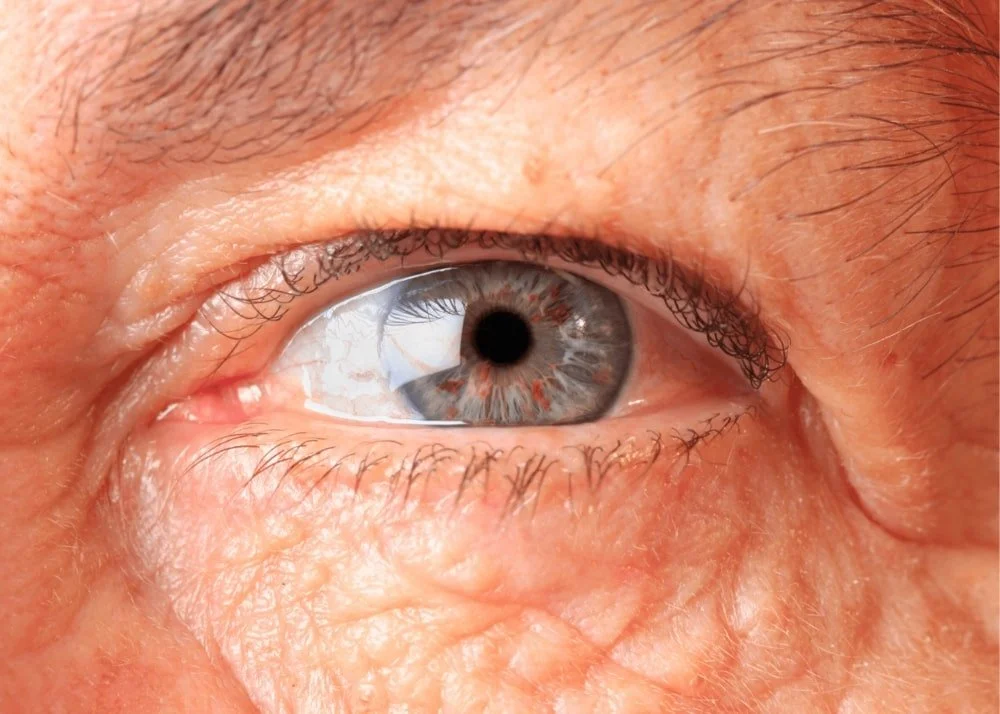
As we grow older, we experience an onset of changes all over the body.
Some of these changes are more obvious, while others tend to creep up on us when we least expect them. Many of these bodily transitions occur gradually, spanning over a course of years. This is exactly what happens with our eyes.
Our eyes, just like every other organ in our body, deteriorate with age. It’s nature.
Although every person is different, most people tend to experience the first changes somewhere around the age of 40. This is the time when the eye lens loses its elasticity and is not able to focus on close objects anymore. This is the reason why most middle-aged people hold their phones farther away when trying to read text messages, for example.
We call this condition presbyopia and it is nothing to be afraid or ashamed of. Presbyopia occurs naturally in every living person over the age of 40.
Similarly, myopia or nearsightedness is a condition in which you’re unable to focus on faraway objects. And hyperopia or farsightedness in which you are unable to focus on near (and sometimes far away) objects. This is the time when you’re most likely to visit your Optometrist and get a prescription for eyeglasses or contact lenses.
Although presbyopia, hyperopia and myopia are quite common, they can be managed. Prescription eyeglasses and contact lenses, as well as corrective surgery, can greatly alleviate these issues, as well as keeping yourself in the best possible health.
However, there are some more conditions that can affect vision and eyesight, which are more severe and can result in complete vision loss.
As time goes by, you might notice other issues with your eyesight as well.
We’ll discuss these conditions in more detail in the following chapter.
EYE CONDITIONS IN SENIORS
Let’s now dig a bit deeper into some eye conditions that affect seniors so you have the knowledge of what to look out for which can help prevent any serious eye issues.
DRY EYE
If your tear ducts are unable to produce enough moisture, you’re most likely suffering from dry eyes. Even though the condition doesn’t sound too serious, it can cause a lot of discomfort and irritation.
As we get older, we experience a lot of hormonal changes in our body. Loss of tears in our eyes is one of the changes that occur with old age. While dry eyes can affect both men and women, the condition is more prevalent in women who have gone through menopause.
Dry eyes are fairly common and there are multiple ways to prevent the symptoms of this condition. Creating a suitable environment in your home or office is one of the first steps towards preventing dry eyes. This includes controlling the amount of moisture in the air (using a humidifier,) or avoiding direct exposure to the AC, blow dryers, fans, heaters, etc.
Protective eyewear is also a suitable solution, especially in settings with a lot of dry air or wind. Another thing you can do to alleviate the symptoms of dry eyes is to take regular breaks from electronic devices. Avoiding cigarette smoke and using artificial tears (lubricating eye drops) is also a good idea for dealign with dry eyes.
For severe dry eye, plugs can be inserted into the tear ducts to keep tears within the eye and prevent them draining away. If you are suffering from severe dry eye, speak to your optometrist or ophthalmologists as to whether this may be a suitable solution for you.
BLURRED VISION
Blurred vision, or not being able to see objects in fine detail could be a result of something minor such as incorrect eyeglass prescription, presbyopia, hyperopia cataracts or myopia, but it could also signify some underlying diseases as well.
Some risk factors associated with blurry vision include diabetes, high blood pressure and certain immune disorders. If you suffer from such conditions and start exhibiting vision problems, make an appointment with your appropriate medical professional.
However, if you experience a sudden onset of blurry or double vision, you’ll want to contact your doctor immediately. This is especially important if you get accompanying symptoms such as eye pain, headaches, dizziness, nausea, etc. These could be signs of strokes, brain tumours, multiple sclerosis, and other severe illnesses.
CATARACTS
Cataracts are considered of the more common eye conditions. They usually develop over the course of years and often occur as a result of old age.
According to the National Eye Institute more than half of all Americans ages 80 or older either have cataracts or have had surgery to get rid of cataracts.
Some cataracts also occur as a result of heavy drinking, smoking, eye surgery, or other conditions such as diabetes. Although many people don’t experience any changes in the early stage, as cataracts grow larger, they may cause cloudy vision, faded colours, light sensitivity, and double vision.
Cataract surgery is a very common and safe procedure where the cloudy lens is replaced with a new artificial lens which will help restore eye sight.
FLOATERS AND FLASHES
You may have seen dots, squiggly lines or even cobwebs in your eyes at some time in your life. These become more noticeable when staring at a blank wall or sky on a clear day. These are known as floaters.
Floaters appear to quickly move away when you try to focus your gaze at them, and slowly drift when your eyes are still.
Flashes, as the name suggests, look like flashing lights or streaks of light in your field of vision.
Floaters and flashes are usually harmless and can disappear on their own over time. If you are getting them regularly or have a sudden increase in both or notice any changes with them it’s best to get checked by your eye doctor as it could indicate retinal damage.
AGE-RELATED MACULAR DEGENERATION (AMD)
Considered one of the main causes of permanent vision loss, age-related macular degeneration happens when the macula, the centre part of the retina, breaks down.
There are two types of macular degeneration - dry and wet. Dry macular degeneration manifests itself as small yellow residues in the macula. People with milder cases may experience dimmed or distorted vision, but the condition can worsen. If this occurs, it can lead to blind spots and loss of central vision.
The wet form, although less common, is also more severe. Wet macular degeneration happens as a result of blood vessels growing from underneath the macula. As the blood vessels rupture, they form scars, which results in permanent vision loss.
Those suffering from AMD may experience symptoms such as blurry or distorted vision, difficulty seeing in dim light, sensitivity to glare, seeing spots, as well as seeing straight lines appear wavy.
Although this condition is most common in those over the age of 50, other factors can also increase the risk of macular degeneration. Genetics, obesity, smoking, and cardiovascular disease are known risk factors for AMD. It is also believed that Caucasians are at greater risk of developing these conditions compared to other races.
GLAUCOMA
Although glaucoma can affect people of all ages, it is most prevalent in older adults. This condition happens due to pressure build-up in the eyes, which damages the optic nerve. Glaucoma causes a gradual loss of sight and blindness, and unfortunately is not curable.
The most frightening thing about glaucoma is that it isn’t curable.
Most people suffering from glaucoma don’t experience any symptoms until it’s too late, so it’s best to know to look out for.
Depending on the type and stage of glaucoma, the condition can manifest itself in several ways. Tunnel vision and blind spots are common symptoms of open-angle glaucoma. Those suffering from narrow or acute angle-closure glaucoma may experience eye pain and redness, headaches, nausea, and blurred vision.
Black, Asian, and Hispanic people are more commonly affected by glaucoma than other races. Other risk factors include genetics, unhealthy lifestyle, high internal eye pressure, eye surgery, prolonged use of corticosteroids and eye drops, etc. Getting regular eye examinations can help detect glaucoma early on and possibly prevent more serious problems.
EYE MELANOMA
Eye or ocular melanoma is a type of cancer that affects the middle layer of the eye, called the uvea. There are many risk factors connected to eye melanoma, but the risks increase substantially with old age. Sometimes, people with this condition don’t have any symptoms, however, those that do may experience floaters, poor or loss of vision (especially peripheral) misshapen pupils, or dark spots on the irises. Eye melanoma often causes vision loss.
Some professionals believe that limiting sun exposure and wearing UV-protected sunglasses could reduce the risk of developing eye cancer.
DIABETIC RETINOPATHY
Although not the most common of eye diseases, diabetic retinopathy occurs in some diabetic patients as a result of diabetes complications.
Diabetic retinopathy occurs when the blood vessels in the retina are damaged and can be present in people who suffer from either type of diabetes – type I or type II. While this condition isn’t exclusively linked to seniors, older age is a definite risk factor in developing type II diabetes.
This eye condition may cause blurred or fluctuating vision, dark spots, colour changes as well as vision loss.
Good and consistent control of blood sugar levels will significantly reduce the risk of long term vision damage. This can be achieved through regular exercise and good nutrition and medication (if required).
POSTERIOR VITREOUS DETACHMENT (PVD) and RETINAL DETACHMENT
Retinal detachment is a severe condition that causes no pain. It’s a situation where the retina pulls away (detaches) from its supportive tissue. Those who experience this emergency may see floaters and flashes and should contact their eye specialist straight away. There are three types of retinal detachment.
Remember earlier in the article we were looking at different structures within the eye and the substance called vitreous humour
Well as we age, the vitreous humour shrinks and pulls away from the retina. Usually it separates without any complications. This is a condition called “posterior vitreous detachment”. However sometimes, it can cause a tear allowing fluid to form between the layers of the retina, causing it to detach. If left untreated, a retinal detachment can cause blindness.
Retinal detachments can also be caused by eye injuries so it’s always important to wear protective goggles when playing certain sports (e.g. squash) or working with certain tools.
EPIRETINAL MEMBRANE (OR MACULA PUCKER) and MACULA HOLES
These can develop similarly to a retina detachment in that irritation and scar tissue (epiretinal membrane) or a hole can form in the central part of the retina- the macula, when the vitreous humour is pulling away from the retina.
Sometimes when the vitreous is detaching, it can rub and irritate the macula then as it heals, it forms a scar tissue over the macula. This scar tissue can cause the macula to wrinkle or pucker.
As the macula is involved, symptoms can be similar to that of AMD such as trouble reading smaller print, blurry and distorted vision, straight lines appearing kinked or wavy, grey shadow/spot in central vision.
There is nothing that can prevent an epiretinal membrane or macula hole and in most cases, the best treatment is monitoring them (early stages) or surgery (later stages) however regular eye check ups can ensure they are detected early.
EPIPHORA
Sometimes also known as watering eyes, epiphora is characterised by an overproduction of tears. In the case of epiphora, the tears will flow down the face, instead of through the usual nasolacrimal system.
There are a few factors that can cause watering eyes, but an obstructed tear outflow tract or misaligned tear ducts, caused by sagging of the lower eyelid(s) away from the eyeball, are often the cause and are a result of ageing.
Some cases of epiphora can be treated with antibiotics or by probing in the ophthalmologists rooms, while others may require surgery.
Some types of epiphora may go away on their own without any treatment. Epiphora may occur as a result of allergies, common colds, or an eyelid stye and generally passes without medical intervention.
If there are other symptoms present such as pain, yellow or green discharge or vision changes, it may be a sign of infection. Make sure to clean your contact lenses and wash your hands regularly as to avoid spreading germs to your eyes, and make sure to see your doctor.
ECTROPION AND ENTROPION
The most common cause of these two eyelid conditions is ageing. As we get older, our eyelids can lose tension due to weakening of the muscles and tendons that support them, causing the lower eyelids to sag down (ectropion) or roll inwards (entropion). Symptoms of these conditions include watery and/or dry eyes, irritated eyes, sensitivity to light and in more severe cases - corneal ulceration.
Temporary relief from symptoms can be achieved through ocular lubricants (eye drops, gels or ointments). Taping of the eyelids with special skin tape to help support them or prevent them from rolling in can also help, especially while sleeping. (Be sure to speak to your doctor or optometrist who can show you the safe and correct way to do this before attempting it yourself). Surgery may also be recommended as a more definitive treatment option.
TIA (TRANSIENT ISCHAEMIC ATTACK)
TIA is a type of mini-stroke that usually lasts only for a couple of minutes. In most cases, TIA doesn’t cause any permanent damage, but one of its symptoms includes blurred vision or blindness. Some professionals believe that these brief attacks are early warning signs of future strokes. It is said that the risk of transient ischaemic attacks increases after the age of 55.
There are certain precautions you can take to lower the chances of experiencing a transient ischaemic attack. Limiting cholesterol, sodium, alcohol and fat intake is said to reduce the risks of TIA. Also, healthy eating and regular exercise can help keep your blood pressure in check, which can lower the chances of both TIA and strokes in general.
RETINAL VEIN OCCLUSION
Often referred to as a “stroke in the eye”, a retinal vein occlusion is caused by a blood clot in a retinal vein.
It is a less common condition, affecting 1-2% of people over the age of 40 although most cases occur in people over the age of 60. The amount of vision loss is significant and risk factors other than age include high blood pressure, cholesterol, diabetes, smoking and being overweight. Therefore, the precautions you can take are similar to those precautions for TIA above.
PTERYGIUM
Pterygium, conjunctiva, eye web, or surfer’s eye are all used to describe a condition in which a tissue growth appears on the conjunctiva and sometimes the cornea. While the true causes of pterygium are unknown, it is believed that sun exposure, geographic setting, and age are risk factors for this condition. Surfer’s eye can usually be treated with lubricants, although some more serious cases may require surgery.
Being exposed to certain elements such as wind, sand, pollen, and smoke can increase the chances of pterygium. The most effective solution for preventing the development of pterygium is to wear protective gear (sunglasses, hats, etc.) and to limit your exposure to the previously mentioned elements.
BLEPHARITIS
A common eye disorder which affects the eyelids, eyelashes and sometimes tear production. Blepharitis is characterised by inflamed, red, and scaly eyelids.
Treatments such as antibiotics and steroid eye drops do exist however the condition is chronic in nature and tends to come back. Eyelid inflammation affects both men and women and the average age of those affected is around 50.
Most of the time, blepharitis is a result of excessive amounts of bacteria found in your eyelids. To minimise the symptoms of this condition, professionals recommend regularly washing your hands and face and not touching irritated eyes with fingers, and also practicing good eyelid hygiene.
Wearing eyeglasses instead of contact lenses is also known to help with symptoms of blepharitis.
This is a common condition in seniors, and proper daily, long term eyelid hygiene is very important for its management and overall eyelid health. If you suffer from this condition, ensure you have spoken to your Optometrist or Opthalmologist about proper eyelid hygiene techniques and you are undertaking it daily.
TEMPORAL ARTERITIS
A condition in which the temporal arteries become damaged or inflamed is called temporal, cranial, or giant cell arteritis.
According to the American College of Rheumatology, people over the age of 50 are more likely to suffer this condition. Temporal arteritis can cause serious complications if left untreated such as blindness, vision loss, internal bleeding, and even death.
Double vision, fatigue, loss of appetite, shoulder and jaw pain are all associated with temporal arteritis. Those experiencing such symptoms should seek immediate medical assistance. Temporal arteritis is not curable, but there are certain treatments aimed at minimising tissue damage.
Depending on the severity of the condition, your doctor may prescribe medication, but also some lifestyle changes. Quitting smoking and getting the right amount of exercise could be beneficial in some cases.
As you might have noticed, this list includes some common eye conditions, but also several rare and more severe diseases that could affect your vision.
However, one thing that they all have in common is their prevalence among the elderly. While this is certainly disheartening, it does not mean that there’s nothing you can do about it.
THE EFFECT TECHNOLOGY HAS ON OUR EYES

Another factor, that can cause issues with the eye, is the overuse of technology…..
I can still remember my parents yelling at me not to sit too close to the telly so I wouldn’t go blind.
At first, I wrote it off to those old wives’ tales adults used to scare children with, but as I got older I started reading into it more.
It’s no secret that we are spending way too much time on screens. Most of us can spend over one-third of our day in front of a screen.
We have become overly dependent on technology; social networking, online banking, paying bills - nowadays, we all use apps and online services for almost everything.
So how does this relate to our eyesight? Computer Vision Syndrome (CVS), also known as digital eye strain, refers to a group of eye-related issues caused by excessive use of electronic devices, such as smartphones, computers, tablets, etc.
Although eye strains are not considered a disease on their own, they do cause a fair share of vision problems like blurred vision, dry eyes, and severe discomfort.
What is it about electronic devices that cause so much harm?
Two words - blue light.
Blue light is everywhere around us. Sunlight is the biggest source of blue light, but it can also be found in some man-made devices; these include fluorescent lights, CFL and LED light bulbs, flatscreen TVs, smartphones, tablets, etc. Now, blue light isn’t all that bad, it can elevate mood and increase awareness, regulate the circadian rhythm, and even promote healthy eyesight development in children.
But, there is a limit to everything and blue light is not an exception to the rule. The amount of time we spend absorbing these rays and the proximity of these devices are what causes unwanted effects.
Research suggests that prolonged screen time can cause slow degeneration of the retina, which can lead to more serious problems such as cataracts, and age-related macular degeneration.
The best thing to do for your eyes to avoid any digital eye strain, is to spend less time on screens. Get outdoors, preferably into nature and look far into the distance.
With the lifestyles we live today it may be difficult to spend less time looking on screens.
Fortunately, there are ways to alleviate the symptoms of digital eye strain by implementing some minor lifestyle changes (which we will cover in the chapter below).
In the following few sections, we’ll discuss what you can do to preserve your eyesight and protect it from harm, and we’ll also go through some exercises you can do to keep your eyes healthy.
CARING FOR YOUR EYES: WHAT YOU CAN DO!
Although we aren’t able to bend the laws of nature and stop the natural degeneration of our body, we can do many things to keep ourselves in the best possible health and CAN prevent certain issues.
Along with old age, multiple factors can affect one’s vision. With advances in technology and new knowledge, there are many tools that can be utilised and new, healthier habits can be incorporated into your life that will go along way in helping you keep those eyes healthy long into the future.
Some of the following eye care tips are more obvious than others, but they’re all equally important when it comes to keeping your eyes in top-notch condition.
ORGANISE REGULAR EYE CHECKS
It’s important to have your eyes checked regularly by an eye doctor.

Make sure you get a comprehensive dilated eye exam, even if you notice no problems, every couple of years. Many eye conditions, even serious ones, don’t have noticeable symptoms.
With regular eye checks these conditions can be detected and appropriate treatment can be given.
Additionally, the right corrective lenses can help you see better, which will make life much easier and decrease your falls risk.
LOOK AFTER YOUR EYES WHEN USING TECHNOLOGY
When spending a lot of time looking at a screen of any sort, here is what you can do.
Keep a distance of about 60-65 cm between yourself and the device you’re using.
Take frequent breaks to allow your eyes to rest (every 20 minutes or so).
When taking breaks look far into the distance, to give your eyes a rest from looking so close to a screen. Follow whats known as the 20-20-20 rule. That is, if you find yourself on a screen for a long time, every 20 minutes, look at least 20 feet into the distance and hold for at least 20 seconds.
Reduce the brightness levels on your screen by using proper ambient lighting in your home/office. (Switch from fluorescent bulbs to soft white LED bulbs).
Reduce exposure to blue light. Screen filters for electronic devices and computer glasses with yellow-tinted lenses are said to be effective against blue light.
If you already use eyeglasses, invest in an anti-reflective lens coating. It minimises the amount of reflected light off the lens surface.
Blink more! We blink less often when staring at the screen and this can lead to dry eyes. Using a humidifier and artificial tears are also known to alleviate the symptoms of dry eyes.
Do eye exercises (covered below).
GET BETTER QUALITY SLEEP
Sleep is one of the, if not the most important component of a person’s health. It doesn’t come as a surprise that lack of sleep or low-quality sleep can take a toll on our eyes as well. Contrary to what you might believe, dark circles and puffy eyes should be the least of your worries when it comes to sleep deprivation.
Some of the most common eye-related issues caused by lack of sleep include dry, sensitive, or itchy eyes. However, eye muscle spasms are also a regular occurrence with those who don’t get enough sleep.
Studies show that obstructive sleep apnea (OSA) a condition in which breathing stops involuntarily for short periods during sleep, is a major risk for developing glaucoma. If you suffer from OSA or experience any related symptoms, it’s vital to consult with a doctor or a sleep specialist to evaluate the severity of the condition.
Getting a good night’s sleep can drastically decrease the chances of falling victim to such conditions.
For tips on getting a good night’s sleep, CLICK HERE.
DECREASE STRESS
Have you ever noticed that your eyes start twitching when you’re really upset or under a lot of stress? Or perhaps how the pupils dilate when you’re nervous or anxious? This is your body’s way of trying to communicate that something is wrong and you might not even be aware of it!
However, eye tremors aren’t the worst thing that can happen as a result of ongoing mental stress. Research suggests that high levels of cortisol, the stress hormone, is one of the leading causes of severe vision disorders such as optic neuropathy, glaucoma, age-related macular degeneration, and diabetic retinopathy.
While stress is something all of us deal with on a daily basis and we can’t completely isolate it from our lives, there are ways to reduce it. Decreasing stress is essential, especially in older age, and it can be done with just a bit of patience and effort.
For tips on how to decrease stress, CLICK HERE.
QUIT SMOKING
You probably don’t need me to tell you about all the negative effects smoking has on your health. But if the increased risk of the many health issues haven’t been enough to persuade you to finally cut down, or quit the habit, perhaps the fact that smoking can lead to vision loss may do so.
Research published in the journal Psychiatry Research suggests that “excessive use of cigarettes, or chronic exposure to their compounds, affects visual discrimination, supporting the existence of overall deficits in visual processing with tobacco addiction.” The study shows that consuming these neurotoxic chemicals found in cigarettes may cause overall colour vision loss, as well as a reduced ability to discriminate contrasts and colours.
Studies also show that heavy smoking increases the risk of developing dry eye syndrome, glaucoma, diabetic retinopathy, age-related macular degeneration, and cataracts.
I’m no expert on how to quit smoking, but if you’re a smoker, you’re going to experience tremendous health benefits by quitting. Your doctor can help with this so speak to them about quitting on your next visit.
WEAR SUNGLASSES
Another simple measure you can do to protect your eyes is to wear sunglasses when you’re outside.
Ultraviolet (UV) lights can greatly harm your lens, retina, and cornea, and wearing protective gear can alleviate the effects these harmful rays have on your eyes.
This is especially important for those living in places with higher UV rays. Here in Australia, we are exposed to up to 15% more UV rays than those living in Europe, for example.

Not to mention that with the right shades, your coolness levels increase exponentially! That could be reason enough to invest in a quality pair of sunglasses, don’t you think?
EAT A HEALTHY DIET
The importance of a well-balanced diet is indisputable.
Eating healthily isn’t just about maintaining the optimal weight; it can reduce the risk of chronic diseases and allow us to feel better physically, mentally, and emotionally.
Our vision is also impacted by the foods and drinks we consume, and the sooner we start implementing some healthy dietary changes, the sooner we’ll be able to see the positive effects. And in this case, I really mean SEE the effects.
Unfortunately, maintaining good eyesight isn’t as easy as simply munching on carrots all day. Maintaining a diet full of nutrient dense foods can greatly improve your eye health and protect your eyes from harm. Similarly, cutting out certain foods can also benefit your vision in the long run.
So, should we start with the good news or the bad news first?
A study published in the British Journal of Ophthalmology links Western-pattern diets to late-stage Age-related Macular Degeneration. People who regularly consume processed junk foods (think fast food, cakes, biscuits/cookies, potato chips, sweets, and soft drinks) are said to be in a higher risk of developing age-related macular degeneration.
What do most of these foods have in common? (Something I have written on before and the number one food you should be minimising and cutting out of your diet). They are highly processed, full of sugar amongst many other artificial ingredients and not to mention the high amount of refined vegetable oils.
The increased consumption of these highly processed and highly inflammatory oils may contribute to vision loss and have been shown to increase the risk of age-related macular degeneration.
Refined carbohydrates are also shown to be disadvantageous to eye health. Researchers report that consuming diets with a higher glycemic index can significantly increase the risk of developing advanced AMD. However, the study concludes that by improving the quality of carbohydrates we consume could diminish the negative effects. Simple changes such as replacing white bread with whole-grain bread could be a step in the right direction.
Nevertheless, certain nutrients have proven to be effective in diminishing and reducing the risks of these eye-related conditions.
Two eye-related eye disease studies, published in 2001 and 2013 found that vitamins E and C can reduce the risk of age-related decline in vision by up to 25%. The studies also found that nutrients like iron, lutein and zeaxanthin can counter the damage of free radicals and blue light.
Furthermore, a meta-analysis research associates vitamin E supplements with decreased risk of ARC (age-related cataracts.)
Multiple studies have also suggested diets high in vitamin A may be associated with decreased risk of age-related macular degeneration (AMD) and cataracts.
A lack of vitamin A causes drying of the cornea, leading to a cloudy cornea, corneal ulcers and vision loss.
Zinc is found in high levels in our eyes and has been shown to protect against macular degeneration.
A diet rich in omega-3 fatty acids could prevent proliferative retinopathies and restrict the progression of AMD, concludes a study published in the Nature Medicine.
Nutrient-dense real foods are recommended over supplements for better eye health (and general health). And before supplementing with any nutrient it’s always best to speak to your doctor.

SOME OF THE BEST FOODS THAT SUPPORT EYE HEALTH INCLUDE:
Fish & Shell Fish (High in zinc and many other vitamins and minerals. Rich in omega-3 fats)
Good quality meat (bone broth, liver etc) - (high in many vitamins and minerals)
Eggs (contain omega-3s, lutein, and vitamin E)
Dairy (high in many vitamins and minerals including vitamin D and K)
Nuts and seeds (cashews, walnuts, Brazil nuts, hemp and chia seeds are excellent sources of vitamin E and omega-3s)
Leafy greens and broccoli (high in many vitamins and minerals, rich in vitamin C, lutein and zeaxanthin)
Citrus and Tropical fruits (high in many vitamins and minerals, great sources of vitamin C).
FOODS TO AVOID:
Processed foods (eat real, natural food)
Refined vegetable oils
Refined carbohydrates
Sodium-rich foods (research suggests a high sodium diet could lead to cataracts)
Diet soda (study found a connection between diet soda and proliferative diabetic retinopathy)
High sugar foods
To read more about healthy eating, including which foods to avoid, CLICK HERE.
GET MOVING MORE - GENERAL EXERCISE
I’m sure you’d have known that there is no way I’d skip the importance of being active/exercising on improving the health of your eyes!
Studies suggest there is a strong correlation between inactivity and Glaucoma, Age-Related Macular Degeneration, and DR (diabetic retinopathy). Those who exercise regularly are less likely to develop these eye conditions.
Eye issues in all age groups are on the rise! This information shouldn’t come as surprise though; when we look to our modern lifestyles, we can notice an obvious change in physical activity and changes in diet.
The modern era brought plenty of great things with it, but it has also created this so-called sedentary lifestyle that many of us became slaves to.
We spend half of our days slouched in front of a computer screen and then proceed to relax on the couch while scrolling on our phones, tablets, and e-readers. Some researchers have found myopia isn’t solely inherited, as previously believed, but that it’s also a product of our technologically-induced environments.
Introducing more physical activity can do wonders for not only your health and with that comes healthier eyes.
It has also been shown that exercise can directly help with certain eye-related conditions such as glaucoma.
Exercise increases blood flow to the eye. Aerobic activities can also help reduce the pressure inside your eyes, which can protect the retinal ganglion cells.
Additionally, eye issues are usually linked to other chronic health issues for example diabetes, high blood pressure or cholesterol, and both of these conditions can be kept in check with regular exercise.
So we now understand that general exercise for the whole body, regularly can he helpful for those eyes. You may also be thinking, are there any specific eye exercises that can be done to keep our eyes in better shape also. And the answer is…. yes!
Although there is no real science to show that eye exercises can improve the vision. There is no harm in doing them to keep the eyes healthy and the muscles of the eyes and focusing strong.
As with all exercises, it is best to check with your doctor before doing them and build up to doing more repetitions and the more frequency of doing them, so you’re not overdoing it.
So let’s look at some specific eye exercises now.
EYE EXERCISES FOR STRONGER, HEALTHIER EYES
Eye exercises are designed to help strengthen the eye muscles and can be a great tool for fixing some common eye problems.
These exercises can also help stimulate your brain’s vision centre and allow you to improve issues like blurred vision, eyestrain, focus and light sensitivity.
1) BLINKING
One of the easiest and probably most important exercises you should do is...well, blinking.
Keeping your eyes well-lubricated is essential for maintaining healthy vision. Blinking more often can help produce more tears, keeping your eyes moist and healthy. This is a great exercise for reducing the effects of dry eyes.
To make the most out of this exercise, try to blink slowly and keep your eyes closed for at least 5 seconds between each blink.
Repeat this routine 10 times in a row, once you wake up and before you go to bed.
2a) FOCUSING

Sit comfortably and hold your finger about 30cm away from your face, and hold your gaze on your finger. Now slowly bring it towards your nose.
Stop just short of your nose and now move the finger slowly away from the face, whilst continuing to hold your gaze on your finger.
Have a little break and repeat this exercise 2-3 times for best results.
2b) CONVERGENCE
A Slight variation of the above exercise.
Sit comfortably and hold your finger about 30cm away from your face, and hold your gaze on your finger. Now slowly bring it towards your nose.
Do your best to focus to stop yourself from seeing double.
If you do see double, stop your finger there and try to focus to make it single.
Keep moving your finger towards your face, until a few centimetres from your nose.
Now slowly move your finger back to the starting position, whilst you continue to maintain your focus on your finger.
Have a little break and repeat this exercise 2-3 times for best results.
3a) ALL FOURS
Finally, this exercise will help strengthen the optical nerves and muscles in your eyes.
Sit up straight facing forward. Keeping your head facing to the front, bring your eyes to your left and hold for a few seconds and then return back to the front. Now do the same to the right, hold for a few seconds and then bring to the front
Now do the same looking up, hold, return to the front and then repeat for looking down.
Remember to keep your head and neck still, all movement comes from the eyes.
Repeat each position 2-3 times.
3b) UNION JACK EXERCISE
A slight variation of the above exercise, in which you move your eyes in all directions like a union jack.

Sit up straight facing forward. Keeping your head facing to the front, bring your eyes to your left and hold for a few seconds and then return back to the front.
Now do the same for all directions, just like a union jack. That is: Down and left. Down. Down and right. Right. Up and right. Up. Up and left.
Make sure to return to front after each exercise.
Repeat each position 2-3 times.
4) PALMING

Another great exercise that can alleviate the symptoms of eye strains is called palming. The process is simple - sit in a chair and place your palms on your lap.
Proceed to place your palms over the eyes and hold it for a couple of seconds. Make sure not to apply too much pressure, gently covering the eyes will suffice.
This exercise can be performed for a few seconds or for 5-8 minutes.
Doing this exercise once or twice a day can help relieve tension and stress in your eye muscles.
5) LOOK INTO THE DISTANCE
Spend at least 2 minutes, each day (if you can do more, great) looking into the distance.
Try and see what’s furthest away. Look at building, houses, look at nature, look at the sky, look at the horizon if you can, look at wave, or mountains..
Remember to blink . If your eyes start watering let them water, if your vision goes blurry or fuzzy, let it be blurry or fuzzy.
If you wear glasses or contacts, why not take them off for a short time, look into this distance and just relax.
Just relax, don’t strain, look into the distance as far as you can.
VIDEO: EYE EXERCISES FOR SENIORS
If you refer exercises you can just follow along with, you do this with this eye exercise routine in the video below.

So there we have it, a complete guide for the eyes for seniors!
I hope you enjoyed reading this article and you got something out of it.
Have you found or heard anything to be helpful for your eyes?
Have you tried eye exercises before? or do you regularly do them?
I’m interested in hearing from you. Let me know in the comments below or in the More Life Health Facebook Community (click to join) or you can always send me an email.
And sign up below for regular emails, with article and video for seniors to help you improve your health and fitness.
SOURCES:
https://www.aao.org/eye-health/anatomy/parts-of-eye https://www.webmd.com/eye-health/picture-of-the-eyes#1 https://www.medicinenet.com/image-collection/eye_anatomy_detail_picture/picture.htm https://www.aao.org/eye-health/diseases/what-is-glaucoma https://www.aao.org/eye-health/diseases/glaucoma-symptoms https://www.mdfoundation.com.au/content/diabetic-retinopathy-about https://www.mdfoundation.com.au/content/how-prevent-diabetic-retinopathy
https://www.mayoclinic.org/diseases-conditions/ectropion/symptoms-causes/syc-20351164
https://www.mayoclinic.org/diseases-conditions/entropion/symptoms-causes/syc-20351125 https://www.nhs.uk/conditions/ectropion
https://www.aao.org/eye-health/diseases/detached-torn-retina
https://www.mayoclinic.org/diseases-conditions/retinal-detachment/symptoms-causes/syc-20351344 https://www.mdfoundation.com.au/content/macular-hole https://www.mdfoundation.com.au/content/epiretinal-membrane-macular-pucker-0
https://www.mdfoundation.com.au/content/about-retinal-vein-occlusion https://www.aao.org/eye-health/diseases/what-is-blepharitis

Do These 5 Exercises! | The 5 Best Exercises For Seniors | More Life Health
In this video, we go through the 5 best exercises to do, to help you function at your best!
THE BEST EXERCISES FOR SENIORS
Join me (Mike - Physiotherapist) for the 5 best exercises to do, to help you function at your best!
Make sure to incorporate these exercises into your weekly exercise routine, at least 3x per week and you will feel a big difference!
REMEMBER TO WARM-UP prior to doing this exercise:
For the Warm-Up Video:
Standing Warm-Up: https://youtu.be/b2DYU7ZQgN0
The exercises in this video:
Exercise 1a: 00:50
Exercise 1b: 02:10
Exercise 2: 03:25
Exercise 3: 04:35 | Other mentions: Wall Pushups
Exercise 4: 06:07
Exercise 5: 07:25

Do your best and any questions ask below!
- Mike
Senior-Friendly Quadriceps Stretches for Enhanced Mobility and Balance
How To Stretch the Quadriceps - Although stretching out the quadriceps seems like a fairly straightforward way to ensure muscle tightness does not develop in this area, the quadriceps can be difficult to stretch. This is due to having to bring the knee up and balance with one leg, which can be an issue if mobility issues are present in the knee or shoulder, or balance issues are present.
To make stretching out the quadriceps a little easier, here are 4 simple and effective stretches that you can do to get a good stretch in your quadricep muscles.
WHAT THE QUADRICEPS ARE AND WHY YOU SHOULD STRETCH THEM!
The quadriceps (commonly referred to as the quads), are a group of 4 muscles which run down the front of the thighs.
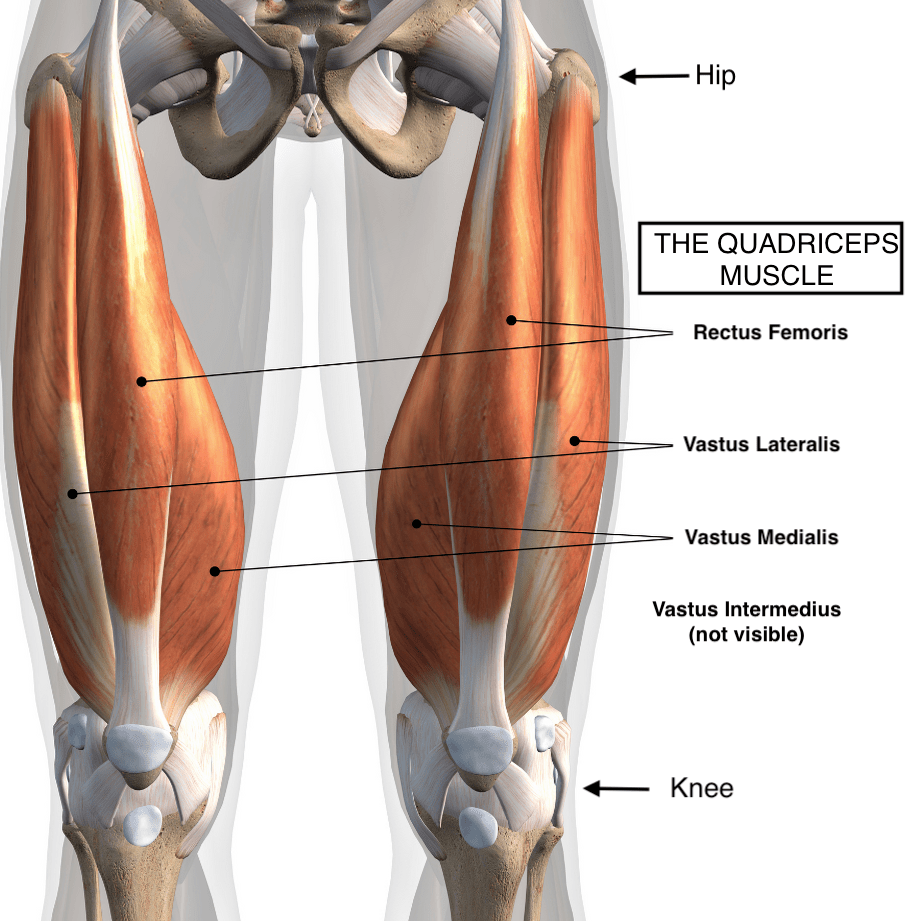
The quadriceps assist in extending the knees, and are used in every day activities such as getting up from a chair, walking and climbing stairs.
As we rely on the quadriceps to complete many every day activities, and if we spend a lot of time sitting, they can become an area of tightness.
In turn, although stretching out the quadriceps seems like a fairly straightforward way to ensure muscle tightness does not develop in this area, the quadriceps can be difficult to stretch. This is due to having to bring the knee up and balance with one leg, which can be an issue if mobility issues are present in the knee or shoulder, or balance issues are present.
Regardless of your current physical capabilities, the quadriceps are an important area of the body to stretch out and shouldn’t be neglected.
To make stretching out the quadriceps a little easier, here are 4 simple and effective stretches that you can do to get a good stretch in your quadricep muscles.
THE IMPORTANCE OF STRETCHING FOR SENIORS
Did you know that stretching is like a secret potion for keeping our bodies youthful and agile? As we age, our muscles tend to become shorter and lose elasticity. Think of them as rubber bands that need a good stretch to get back to their springy selves. Regular stretching is key to maintaining mobility, ensuring you can enjoy those lovely walks in the park and boogie down whenever the mood strikes.
Beyond keeping us limber, stretching plays a vital role in safety. It's our ally in the fight against falls and injuries, enhancing balance and coordination. This makes us more stable and sure-footed, which is incredibly important as we navigate our golden years.
PREPARATION FOR STRETCHING
Before we jump into the stretches, let's talk about doing it right. Timing and safety are paramount. Always warm up those muscles a bit before stretching - a light walk or gentle warm-up does wonders. Remember, stretching should feel good; it's not a competition. Listen to your body, take it slow, and breathe deeply. It's all about enjoying the process and feeling great.
QUADRICEPS STRETCHES FOR SENIORS
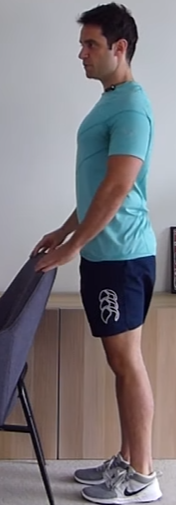
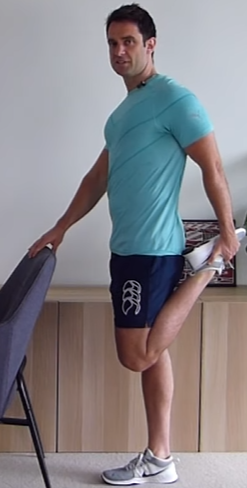
1) COMMON STANDING QUADRICEPS STRETCH
HOW TO:
Standing up tall holding on to a sturdy surface to ensure you’re steady.
Bring your foot up to your buttocks while reaching back and holding on to your foot.
Ensure your knees are in line with each other and you remain standing up tall.
Hold for the set time and repeat on the other leg.
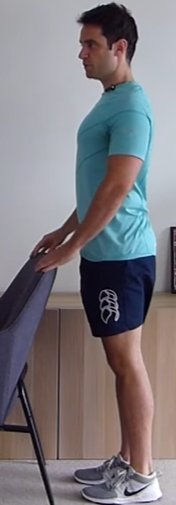
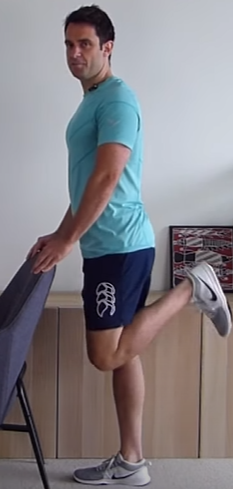
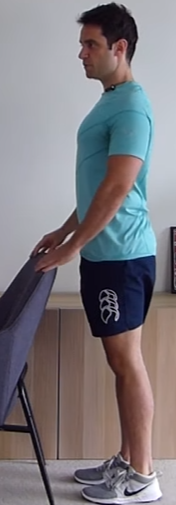
2) DYNAMIC STRETCH
For those not familiar with dynamic stretches, dynamic stretches consist of a movement-based type of stretching, where the muscles themselves are used to bring about a stretch.
HOW TO:
Standing up tall with your shoulders back and down and your feet hip-width apart.
Bring your foot up behind you as far as you feel comfortable, and then bring it back down.
Repeat on the other leg.
Continue alternating legs while completing this movement for the set time.
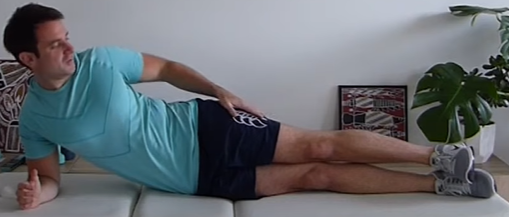
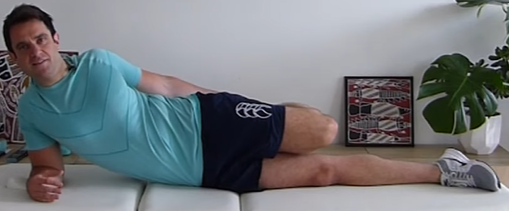
3) SIDE LYING STRETCH
HOW TO:
Lying on your side on your bed or floor in the position that is most comfortable for you.
Bring your ankle to your buttocks while bringing your arm back and holding on to your foot.
Gently bring your foot into your buttocks, feeling the stretch in the front of your thighs.
Hold for the set time and repeat on the other leg by safely rolling over and doing the same on the other side.
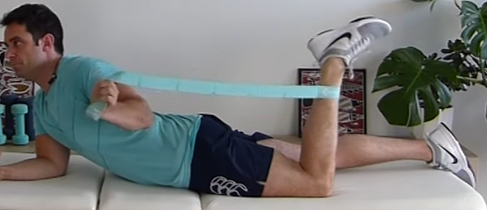
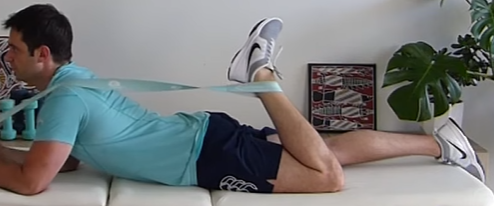
4) PRONE STRETCH (ON STOMACH) - WITH BELT
While effective when completed on the stomach, this stretch can also be completed in a side lying position.
HOW TO:
Place the end loop of the resistance band or belt around your ankle, facing behind you.
Lying on your stomach on your bed or floor in the position that is most comfortable for you.
Lift your leg up and place the resistance band or belt over your shoulder.
Gently pull on the resistance band or belt until you feel the stretch in your quadriceps.
Ensure your leg is coming directly up, and not pointing in ways or out ways.
Hold for the set time and repeat on the other leg.
You can also see the stretches performed in video below!

Order the resistance band used in this video.

15-Minute Strength Workout For Seniors | Intermediate
In this video, we go through 15-minutes of intermediate-level strength exercises, working the whole body to help get you stronger.
Increase strength & fitness - strength workout for seniors (intermediate)
Join me (Mike - Physiotherapist) for this full-body workout for seniors.
Get your whole body stronger and fitter, and improve your coordination with these exercises. This session goes for 15 minutes.
REMEMBER TO WARM-UP prior to doing this exercise:
For the Warm-Up Video:
Standing Warm-Up: https://youtu.be/b2DYU7ZQgN0
Do your best and any questions ask below!
- Mike

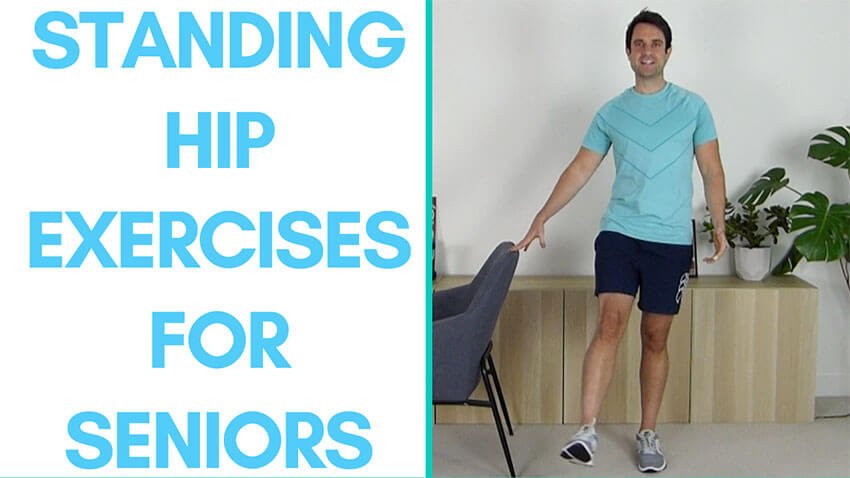
Standing Hip Exercises For Seniors | Beginner Hip Exercises
Join Mike, Physiotherapist, for 8-minutes of standing hip exercises for seniors.
Increase mobility & strength - beginner Hip exercises for seniors
Hey everyone, join me (Mike - Physiotherapist) for these standing hip exercises for seniors.
In this exercise video, we work the hips.
The hips are an important area of the body to keep strong and moving well!
Today's hips exercises are all standing ones. You may have found in the past, or today, that with certain single-leg standing exercises, for example, hip abductions, or hip extensions (like we do in today's video) or the balance exercises, the opposite side seems to get a workout.
Maybe even more so than the leg that is moving!
This is completely normal! When we do single leg work, the leg that is stationary is now working overtime to keep you stable. You're working your hip stabilisers.
Once you get stronger, after staying consistent with the exercises, you'll notice this muscle fatigue you feel goes away.
- Mike

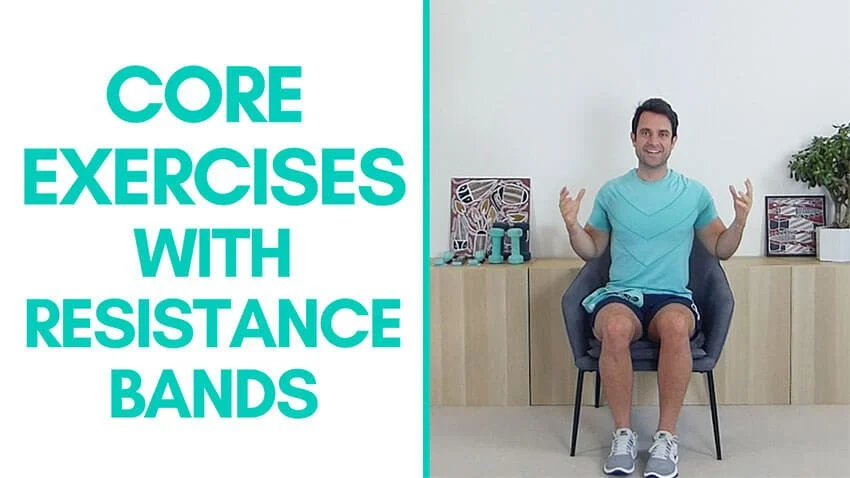
CORE EXERCISE FOR SENIORS (With Resistance Band)
Join Mike, Physiotherapist, in this 10 minute, seated core exercise routine using a resistance band.
Effective Core Exercises For Seniors (with resistance band)
Hey Everyone, join me (Mike - Physiotherapist) in this 10 minute, seated core exercise routine using a resistance band. You can also just follow the exercises, without the resistance band, and still work your core.
To order the RESISTANCE BAND SEEN IN THIS VIDEO, visit: https://morelifehealth.com/bands
REMEMBER TO WARM-UP prior to doing this exercise:
For the Warm-Up Video:
Seated Warm-Up: https://youtu.be/b2DYU7ZQgN0
Do your best and let me know how you went below!
- Mike

10 Minute Workout For Seniors (advanced)
Join Mike, Physiotherapist, in this 10 minute, Intermediate, standing workout with weights.
strength workout with weights for seniors - (advanced)
Hey everyone, join me (Mike - Physiotherapist) in this 10 minute, Intermediate, standing workout with weights.
If you don't have hand weights you can use drink bottles or food cans (always start with lighter weights and move your way up), or you can just follow the exercises, without any weights.
(To get straight into the exercise go to 0:51 seconds).
REMEMBER TO WARM-UP prior to doing this exercise:
For the Warm-Up Video:
Standing Warm-Up: https://youtu.be/b2DYU7ZQgN0

Do your best and let me know how you went below!
- Mike

The Squat: Perfecting The Best Exercise For Your Legs
How to squat correctly - Perfect your squat and get the most out of it.
How to Squat For Seniors
The squat is one of the most effective exercises to keep your legs strong. It works all the muscles in the legs and activates the core.
It's also a movement that you undertake throughout your day; when you lift things, and when you are standing in certain postures. Remember, we never bend at the back to pick something up, or to move something heavy. We use our stronger muscles - our legs and our glutes (buttocks).
You want to get your squat technique correct to work the muscles effectively, and to not put excess strain on areas you shouldn't be.
So, without further ado, here is how to squat correctly. (why not get up and practice it now - it's an important exercise that will benefit you greatly).
Squat: How to
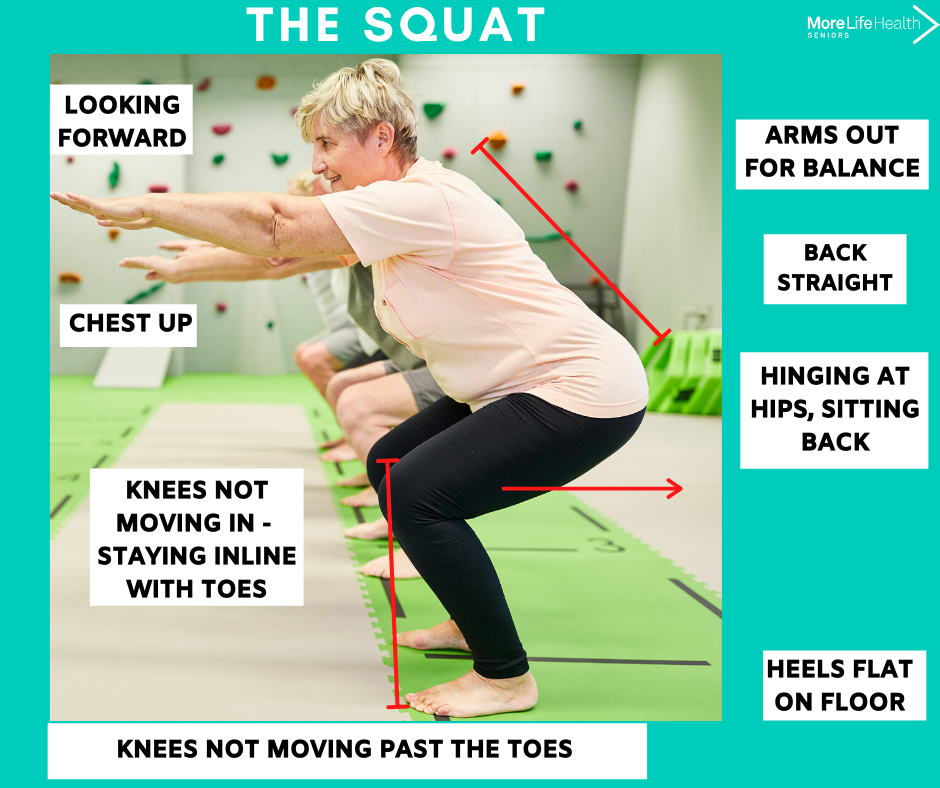
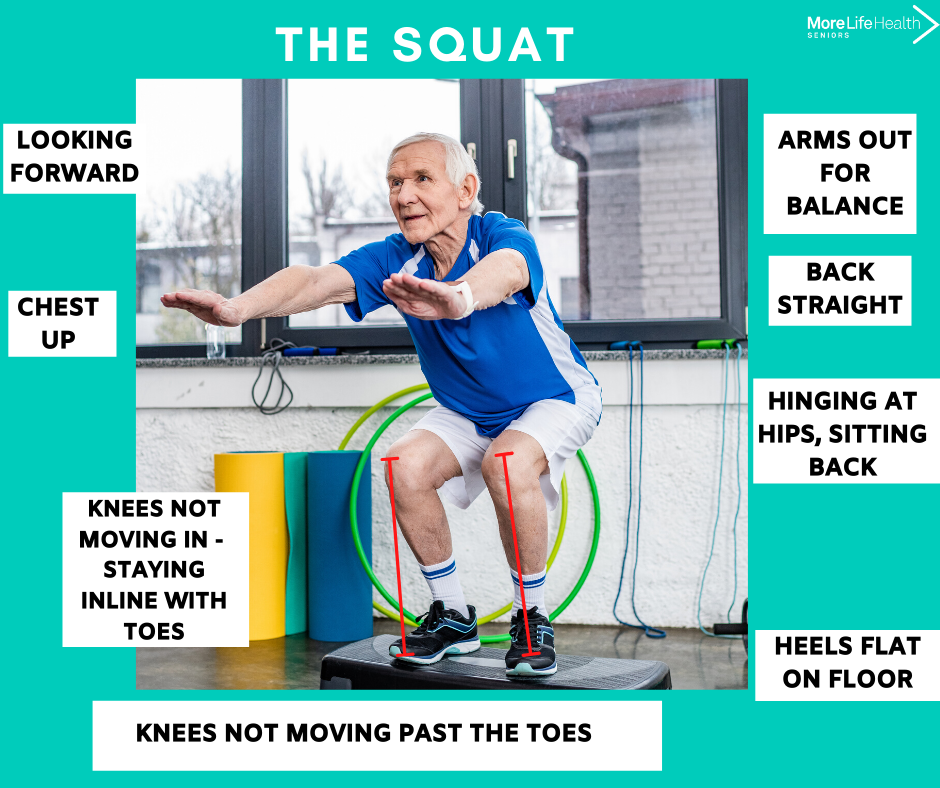
Standing up tall with your feet shoulder-width apart. Toes can be facing forward, or slightly outwards.
Holding onto your chair with both hands, or keep your arms straight out in front for balance.
Engage your core, hinge (bend) at the hips and sit back as you would if you were to sit on a chair.
As you sit back, keep your chest up and your core tight, and go no lower than 90 degrees.
As you stand back up, put equal weight through both legs, ensuring your heels remain on the floor throughout.
Make sure your knees stay in the line of your toes; they don’t go forward past your toes, and they aren’t moving inward throughout the exercise.
Now, I also want to go through some common mistakes with the squat!
Let's take a look at these two ladies performing a partial squat.
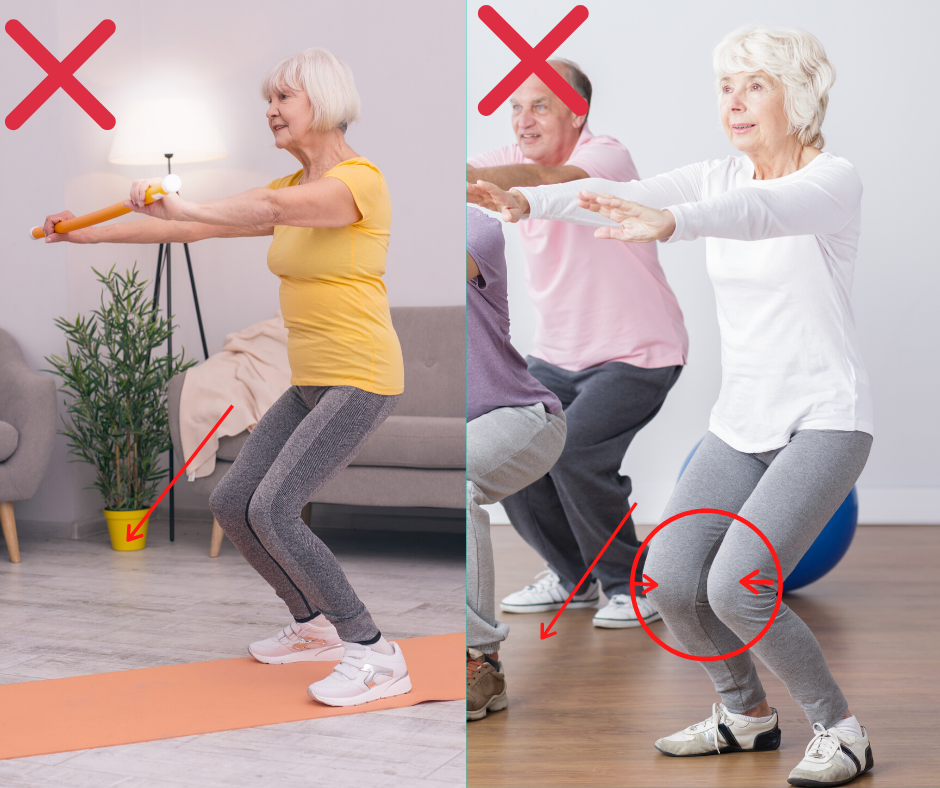
In these photos, it may look at first glance like the squat is being performed correctly, however, both ladies are leading with their knees.
With the lady on the right (white shirt), her knees are also moving inwards as she squats down (they are not in line with her toes).
Performing the squat like this places excess strain on the knees.
Remember to sit back and keep your knees in line with your toes.
Get the exercise technique correct - practice, practice, practice. It's important!
Benefits of Squats for Seniors
Improves Functional Independence: Regular squatting enhances leg strength and balance, crucial for daily activities such as walking, climbing stairs, and getting up from a chair.
Increases Bone Density and Joint Health: Weight-bearing exercises like squats can help maintain or increase bone density, reducing the risk of osteoporosis.
Enhances Overall Fitness: Squats engage multiple muscle groups, improving strength, flexibility, and endurance.
Common Concerns Addressed
Knee Pain and Joint Issues: We discuss modifications to the squat technique to reduce strain on knees and joints.
Balance Difficulties: Tips on maintaining balance during squatting, including using support like a chair or wall.
Fear of Injury: Emphasis on proper form and gradual progression to build confidence and prevent injuries.
Senior-Friendly Squat Techniques
Chair Squats: Using a chair for support, this technique is excellent for beginners or those with balance concerns.
Wall Squats: Leaning against a wall reduces pressure on the knees and helps maintain proper posture.
Partial Squats: Reducing the squat depth can benefit those with severe knee or hip issues.
Adapted Squat Routines
With Resistance Bands: Adding resistance bands can increase strength without heavy weights.
Squat to Overhead Raise: Combining squats with an overhead arm raise to engage the upper body and improve coordination.
Squat Holds: Holding the squat position for a few seconds increases muscle endurance and stability.
Tips for Successful Squatting
Warm-Up Properly: Engage in light cardio or stretching exercises to warm up the muscles before squatting.
Focus on Form, Not Depth: Maintaining correct posture’s more important than squatting deeply.
Listen to Your Body: Pay attention to any discomfort or pain and adjust the exercise accordingly.
Stay Consistent: Regular practice leads to improvement. Aim for a routine that is sustainable and enjoyable.
Consult with Health Professionals: Especially important for seniors with existing health conditions or mobility issues.
For more info on the squat:
That's it from me....
Remember new exercise videos are out regularly on the More Life Health YouTube Channel, so make sure you're subscribed to be the first to know.
Stay moving and stay happy!
- Mike
P.S. Join the Facebook Support Group (if you haven't already).

Resistance Band, Strength Exercises For Seniors (13 Minutes - Intermediate)
Here is an intermediate level resistance band, strength workout targeting the whole body.
resistance band exercises for seniors - improve your strength
GET STRONGER AND IMPROVE YOUR FITNESS - with this intermediate level resistance band, strength workout targeting the whole body for seniors.
In this video, there are some exercises we haven't done before. A standing whole-body exercise and a new exercise targeting the back of the arms (triceps).
If you have trouble placing the band on kneeling, do this in a seated position.
To order THE RESISTANCE BAND used in this video: https://morelifehealth.com/bands
REMEMBER TO WARM-UP prior to doing this exercise:
For the Warm-Up Video:
Standing Warm-Up: https://youtu.be/b2DYU7ZQgN0

Do your best and let me know how you went below!
- Mike

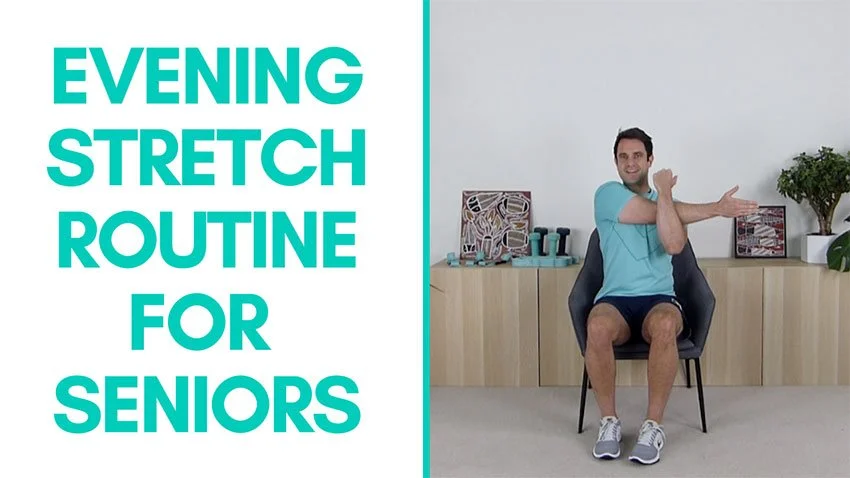
Stretch Routine To Do Each Evening (8-Mins) | Stretches For Seniors
In this video, we go through a stretching routine that you can do each evening.
Evening STRETCH ROUTINE FOR SENIORS
In this video, we go through a stretching routine that you can do each evening.
Combine this stretch video with the four stretches to do each day: https://youtu.be/eHXbj2Uq8mM and the morning routine: https://youtu.be/iylk12bmlpY for a whole-body stretch each day.
You can also go through this routine two or three times for an even better stretch.
Remember to warm-up prior to doing exercise:
For the Warm-Up Video:
Seated Warm-Up: https://youtu.be/b2DYU7ZQgN0
Do your best and let me know how you went below!
- Mike

Fitter in 5 - Stretch Routine To Do Each Morning | Stretches For Seniors
In this video, we go through a stretching routine you can do when you wake each morning.
morning stretch routine for seniors
In this video, we go through a stretching routine you can do when you wake each morning.
If you want to cover more areas of your body each day, combine this video with the four stretches to do each day: https://youtu.be/eHXbj2Uq8mM and the evening routine: https://youtu.be/e68piWxSNu8
You can go through this routine two or three times for a better stretch..
This video goes for only 5-minutes and it's great for those times you're having trouble with motivation, or you're short of time.
Remember to warm-up prior to doing exercise:
For the Warm-Up Video:
Seated Warm-Up: https://youtu.be/b2DYU7ZQgN0

Do your best and let me know how you went below!
- Mike

How to Make Your Favourite Exercise Videos Easy to Access.
Finding it difficult to access your favourite exercise videos, here’s how to create a playlist with your favourite More Life Health exercise videos, to ensure you are exercising each day!
CREATING AN EXERCISE VIDEO PLAYLIST ON YOUTUBE
Sifting through all the More Life Health exercise videos can be a time consuming process, and we want to make it as easy as possible to get moving without wasting any time.
When we can make it as easy as possible, sticking to the exercises becomes much easier to do!
So today, I am going to show you how you can save your favourite exercise videos and organise them effectively on YouTube (by creating a playlist), so when you want to get exercising, you’re all set to go with no time wasted.
Creating a YouTube playlist is simple and involves a fairly straight forward process, here’s how to do it.
Step 1: Sign in to your Google account

To create a YouTube playlist, you must have a YouTube account.
This can be achieved by simply signing in to YouTube with your Google account. If you do not have a Google account, you will need to create one and then sign in to YouTube with that account. To do this, please click here.
Step 2: Locate the video to add to The playlist
In the search bar at the top of the YouTube page, search for the exercise video you wish to add to your playlist or browse the multiple videos by clicking on the More Life Health YouTube Channel page.
You can also find the exercises categorised and updated on the More Life Health Website here.
Once you have located the video, click the video as if you are going to watch it.
Step 3: Select the Save icon BELOW the video

Below the video, select the Save icon on the video. This icon looks like three horizontal lines alongside a plus sign.
Step 4: Select Create new playlist

After selecting the Save icon, a menu should appear (as per the image). Select Create a new playlist.
Step 5: Name your playlist

Once you have selected Create a new playlist, another menu will appear. In the box labelled Name, type in the name of your new playlist.
Step 6: Choose your Privacy level

Within the same menu, you can chose the level of privacy that you want for your playlist. From the drop-down menu labelled Privacy, you can chose to make your playlist either public, unlisted, or private. For more information on these options, please click here.
Step 7: Select Create

Once you have named your new playlist and selected a privacy option for it, select the blue Create button. Once you have done this, your new playlist will have been created and the exercise video that you selected will have been automatically added to it.
To add more exercise videos to your new playlist, simply repeat step 3 and select which playlist you wish to add the exercise videos to.
ACCESSING YOUR new YouTube playlist
Step 1: select the GUIDE menu icon

On the very top left-hand corner of your screen, select the Guide menu icon. This icon looks like three horizontal lines stacked on top of one another.
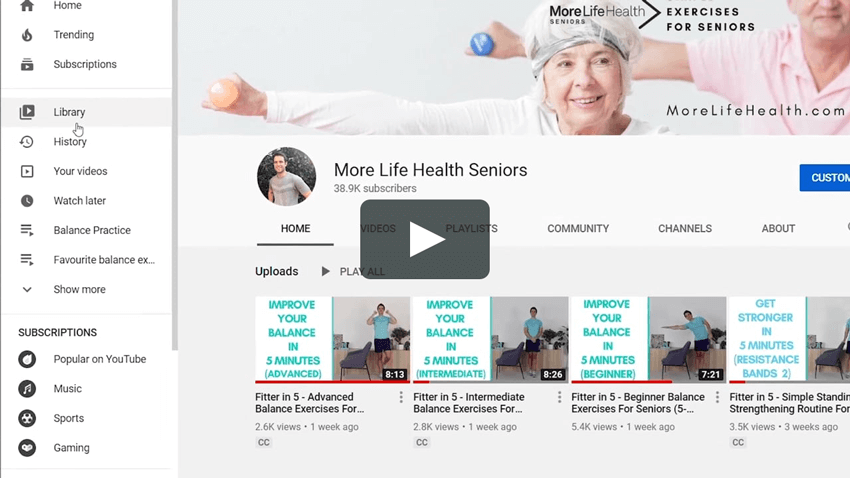
Step 2: Select your playlist from the side menu

Your new playlist will be listed as an option on the side menu.
By selecting your playlist from the side menu, you will be able to view it and watch the exercise videos that you have saved to it (See image below).

Once you’re done, it’s now time to get exercising!
Remember to also make sure you’re subscribed to the More Life Health YouTube channel and you’ve got notifications turned on.
If you have any questions setting this up, let me know down below!
- Mike

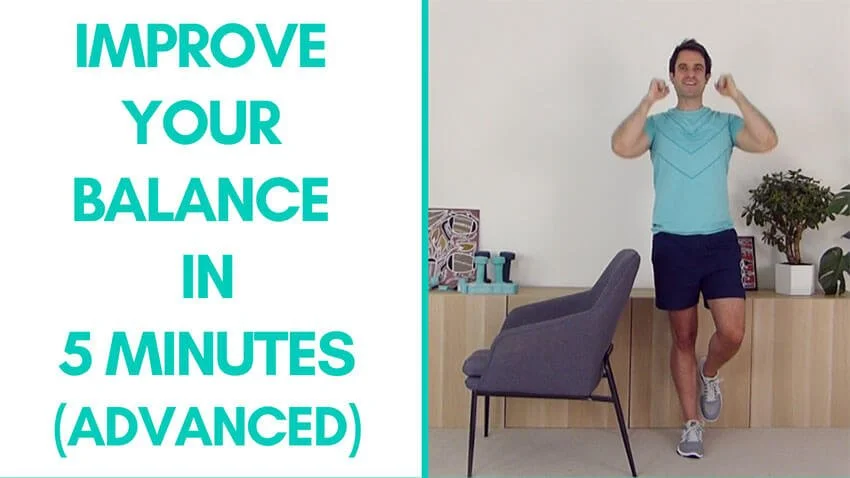
Fitter in 5 - Advanced Balance Exercises For Seniors (5-Minutes)
In this video, we go through an advanced balance routine. These exercises are a progression from the previous beginner balance exercises and the intermediate balance exercises.
BETTER BALANCE - 5 MINUTES BALANCE EXERCISES (ADVANCED)
In this video, we go through an advanced balance routine. These exercises are a progression from the previous balance exercises:
Beginner balance exercises: https://youtu.be/7j8hDHlaLw4
Intermediate balance exercises: https://youtu.be/E1nrbYspnHY
You can go through this routine two or three times for an even better workout and make sure you do it at least 3 times a week to start seeing improvements.
This video goes for only 5-minutes and it's great for those times you're having trouble with motivation, or you're short of time.
Remember to warm-up prior to doing exercise:
For the Warm-Up Video:
Standing Warm-Up: https://youtu.be/b2DYU7ZQgN0
Do your best and let me know how you went below!
- Mike

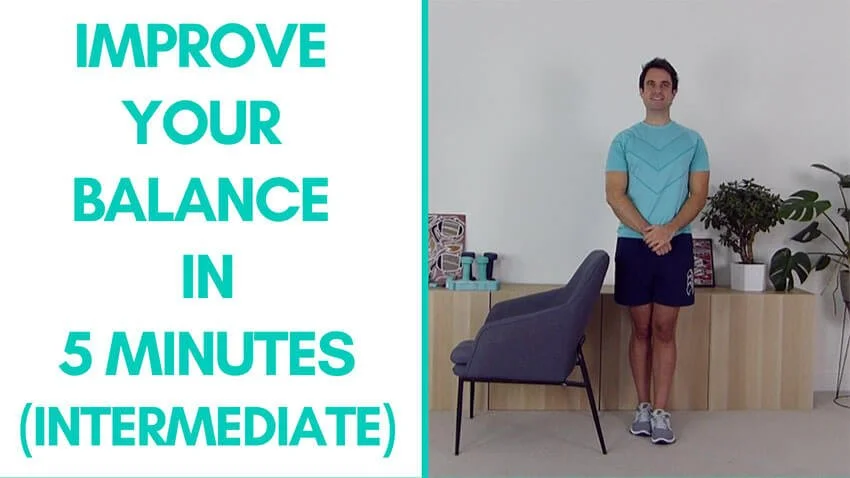
Fitter in 5 - Intermediate Balance Exercises For Over 60 (5-Minutes)
In this video, we go through an intermediate balance routine. These exercises are a progression from the previous beginner balance exercises.
BETTER BALANCE - 5 MINUTES BALANCE EXERCISES (INTERMEDIATE)
In this video, we go through an intermediate balance routine. These exercises are a progression from the previous beginner balance exercises: https://youtu.be/7j8hDHlaLw4
You can go through this routine two or three times for an even better workout and make sure you do it at least 3 times a week to start seeing improvements.
This video goes for only 5-minutes and it's great for those times you're having trouble with motivation, or you're short of time.
Remember to warm-up prior to doing exercise:
For the Warm-Up Video:
Standing Warm-Up: https://youtu.be/b2DYU7ZQgN0
Do your best and let me know how you went below!
- Mike

Fitter in 5 - Beginner Balance Exercises For Seniors (5-Minutes)
In this video, we do a beginner balance routine. This video is best for those who are getting started improving their balance and who have some difficulties with other balance exercises.
BETTER BALANCE - 5 MINUTES BALANCE EXERCISES (BEGINNER)
Have you ever felt disheartened when you've tried to do something and couldn't?
This is something I see frequently when it comes to exercise.
It's not uncommon for people to just give up when attempting exercises and find them too difficult. They resort to the fact they're not good enough (which isn't true) and then not continue. Especially when they are new to exercise.
But........ YOU ARE CAPABLE OF DOING WHATEVER IT IS! You just may not be there yet!
And that's ok!
What it takes is consistency and to keep moving forward. Don't give up!
Or.... you may need to take a few steps back by doing a less difficult variation of the exercise and then work your way through more challenging exercises until you can do it.
Which is what we do in today's exercise video. We're going to do some beginner balance exercises.
Click on the video below, to get moving with me!
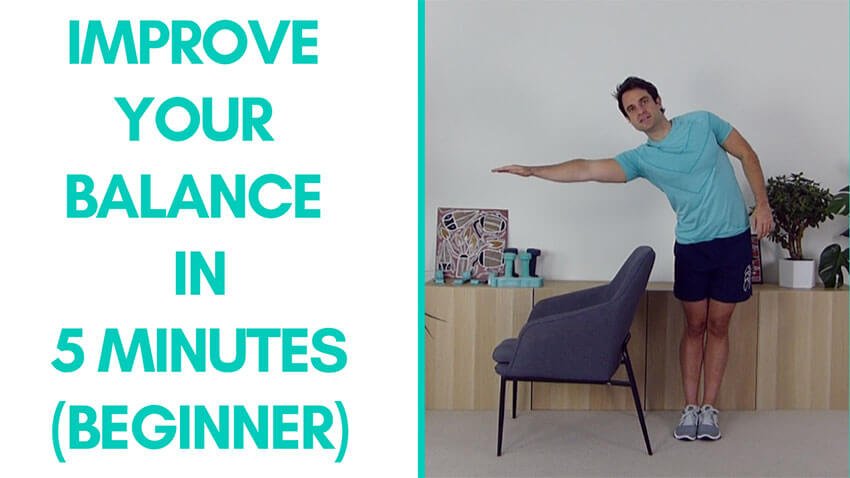
If you're someone that has trouble with other balance exercises, you can start here and work your way through to more difficult exercises over time. Or, if you want something to get you exercising today, why not do this also!
Tomorrow we'll do intermediate balance exercises and the following day, advanced balance exercises.
Do your best and let me know how you went below!
- Mike

Fitter in 5 - Simple Standing Strengthening Routine For Seniors (5-Mins) | Resistance Band Exercises
In this video, we do a 5-minute, standing resistance band strengthening routine working the whole body.
STRONGER STANDING BODY EXERCISES FOR SENIORS (5-MINUTES-RESISTANCE BAND)
In this video, we do a 5-minute, standing resistance band strengthening routine working the whole body.
You can go through this routine two or three times for an even better workout.
To order the resistance band used in this video: https://morelifehealth.com/bands
Remember to warm-up prior to doing exercise:
For the Warm-Up Video:
Standing Warm-Up: https://youtu.be/b2DYU7ZQgN0

Do your best and let me know how you went below!
- Mike

Intermediate Cardio Workout For Seniors (SEATED) - Improve Your Fitness in 5 Minutes
In this video, we are doing a seated cardio routine using light hand weights to help improve your cardiorespiratory fitness and your muscular endurance. It is an intermediate level workout.
cardio workout with weights for seniors (intermediate) - seniors chair exercises
In this video, we are doing a seated cardio routine using light hand weights to help improve your cardiorespiratory fitness and your muscular endurance. It is an intermediate level workout, if you feel your arms fatiguing, put the weights down and carry on.
Go at your own pace!
You can go through this routine more times if you're feeling extra keen.
This video goes for only 5-minutes and it's great for those times you're having trouble with motivation, or you're short of time.
Remember to warm-up prior to doing exercise:
For the Warm-Up Video:
Seated Warm-Up: https://youtu.be/b2DYU7ZQgN0

Do your best and let me know how you went below!
- Mike

Fitter in 5 - Shoulder Exercises For Seniors (5-Minutes)
In this video, we work the shoulders. You can go through this routine two or three times and it can also be completed standing.
HEALTHY SHOULDERS - 5 MINUTES SHOULDER EXERCISES
In this video, we work the shoulders. You can go through this routine two or three times and it can also be completed standing.
This video goes for only 5-minutes and it's great for those times you're having trouble with motivation, or you're short of time.
Remember to warm-up prior to doing exercise:
For the Warm-Up Video:
Seated Warm-Up: https://youtu.be/b2DYU7ZQgN0

Do your best and let me know how you went below!
- Mike

Advanced Cardio Workout For Seniors - Improve Your Fitness in 5 Minutes
In this video, we are doing a cardio routine using light hand weights to help improve your cardiorespiratory fitness and your muscular endurance. It is an advanced level workout.
GET FITTER- 5 MINUTES AEROBIC WORKOUT FOR SENIORS (ADVANCED - WEIGHTS)
In this video, we are doing a cardio routine using light hand weights to help improve your cardiorespiratory fitness and your muscular endurance.
Go at your own pace!
You can go through this routine more times if you're feeling extra keen.
This video goes for only 5-minutes and it's great for those times you're having trouble with motivation, or you're short of time.
Remember to warm-up prior to doing exercise:
For the Warm-Up Video:
Standing Warm-Up: https://youtu.be/b2DYU7ZQgN0

Do your best and let me know how you went below!
- Mike

Fitter in 5 - Simple Strengthening Routine For Seniors (5-Minutes) | Resistance Band Exercises
In this video, we do a 5-minute, seated whole-body resistance band strengthening routine.
IMPROVE YOUR BODY STRENGTH STRENGTH EXERCISES FOR SENIORS (5- Minutes- RESISTANCE BAND)
In this video, we do a 5-minute, seated whole-body resistance band strengthening routine.
You can go through this routine two or three times for an even better workout.
To order the resistance band used in this video: https://morelifehealth.com/bands
Remember to warm-up prior to doing exercise:
For the Warm-Up Video:
Seated Warm-Up: https://youtu.be/b2DYU7ZQgN0

Do your best and let me know how you went below!
- Mike