![The Complete Guide To Strong Bones Over 60 [Part 1]](https://images.squarespace-cdn.com/content/v1/5652f717e4b0070eb05c2f63/1623694989255-558WBGT4E3USETS22J47/Bone+Health+Osteoporosis+Osteoarthritis+1+%281%29.png)
The Complete Guide To Strong Bones Over 60 [Part 1]
To find out the structures of your body that hold you up, help you to move and to go about your daily activities are failing, and potentially going to get progressively worse over time, can be quite unsettling to say the least.
Maybe you’ve been diagnosed with osteopenia or osteoporosis; maybe you’ve had fractures yourself, or maybe you want to make sure you’re doing all that you can to keep your bones at their strongest, which everyone should be doing.
In this article, we are going to be covering everything you need to know for healthiest bones.
PART 1: WHAT YOU NEED TO KNOW TO GET STRONGER BONES
In early life, keeping our bones strong is something we don’t think too much about!
We know our bones keep us standing.
We know that we can break our bones.
We know it’s important to have strong bones.
But…… that’s all we usually know about our bones most of our life. They just do their thing in the background and we get on with it.
It’s not until later in life that most people start to think more about keeping their bones healthy. This is usually because there is more talk about the effects of weaker bones, or a fracture occurs somewhere in the body, or, after tests, a doctor brings the news that your bones are weaker (which can come as quite a shock).
If you’re reading this article, having strong bones has most probably become important to you. Maybe you’ve been diagnosed with osteopenia or osteoporosis; maybe you’ve had fractures yourself, or maybe you want to make sure you’re doing all that you can to keep your bones at their strongest, which everyone should be doing.
In this article, we are going to be covering everything you need to know for healthiest bones.
In Part 1, we’ll learn about bones and how they work because having a better understanding of your body helps you to be healthier.
We’ll discuss osteopenia and osteoporosis, what is happening in these conditions and why they occur.
We will go through the testing procedures for determining bone strength and how often you should be getting your bone strength tested. We’ll also discuss the factors that contribute to bone strength (which goes beyond bone density).
In Part 2, we will go through all treatment approaches for improving bone strength and preventing fractures, from habits to cut out to nutrition (including vitamins and minerals for bone strength).
And in Part 3, we will cover all about exercise techniques for stronger bones, including some exercise programs (which include videos) that you can do to help promote bone strength.
After reading this article, you’ll have everything you need to make a difference in your bone health.
So read through it all, make the changes required and you’re on your way to better bone health.
Now…. Let’s get into it.
WHAT WE’LL BE COVERING IN PART 1:
ALL ABOUT YOUR BONES & BONE LOSS
WHAT HAPPENS TO OUR BONES AS WE GET OLDER - WHY DO OUR BONES BECOME WEAKER
OSTEOPENIA vs OSTEOPOROSIS: WHAT CAN HAPPEN WHEN BONES BECOME WEAKER
ALL ABOUT BONES AND BONE LOSS
EASING YOUR FEARS AROUND ‘BRITTLE BONES’ AND FRACTURES
To find out the structures of your body that hold you up, help you to move and to go about your daily activities are failing, and potentially going to get progressively worse over time, can be quite unsettling to say the least.
To think that your bones are now what’s commonly described as ‘brittle’ would not give anyone confidence in going about their day in fear of breaking a bone.
There are also some frightening statistics about hip fractures and the outcomes if this was to happen over a certain age that you may have heard (I.E. requiring permanent nursing care or even death not long after the fracture).
It makes the thought of getting older and the possibility of this occurring a terrifying and somewhat helpless situation.
But let’s look at this all from a different view.
Firstly, (I want to get this out of the way first), in regards to those statistics following a hip fracture, those who die following a hip fracture are usually very frail with serious health conditions prior to the fracture. Full recoveries can be made.
Secondly, it’s important to know that bone health is graded from normal (healthy bone levels) to mild bone loss and to osteoporosis (which has graded levels also).
Whatever your bone health is at this current time, you can prevent bone loss and loss in bone strength and it is possible to get them stronger.
As with many factors that are typically put down to ageing like muscle loss and strength, decreased fitness, and poor balance, weaker bones are also NOT due to ageing alone.
Yes, your bones will not be like they were when you were younger, but there are many other factors that contribute to loss of bone strength beyond ageing that can be changed.
Thirdly, being diagnosed with osteoporosis does not mean you’re definitely going to get fractures. Although osteoporosis does increase fracture risk and fractures are common with osteoporosis, there are many who get diagnosed with this condition that do not get fractures.
And finally, falls, which can lead to fractures, can be prevented.
There are always things you can do to improve your bone health and your situation.
Let’s focus now on what can be done to improve bone health and decrease fracture risk, starting with learning about our bones.
ABOUT YOUR BONES
Throughout life, the bones of our body are constantly being broken down (by cells known as osteoclasts) and then built up with new bone (by cells known as osteoblasts).
This process is called bone remodelling and it ensures that your body is well-adjusted to the ever-changing mechanical forces placed on it.
Basically, your body is continuously doing renovations to make sure that the whole structure maintains its integrity for the demands of life.
As children, our bones go through rapid periods of growth in both size and density where more bone is added than being taken away.

This increase in bone size and density continues into our late twenties when our skeleton reaches full maturation, and we reach what’s known as peak bone mass.
From this point, although our skeletal structure has now reached full maturation, bone remodelling continues to take place (now at a slower rate, however, in comparison to childhood).
To put it simply, as long as your body continues to create good quality bone tissue at the same (or similar rate) as it resorbs the old bone, your skeletal system remains strong and healthy.
WHAT HAPPENS TO OUR BONES AS WE GET OLDER - WHY DO OUR BONES GET WEAKER
As our body ages, the rate at which the new bone replaces the old bone slows down.
In other words, the resorption exceeds the formation of new bone tissue, leading to less bone mass.
Additionally, there is deterioration in the structure of the newly laid bone leading to poorer bone quality. [1]
This decline in quantity (density) and quality commonly results in conditions such as osteopenia and osteoporosis, predisposing one to the risk of fractures.
However, as touched on earlier, age-related bone loss is a complex disorder that occurs due to numerous factors and not just ageing alone. These factors include genetics, hormonal changes, as well as biochemical, lifestyle and environmental factors. We will cover this more later in this article.
OSTEOPENIA vs OSTEOPOROSIS: WHAT CAN HAPPEN WHEN BONES BECOME WEAKER
So when the rate of bone breakdown exceeds the rate of new bone formation, our bone mass decreases and becomes less dense (more porous).
When there is a loss in bone density, the first stage is what’s known as osteopenia.
If this loss in bone density was to progress further, we get into the ranges of osteoporosis.
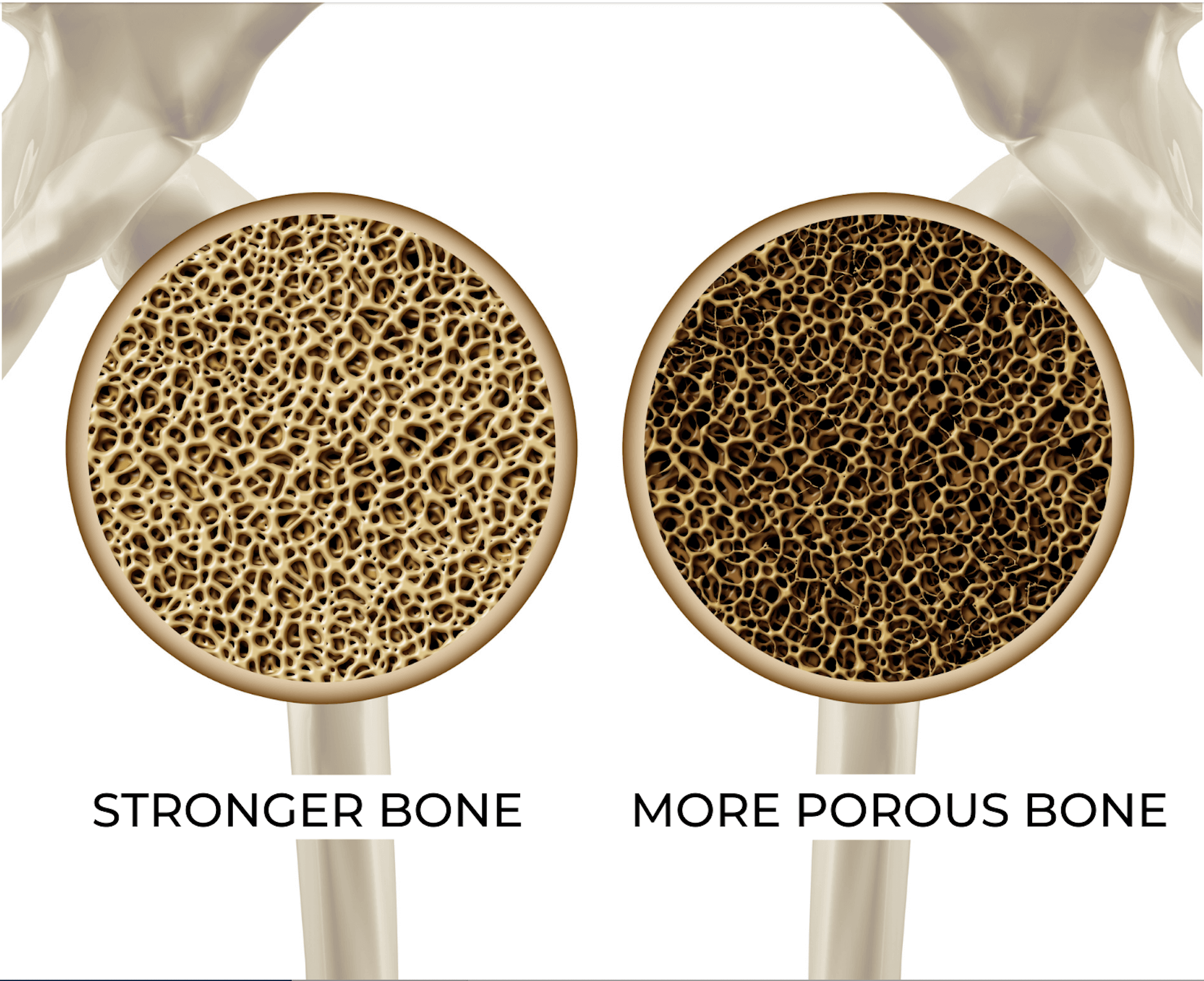
Image: Healthy Hip Bone vs Porous Bone (Osteoporosis)
Osteoporosis is derived from Greek “osteon” (bone) and “poros” (little hole). Osteoporosis meaning ‘porous bone’. [2]
When bones become weaker, it can lead to secondary issues, the most common being fragility fractures.
As osteoporosis can affect any bone in the body, they are all at increased risk of fracture. However, fractures most commonly occur in bones that undertake more strain (such as the spine) or sites most at risk if one was to fall (wrists or hips).
Fractures can be painful and can lead to further problems, such as changes in posture, height loss, decreased quality of life, fear of further fractures, depression and social isolation.
HOW TO KNOW IF YOU HAVE BONE LOSS OR OSTEOPOROSIS
Osteoporosis can be present with no symptoms. Most of the time it usually goes undetected until a fracture occurs. For this reason, osteoporosis has been named the ‘silent disease’.
Osteoporosis can only be diagnosed by certain tests. If you are at risk of osteoporosis, your doctor will recommend and organise bone testing.
Let’s now look at the risk factors for osteoporosis.
RISK FACTORS FOR OSTEOPOROSIS
It’s important for you to be aware of the risk factors for bone loss and osteoporosis to know if you’re at risk and so you can get tested and take action if need be.
The following factors are risk factors for bone loss:
GENDER. Women are generally at higher risk of osteoporosis and osteopenia due to naturally having less bone mass than men.
Bone loss in women is most rapid following menopause with studies showing osteoporosis is related to estrogen deficiency.
By the age of 65-70, both men and women start losing bone at the same rate. [3]
AGE: Your risk for osteoporosis increases with age. Women over 65 and men over 70 are at greater risk.
BONE STRUCTURE & BODY WEIGHT: Thin people usually have a greater risk of developing osteoporosis due to having less bone mass to begin with. Additionally, those that have had major weight loss could also be at risk.
FAMILY HISTORY: Fracture risk secondary to osteoporosis is increased if a parent experiences a hip fracture, particularly if that fracture occurred at a younger age.
NUTRITION: Eating an inadequate amount of calories and consuming a poor diet limited, or devoid, of vital nutrients increases the risk of osteoporosis.
SEDENTARY LIFESTYLE: Lack of exercise and physical activity increases the risk of osteoporosis.
SMOKING AND EXCESSIVE ALCOHOL CONSUMPTION: Smoking decreases bone density and bone quality and increases the risk of fractures [4]. And the same goes for excessive alcohol consumption. [5]
HEALTH CONDITIONS: Certain conditions can put one at risk of developing osteoporosis. The diseases include thyroid disease or an overactive thyroid gland (hyperthyroidism), parathyroid disease or an overactive parathyroid (hyperparathyroidism), chronic kidney and liver disease, and rheumatoid arthritis, plus conditions that affect the body’s ability to absorb nutrients (e.g. Crohn’s disease, coeliac disease, and other inflammatory bowel conditions).
MEDICATIONS: Certain medications (e.g. corticosteroids or thyroid medications) can result in side effects that may damage bone and lead to osteoporosis.
Other possible signs of bone loss or osteoporosis:
Height Loss: 1/2 inch or more within one year. Or 1½ inches from your original height overall.
Past history of Fractures: - Fracture after age 50, fragility fracture at any age, or a spinal X-ray showing a fracture or bone loss in your spine
Pain: Back pain with potential spinal fracture
TESTING FOR BONE LOSS
HOW BONE LOSS IS COMMONLY TESTED
Firstly, a doctor will examine your medical history and ask questions to determine what risk factors (as discussed above) are present that could be putting you at risk of bone loss.
The doctor will also recommend a bone mineral density (BMD) test which is the primary and most commonly used test for bone loss.
Dual-energy X-ray absorptiometry (DEXA or DXA) is considered the gold standard for measuring bone mineral density.

Image: DEXA/DXA machine
The DEXA machine scans your body to measure bone mineral density at the hip and spine.
It measures the amount of minerals, namely calcium, in your bones and is a non-invasive and painless test that usually takes around 10 - 20 minutes.
Lab tests (blood and urine) may also be ordered which can help give more of a picture of what is going on with your bone health.
Lab tests can confirm or eliminate the existence of certain diseases or health problems that could contribute to bone loss or osteoporosis.
UNDERSTANDING BONE MINERAL DENSITY (DEXA) SCAN RESULTS
Once the DEXA scan is completed, the doctor will analyse the results using a T-score. A T-score compares a patient's bone density to the bone density of a healthy, young adult.
The bone density results are typically classified according to the following scores:

Normal Bone Density: between 1 and -1
Low Bone Density (Osteopenia): -1 to -2.5
Osteoporosis: -2.5 or lower
Severe Osteoporosis: -2.5 or lower with a history of bone fractures.
The DEXA test provides an important piece of information regarding your bone health. However, one DEXA scan can only give a snapshot of your bone at that point in time. It is not a definitive test to determine if you are losing bone.
IS BONE DENSITY THE ONLY FACTOR IN STRONG BONES?: INTRODUCING BONE QUALITY

Bone mineral density testing (DEXA) is the most widely used clinical tool by doctors to evaluate bone strength and risk of fracture due to its low radiation exposure and ease of use.
While this test is a considerably easy way to give an idea of bone strength and can help in making decisions for treatment and to determine treatment effectiveness, it is limited, however, to only measuring the mineral components of the bone, without any details regarding the structure of the bone.
This is important as bone density alone is not the only factor involved in bone strength and risk of fractures. Yes, lower bone density does correlate to increased fracture risk. [6, 7] However, bone density is only one component of bone strength. [8]
As discussed earlier in this article, as we get older we not only lose bone density (mass), we also get a change in the structure of the bone (or the quality).
A measurement of bone mineral density alone neglects other important contributors to bone strength and fracture risk reduction. Hence additional data is needed for predicting bone strength.
So…… What’s going on here?
As you’re starting to see, BONE DENSITY ALONE DOES NOT EQUAL BONE STRENGTH.
Bone strength is a combination of bone quantity (density and size) and bone quality, consisting of structure (micro and macro architecture), material properties, and bone turnover (remodelling). [9]
In simple terms, bone quality is related to what the bone is made up of and where this material is in regards to its structure, not just how dense the bone is, which is important to uphold the mechanical forces of the body.
BONE STRENGTH = BONE QUANTITY (DENSITY) + BONE QUALITY
This is important as the gold standard and most commonly utilised method for testing bone strength is bone mineral density. However, there is more evidence to show that bone quality is more important in predicting bone strength. [10]
HOW TO GET BONE QUALITY TESTED
At this point, you can see that bone density tests, the most commonly used test to determine bone strength, do not give a complete picture of your overall bone health.
You’re most probably thinking at this stage, “then how do I get my bone quality tested?” And, unfortunately, it’s not that simple.
Although there are methods to measure bone quality that can give a better idea about bone strength and risk of fracture (in comparison to bone density testing), bone quality testing methods are less readily available, invasive, or more expensive than a bone density test. Hence the reason bone density tests are commonly used by doctors over bone quality tests.
Bone density is still an important measurement of bone health. However, we must understand a bone density measurement is only one piece of the puzzle; it is giving you a snapshot of your bone strength at the point in time that test was taken. It is also not telling you if you are losing bone.
You may have a low bone density reading and are not currently losing bone.
Your doctor will require at least two tests over a period of time (and a lab test) to understand if you are losing bone.
HOW OFTEN SHOULD I HAVE MY BONE DENSITY TESTED? - WHEN TO GET YOUR BONES TESTED
If you are a woman over the age of 65 and a man over 70, or if you have any of the risk factors discussed above, it is recommended you get a bone mineral density test.
A follow-up BMD test is recommended at least every two years.
To improve the accuracy of your testing results, make sure you use the exact same machine for each measurement, as different machines may lead to different results.
If you feel you are at risk for osteoporosis or fractures, do not hesitate to speak to your doctor about getting bone density tested.
CAN BONE DENSITY BE IMPROVED OVER 60?
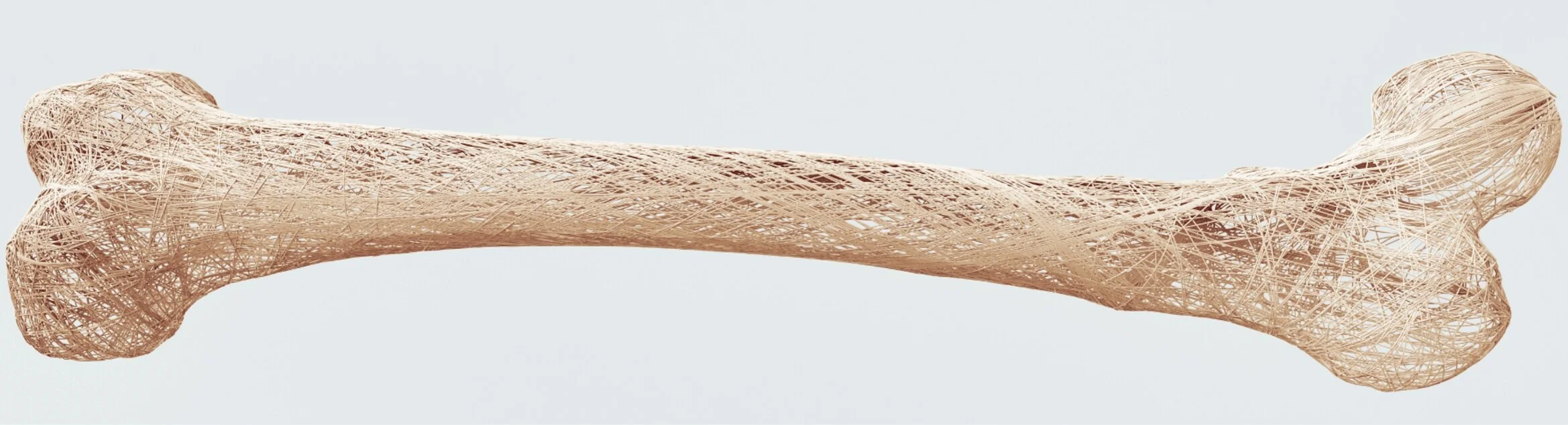
With bone loss and osteoporosis, the best thing that can be done is to prevent it from occurring in the first place. Or preventing further loss in bone mass and strength, and this most certainly can be done.
The question now is, “is it possible to go beyond this and get the bones stronger rather than just preventing them from getting weaker?”
To answer this question, we look back to the components of bone strength that we discussed earlier, that being: bone strength = bone quantity (density) + bone quality.
Studies have shown that when it comes to exercise, exercise programs either show no benefit or only minor benefit when it comes to improving bone mineral density in those with osteoporosis. [11, 12]
On the other hand, however, osteoporosis treatments and exercise have been shown to have beneficial effects on other determinants of bone strength (more specifically bone quality and bone turnover), which can help to strengthen those bones and reduce fracture risk beyond bone mineral density. [13]
By undertaking the right steps, you can improve your bone strength and decrease your risk of fractures.
It’s important now to switch your focus to improving your bone health and being healthy overall.
OSTEOPOROSIS AND MEDICATIONS
I am going to be brief with this section because this is not my area of expertise and something which is best discussed with your doctor.
There are two categories of osteoporosis medications, these being:
Antiresorptive medications - These stop bone loss by suppressing the action of osteoclasts (the cells which break down bone).
Antiresorptive medications include bisphosphonates, denosumab (Prolia), estrogen and hormone therapy, and raloxifene.
Anabolic medications - These increase the rate of bone formation by boosting the activity of osteoblasts (the cells which re-build bone).
The most commonly used anabolic medication for osteoporosis is teriparatide.
Medications do have a place in the treatment of osteoporosis and it will be determined by your doctor if you require them.
The foundation of any bone-strengthening plan, however, should always be nutrition, exercise and other lifestyle factors (which we will cover in part 2).
With everything medical-related that could potentially have long-term effects, it is ok to get a second doctor’s opinion, or even a third if you want to. This way you can hear different perspectives and get a better idea about what is best for you.
Now, let’s get into what you can do to improve your bone health beyond medication.
PART 2: HOW TO EAT FOR STRONGER BONES (AND OTHER FACTORS THAT IMPROVE BONE HEALTH)
SOURCES
CLICK HERE TO VIEW ALL SOURCES USED IN THIS ARTICLE.

Heart Rate and Weightloss in Seniors
Does heart rate have an effect on weight loss in Seniors?
Read more to find out out more about heart rate and its effect on weight loss.
Does the heart rate determine weight loss for seniors?
“I go to my local health club and walk on the treadmill. Is there a certain heart beat rate that I should try to get to in order to lose weight? I have been losing a pound (0.5kg) a week but I think that is more due to eating less. Also anything to help to flatten a stomach?”
There are a few things I want to touch on with Jan's questions.
Number 1) Jan made comment about her weight loss may be from eating less.
My comment: 80% of losing weight is about the food you are putting into your body.
If you’re eating too much food (too many calories), you’re going to find it very, very difficult to lose weight just with exercise.
Make sure you’re eating healthy food and not overeating and, like Jan, you’ll see results.
(In the future I plan on giving information and videos on nutrition for seniors so keep an eye out for this)
Number 2) Jan asked if there is a certain heartbeat rate she should be exercising at to lose weight.
My comment: A great question. Many fitness trainers would say that you want to keep your heart rate in a “FAT BURNING” zone, but I disagree with this. There is no “FAT BURNING” zone you need to stick to when exercising.
However… When exercising we DO want to elevate our heart rate to get the health benefits and burn calories, which will help lose weight.
So what do we elevate our heart rate to?
I recommend exercising in the zone of 60-80% of your max heart rate for the duration of your exercise session.
This may sound complicated, but it actually isn't.
To get your max heart rate, you’re going to put your age into the following formula.
Max Heart Rate = 208 – 0.7(age)
Let take a look at an example: I'm going to pick the age of 70.
Putting Joe's age into the formula: Max Heart Rate = 208 – 0.7(70)
We get 159.
Now when we find 60-80% of this we get the following:
60% = 95 beats per minute
80% = 127 beats per minute
For someone aged 70, they will aim to keep their heart rate between 95 beats to 127 beats per minute for the duration of their exercise session.
When we exercise at 60-80% intensity and combine our exercise with healthy eating we will lose fat and get many health benefits.
Also to touch on the question of flattened stomach's when we lose fat from our body overall, eventually our stomachs will flatten.
As you can see Jan combined her exercising with “eating less” and she is seeing results. Great work Jan!
Now, if you’re like Jan (or me) and like to track and follow numbers when exercising, it’s easy to track if you have a heart rate monitor or you use a treadmill (or other exercise equipment) that tracks your heart rate.
If you don’t have this equipment however, I have created a table known as a Rating of Perceived Exertion (RPE) table which can be printed off and makes it easy for you to track how hard you are exercising.
From this RPE table you can determine the effort (or exertion) you are putting in when exercising by matching up how you feel during exercise and your % of Max Heart Rate.
This table gives you an easy way to determine how much effort you are putting into the exercise and it is worth printing off, familiarising yourself with, and using during your exercise sessions.
To know if you are at 60% of your max heart rate it basically means you are sweating minimally and can easily hold a conversation. As the effort of the exercise increases your heart rate will begin to climb until you get to 80% max heart rate. At 80% of your max heart rate you'll be sweating, can still hold a conversation but with difficulty.
Anything below 60% is still exercise and it has its place for the health benefits. Anything above 80% is not required for seniors.
Well, I hope the above made sense to you. It can be confusing until you get used to it.
Enter your age into the formula and work out 60-80% of your max heart rate and try to stick to this next time you go for a walk, cycle, etc.
If tracking numbers is not something you are interested in, that’s fine also. Just get moving! Get out there and enjoy it. Be happy and if you’re ready to think about different ways of exercising you can do the above also.
- Mike

How Heavy Should Weights be For Seniors? (Strength Training)
You have most probably heard me say before that sooner or later it’s a good idea to add in resistance to your exercises in some form (whether weights or a resistance band). This is so you continue to challenge yourself and get further strength gains. When you’re stronger, you’re going to notice a big difference.
A question I often get asked is “how heavy should my weights be?”
This is a question I cannot give a direct answer to. Everyone has different capabilities, however, this is what you should do:
Choosing the right weights for strength training
You have most probably heard me say before that sooner or later it’s a good idea to add in resistance to your exercises in some form (whether weights or a resistance band). This is so you continue to challenge yourself and get further strength gains. When you’re stronger, you’re going to notice a big difference.
A question I often get asked is “how heavy should my weights be?”
This is a question I cannot give a direct answer to. Everyone has different capabilities, however, this is what you should do:
Step 1 - Practice First
Once you’re ready to begin using weights, choose a light weight to begin with. A weight that you can still do the exercises with no trouble. Say 1kg. If you don’t have weights, you can also use cans of food to begin with, or water bottles.
Don’t rush this. This is so you can practice the exercise with using weights, which will ensure you avoid any injuries and get the most out of your exercise.
Do this whenever completing a new exercise with weights for the first time.
Only when you feel you are doing the exercise correctly is it time to increase the weight.
Step 2 - Find Your Sweet Spot
Now you've got the exercise down, choose a weight that when completing the exercises it challenges you, yet you are still completing the exercises with correct exercise technique.
You want to feel your muscles being worked.
If you feel it is too easy, that’s ok, continue the workout and next time increase the weight a little. Note this down if you need to.
If you feel you are not able to lift the weight or are losing the correct exercise technique the weight is too heavy, put the weight down. Lower the weight.
For some exercises, you will find the weight too easy, for others too heavy. So you'll most probably be using different weights for different exercises.
This is why I recommend a weight set.
Step 3 - Stay Consistent and Progress
By doing the above (step 2) consistently AND ensuring you’re eating adequately, you WILL get stronger, you WILL get fitter.. It’s going to happen. 💪
So now it’s time for you to increase the resistance you’re using.
Use a slightly heavier weight, or a different loop on the resistance band, or double up your band. Or, use a thicker resistance band. If you’re using a resistance machine, you can increase it up a notch. Follow again as per step 2.
This is what I'd do (or any trainer would do) If training you. Working out your safe starting strength and over time increasing the resistance (or progressing the exercises in other ways).
And this is how you do it yourself. 🙂
For more on this you can check out my comprehensive article on strength training here: The Strong Senior
If you have any questions, ask them below (Many questions are answered in the article above)! 👇
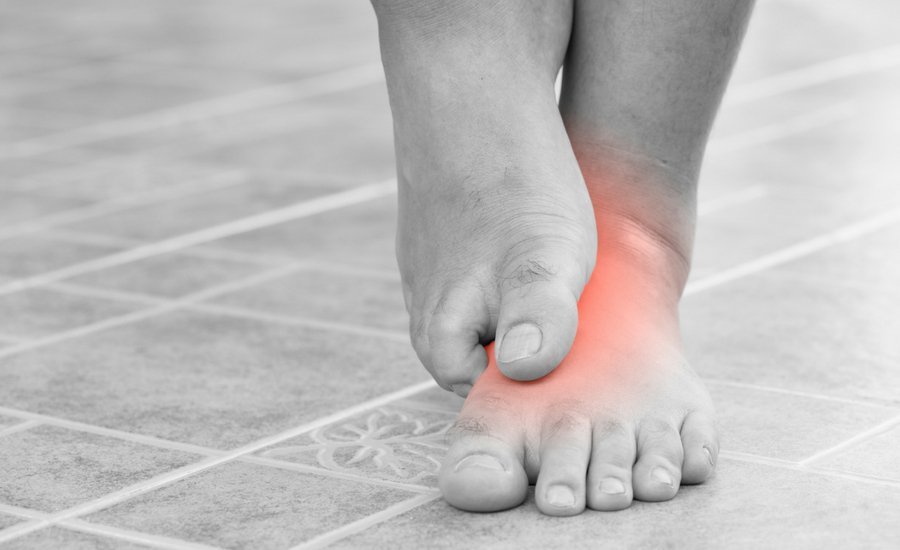
Easing Peripheral Neuropathy
Peripheral neuropathy is a condition that affects and damages the nerves of the peripheral nervous system, causing them to malfunction.
Symptoms of peripheral neuropathy may range from mild to severe, depending on the type of the affected nerves, as well as the gravity of the damage.
Sometimes, the symptoms occur suddenly, but in most cases, the symptoms develop gradually over a longer period.
INCLUDES Exercises for Peripheral NEUROPATHY
Over the years, having helped many patients with peripheral neuropathy experience relief from their symptoms, I have witnessed how uncomfortable this condition can be, and I want to do my bit in helping bring relief to as many as I can.
I have written this in-depth article to help bring you a better understanding of peripheral neuropathy and what you can do to ease the uncomfortable symptoms that come along with it.
I have also included an exercise program in video and pictures that you can follow to help you improve your strength and flexibility, relax your body and muscles and help reduce the symptoms.
So, let’s get into it!
This article covers the following:
WHAT IS PERIPHERAL NEUROPATHY?
Peripheral neuropathy is a condition that affects and damages the nerves of the peripheral nervous system, causing them to malfunction.
To understand this condition a little better, we’ll need to get a grasp on the function of the nervous system, and more specifically, the peripheral nervous system itself.
The nervous system of our body is made up of two major components, both the central nervous system (CNS) and the peripheral nervous system (PNS).
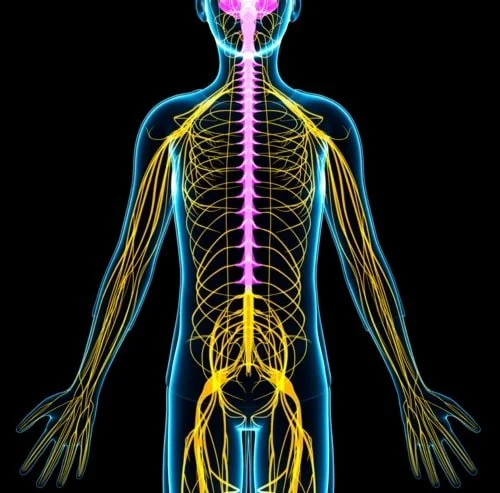
The central nervous system comprises the brain and the spinal cord. This part of the nervous system is the processing centre of the body.
It controls both our body’s voluntary functions (functions we consciously control) and involuntary functions (automatic functions). The CNS is responsible for interpreting information from the PNS and responding to this information.
The peripheral nervous system on the other hand, is a complex network of nerves that connects your brain and spinal cord to, as you might have guessed from the name, the peripheral areas of your body. It’s the parts of the nervous system outside the brain and spinal cord.
To put it simply, the peripheral nervous system allows your brain and spinal cord (the CNS) to communicate with your body parts (your limbs, skin, muscles, and internal organs). It communicates to your CNS, for example letting your brain know you’ve touched something hot. And it also carries messages from the CNS to different parts of your body (E.G. moving your hand off the hot item).
In the case of peripheral neuropathy, the nerves outside your brain and spinal cord are damaged leading to unpleasant symptoms usually in the lower legs and feet, or the hands.
TYPES OF PERIPHERAL NEUROPATHY
There are different kinds of peripheral neuropathy and they’re generally categorised based on the number of affected nerves. As such, we recognise mononeuropathy and polyneuropathy.
Mononeuropathy is a type of neuropathy that affects only a single peripheral nerve. The most common cause of mononeuropathy is physical injury to the affected area or prolonged pressure on the specific nerve. Mononeuropathy is often observed in patients who lead an overly sedentary lifestyle or are involved in activities that cause repetitive motions in specific areas of the body.

One such example is carpal tunnel syndrome. This condition is caused by prolonged pressure on the nerve which passes through the wrists and ends in the hands. People who work office jobs or assembly lines in factories are often affected due to the overuse of their wrists. This condition is characterised by numbness, tingling, and pain in the hands, usually in the first three fingers starting from the thumb.
Polyneuropathy, on the other hand, is a type of neuropathy that affects multiple peripheral nerves at once. Most of the cases of peripheral neuropathy are, in fact, polyneuropathies. The condition results in weakness, numbness, and burning pain, which usually starts in the hands and feet and often progresses throughout the body, affecting other areas as well.
Polyneuropathy occurs due to a multitude of reasons, although the most common form of polyneuropathy is diabetic neuropathy, generally observed in patients suffering from diabetes or those with irregular blood sugar levels.
The condition can be acute or chronic in nature.
Acute polyneuropathy is often a result of an infection or an autoimmune reaction. It occurs suddenly and poses a higher risk with more severe symptoms. Guillain-Barré syndrome is one of the most serious forms of acute polyneuropathy where the immune system attacks the nerves in the body. This disorder spreads quickly and if left untreated, it can lead to permanent damage and even paralysis.
Chronic polyneuropathy is when the neuropathy is longer lasting and is generally difficult to treat. There are different causes of this condition and some are a direct result of underlying disorders such as diabetes.
SYMPTOMS OF PERIPHERAL NEUROPATHY
Symptoms of peripheral neuropathy may range from mild to severe, depending on the type of the affected nerves, as well as the gravity of the damage.
Sometimes, the symptoms occur suddenly, but in most cases, the symptoms develop gradually over a longer period.
In certain cases, symptoms may go away on their own, without any intervention. Other cases may require medical attention, but it’s important to keep in mind that treatments are available and can greatly alleviate the symptoms of these disorders.
The symptoms of peripheral neuropathy can vary and depend on the type of damaged nerves. These types can be motor, autonomic, and sensory nerves.
Motor Nerves
Motor nerves are in charge of the muscle movements in the body. They control how we walk, how we talk and when we undertake certain actions, like holding a cup of coffee. When your motor nerves are affected you may experience symptoms such as muscle loss (atrophy), muscle weakness and spasms, coordination loss and falling. Loss of reflexes, difficulty moving your arms and legs or paralysis.
Autonomic Nerves
These nerves are responsible for bodily functions that people can't control consciously. This includes breathing, digestion, bladder function, as well as heart rate. Damaged autonomic nerves can result in nausea, vomiting, sweating, dizziness, abnormal heartbeat, as well as gastrointestinal issues.
Sensory Nerves
When you get a paper cut or burn your mouth with some scolding coffee, it’s your sensory nerves that are alerting the brain of these sensations. If the peripheral neuropathy has damaged your sensory nerves, you may experience either a heightened or a decreased sensitivity to touch. Burning, sharp or throbbing pains. Other symptoms include tingling and numbness, and decreased reflexes. Many people also report a feeling as if they are wearing tight gloves or socks.
Nerves have the responsibility to send signals to your brain. When those nerves are damaged, the signals may be interrupted or misinterpreted.
In some cases, your nerves may alert your brain of pain sensations that aren’t even there; similarly, they might not send the signals when the pain does occur.
Peripheral neuropathy can be caused by several factors and can often be a result of underlying conditions. It’s essential to determine the underlying causes to your neuropathy, as it’s important to treat the root of the problem, rather than just the symptoms.
COMMON CAUSES OF PERIPHERAL NEUROPATHY
Peripheral neuropathy isn’t caused by a single factor and it can be a result of different medical conditions, traumatic injuries, infections, alcoholism, and even certain medicines. By far the most common cause of peripheral neuropathy is diabetes.
Diabetic polyneuropathy is progressive nerve damage caused by type 1 and type 2 diabetes. Studies show that peripheral neuropathy affects nearly 50% of adults with diabetes. There is no available cure for diabetic neuropathy, but it is possible to slow the progression with certain lifestyle changes.
Aside from diabetes, several other health conditions can cause peripheral neuropathy. These conditions include:
Inherited disorders
Also called hereditary motor and sensory neuropathy, Charcot–Marie–Tooth disease (CMT) is a type of disorder that causes nerve damage, mostly in the arms and legs. It is known to be one of the most common inherited neurological disorders.
Bone marrow disorders
Certain conditions characterised by abnormal levels of protein in the blood are also known to cause peripheral neuropathy.
Autoimmune diseases
Guillain-Barre syndrome is one of the most severe types of peripheral neuropathy caused by an autoimmune disease.
Other medical conditions caused by an abnormal immune system response that are linked to neuropathy are Sjogren’s syndrome, rheumatoid arthritis, lupus, vasculitis, and chronic inflammatory demyelinating polyneuropathy (CIDP).
Infections
Peripheral neuropathy can also be a result of certain bacterial and viral infections. Lyme disease, leprosy, diphtheria, and HIV are some of the infections known to cause neuropathy.
Other diseases
Several other diseases such as kidney and liver disease, certain cancers, hypothyroidism, and connective tissue disorders are also linked to potential peripheral neuropathy.
Peripheral neuropathy can also be caused by other factors, such as:
Traumatic injuries
Physical injuries, including sports injuries, falls, automobile accidents, or complications during surgery are some of the most common causes of mononeuropathy. Such injuries can compress and stretch the nerves, or even cause them to detach from the spinal cord.
Medications
Peripheral neuropathy sometimes occurs as a side effect of certain medications. Research suggests that drug-induced peripheral neuropathy is commonly observed in chemotherapeutic agents, antimicrobials, cardiovascular drugs, psychotropic, and anticonvulsant drugs.
Toxins
Prolonged exposure to poisons and toxic substances such as lead, arsenic, thallium, and mercury can also cause neuropathy.
Vitamin deficiencies
Vitamins play a big role in regulating our nervous system. A deficiency in certain vitamins, (especially B vitamins) have been linked to a higher risk of peripheral neuropathy.
Certain studies show that patients undergoing bariatric surgery should especially pay attention to possible deficiencies in their systems.
Alcoholism
Excessive alcohol usage is also associated with neuropathy due to several risk factors.
Research shows that thiamin deficiency, malnutrition, and direct alcohol toxicity could be the main reasons behind alcoholic neuropathy.
Sometimes it’s not possible to determine the exact cause of peripheral neuropathy. When this happens, it is called idiopathic neuropathy.
TREATMENT OPTIONS FOR PERIPHERAL NEUROPATHY
Now that we’ve explained what peripheral neuropathy is, how it develops and the way it manifests itself, you’re probably wondering - is it treatable?
Unfortunately, there isn’t an easy answer to this question. Certain types of peripheral neuropathy can be effectively treated and even reversed in some cases.
This is especially true when it comes to neuropathy caused by alcoholism, vitamin deficiency, toxins, and certain medications. Implementing certain lifestyle changes can significantly improve the chances of recovery.
Of course, this isn’t always possible.
The good news is that our nerves (have amazing regenerative abilities, meaning, they are able to heal themselves. However, there is a limit to this power, and sometimes, if the damage is too severe, the nerves aren’t able to fully repair themselves. When this happens, it’s possible to slow down the progression of the disorder, but not completely reverse it.
The earlier you manage to diagnose your condition and seek treatment, the better chance you’ll have at recovery, however, the body is capable of many miraculous things, so always, I repeat…. always, remain hopeful.
Treatments for peripheral neuropathy depends on the cause of the condition. Some types of neuropathy may require medical intervention like surgery or injections, while others can be effectively treated through physical therapy and lifestyle modifications.
MEDICAL TREATMENTS
Surgery
Peripheral neuropathy caused by physical injury or nerve compression often requires surgical treatments. These procedures are called nerve decompression surgeries and their aim is to relieve the pressure caused by a pinched or entrapped nerve. This type of surgery is not overly invasive and is believed to be successful in 80% to 90% of cases.
Therapy
Several therapies can help ease the symptoms of neuropathy.
Physical therapy aims at treatments to reduce symptoms and improve muscle strength and mobility issues.
However, other, therapies like transcutaneous electrical nerve stimulation (TENS) plasma exchange (PE) and intravenous immune globulin (IVIg) have also proven to be effective tools for relieving the symptoms and signs of neuropathy.
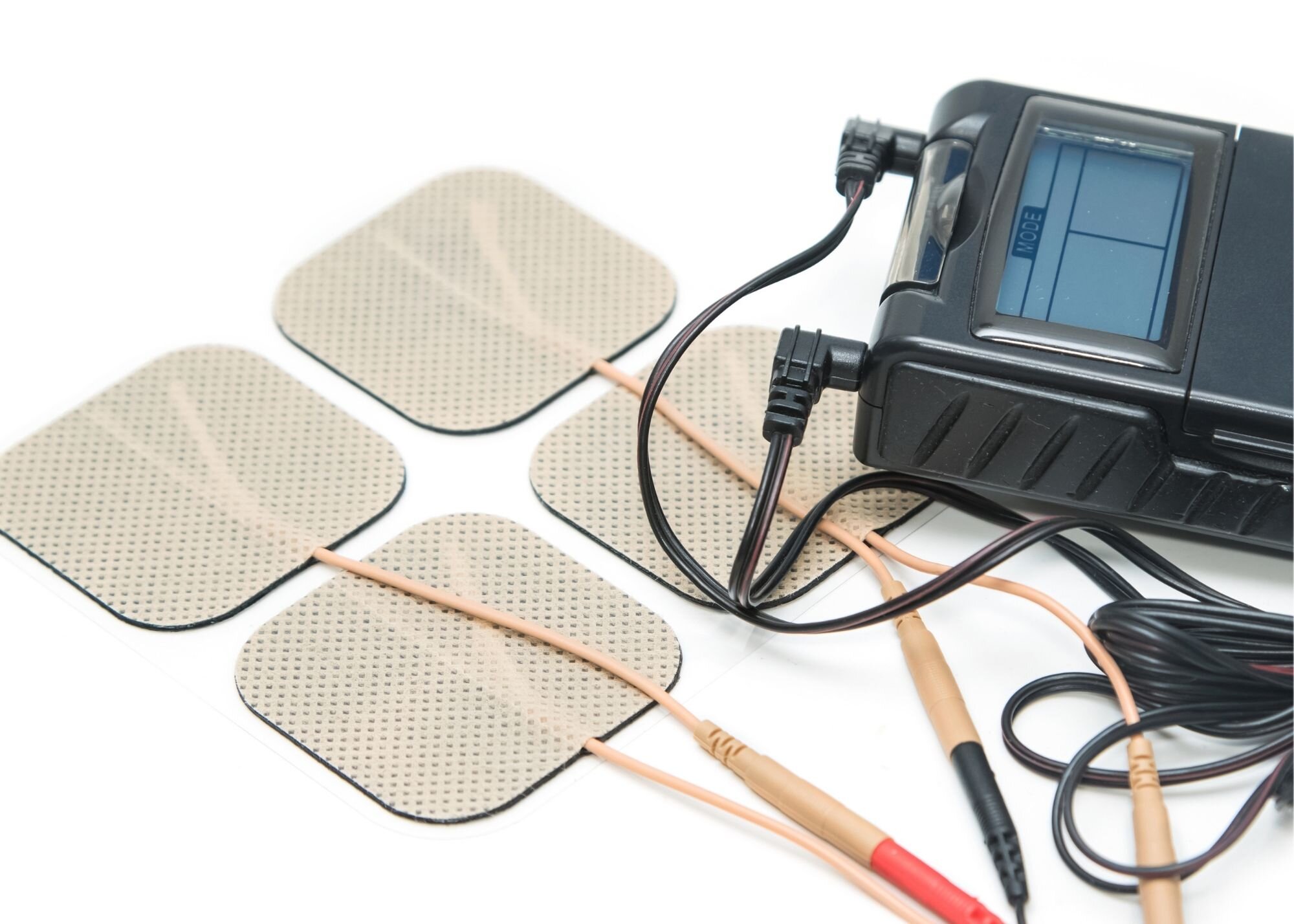
TENS unit.
TENS therapy relies on electrical currents to stimulate the nerves. Studies show that TENS therapy can significantly decrease pain in patients suffering from neuropathy as well as other painful conditions. These devices are small units that can be self-administered and are not difficult to use. TENS units can be easily purchased online. I recommend you see your Doctor or Physiotherapist to determine if a TENS unit is suitable for you and they can also help show you how to use it appropriately
Medication
Easing the symptoms of peripheral neuropathy can also be achieved through the use of certain medications. Depending on the severity of the symptoms, your doctor may prescribe pain relievers, anti-seizure medications, and even antidepressants.
NATURAL TREATMENTS
Quitting Harmful Habits
The first step in improving your health and the symptoms associated with peripheral neuropathy is minimising exposure to, or stopping, substances that can be causing harm to your health.
We all know the damage smoking does to our health and it can limit the blood flow to your nerve cells, impairing your blood circulation in the process.
Additionally, alcohol abuse is linked to nerve damage and can even cause permanent disability in some cases.
The first step towards a successful recovery starts with making small, but effective modifications that can change your life for the better.
If this is an issue for you, speak to your doctor about the options you have available for this.
Diet
Get your Diet right! Start eating healthier.
Move away from processed food and do your best to start eating the best quality natural foods.
Eat foods that are high in nutrients and decrease or cut out anything that can be detrimental to your health.
This will help decrease the inflammation in your body and ensure you are getting all nutrients you need to support good health.(For more on healthy eating, check out more of my healthy eating articles HERE)
As mentioned earlier, certain types of neuropathy are directly caused by vitamin deficiencies, particularly certain vitamin B deficiency (mainly vitamin B-12).
Meat and dairy products are some of the best sources of B vitamins, which is why those following a plant-based diet are commonly at risk for deficiency.
It is possible to increase the intake of B vitamins through supplements, although it is necessary to consult with your doctor first to determine the right dosage and it is always best to get your nutrients from real food and only supplement if necessary.
Relaxation Technique
Anxiety, depression, chronic stress and worry all lead to a sensitised nervous system.
When you’re in a state of chronic stress (even mild) you are going to experience more pain and other symptoms.
Make lowering stress a priority in your life. When we are more relaxed, our nervous system is less sensitive, and symptoms will be reduced.
Lowering stress is a very important step towards recovery not only with peripheral neuropathy symptoms but your health in general, which is why it’s crucial to find a suitable way to decrease your stress levels.
Several techniques have proven to be effective in relieving stress and also pain caused by neuropathy.
Most of these methods rely on a body-mind connection, allowing you to ease symptoms of pain, but also help you cope with the condition.
Meditation, is very effective in reducing symptoms in not only peripheral neuropathy but also many other painful conditions.
Desensitisation Techniques
When sensation is increased in the hands or feet a light massage with moisturiser or cream of your choice can help reduce the symptoms.
Not only is massage good for sensitivity it will reduce pain, improve balance and improve range of motion also.
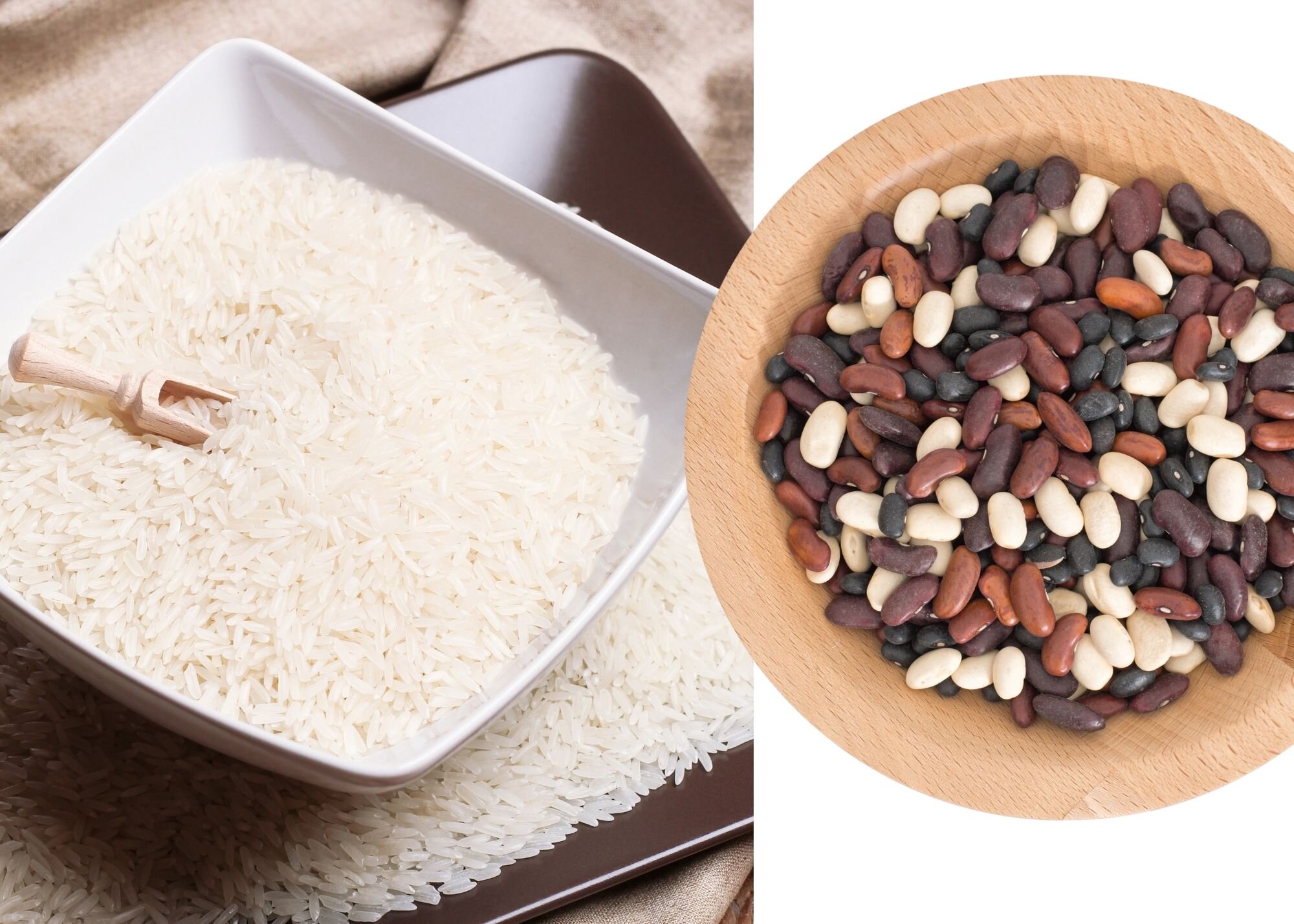
Another technique that may sound a bit crazy but is used frequently by Physiotherapists (which you can do yourself), is gently moving your hands or feet in a bucket of dry rice or dry beans. The texture of these items stimulates the nervous system and calms down the nerves.
Acupuncture
Another type of alternative medicine that relies on stimulating pressure points on the body. Through stimulation of the nervous system, the body releases endorphins, which act as natural painkillers.
Although not many people believe in the effectiveness of this technique, certain studies have confirmed the successfulness of acupuncture in treating neuropathic pain.
Exercise
Increasing activity levels can help combat the symptoms of neuropathy.
Regular exercise is beneficial for blood sugar control, as well as stress relief, both of which can greatly improve neuropathic pain.
Multiple studies have confirmed that routine exercise can prevent, and in some cases delay, the onset of neuropathic symptoms.
In the next section, we’ll go through some helpful exercises for peripheral neuropathy in some of the following chapters.
EXERCISE TO IMPROVE PERIPHERAL NEUROPATHY SYMPTOMS
Dealing with neuropathic pain can be uncomfortable, to say the least. When you’re dealing with these symptoms, exercise may feel like the last thing you feel like doing. And that’s ok. Sometimes you will just have to wait for symptoms to ease. However, maintaining a regular exercise schedule will do a great deal in managing and improving neuropathy symptoms.
It’s necessary to consult with your doctor before starting any type of exercise, and it is highly recommended you see a Physiotherapist to get a full assessment and an individualised exercise plan for you.
When exercising, if you notice that certain activities make your pain and symptoms worse, you should communicate this with your doctor or Physiotherapist.
Easing the symptoms of neuropathy can be achieved through an exercise program including aerobic exercise, exercises for flexibility and joint range of motion, balance and strengthening exercises, and exercises for pain management.
Aerobic exercises
Walking, swimming or cycling are some examples of great light aerobic exercises that can help you with neuropathic pain.
Undertaking aerobic exercises three times a week will improve your blood flow, work your muscles, and increase your heart and breathing rate. Improved fitness will help with pain and other symptoms.
Aim for 20-30 minutes of aerobic exercise per day. Always work your way up to this amount. Start with a few days per week at a smaller time frame and gradually building your way up.

If you’re able, a great place to go walking is on a beach or on soft grass. Being out in nature combined with the different textures of the sand or grass on your feet will help with symptoms whilst also getting the additional benefits of walking.
Stretching exercises
Flexibility exercises can help keep your joints flexible, which can, in return, improve your balance and minimise the risk of falls.
These types of exercises are also instrumental in preventing injuries during other activities. Incorporating static and dynamic stretches into your workout routines is the best way to ensure a safe and successful exercise outcome.
Balance exercises
Muscle weakness and numbness are common symptoms of peripheral neuropathy. This can greatly interfere with everyday life and can cause issues with balance and coordination.
Balancing exercises can help you improve your balance and proprioception and by doing this decrease your falls risk.
SPECIFIC EXERCISES FOR PERIPHERAL NEUROPATHY
The exercises below can help reduce your neuropathy symptoms by moving the area, improving blood flow to the area and relaxing the area.
Additionally, when range of motion/flexibility and strength are improved - pain and other symptoms (numbness/tingling etc.) will be reduced.
In the below exercises, we start with lower repetitions to ensure symptoms are not aggravated. Stay patient, and work your way up to more repetitions and sets over time.
WE START WITH LOWER REPETITIONS TO ENSURE WE DO NOT AGGRAVATE SYMPTOMS. STAY PATIENT.
SEATED PERIPHERAL NEUROPATHY EXERCISES FOR THE LOWER LEGS AND FEET.
TOE RAISES
Toe Raise Exercise
How To:
Place your feet flat on the floor.
Whilst the balls of your foot remains on the floor throughout, gently lift up your toes.
Hold for a few seconds and lower back to the ground.
Repeat for 5 Repetitions.
TOE SPLAYS
Toe Splays - Spreading Toes Apart - (I am not a good toe splayer :)
How To:
Place your feet flat on the floor
Now do your best to splay your toes (moving them apart).
Hold for a few seconds and relax your toes again.
Repeat for 5 repetitions.
TOE RAISES
Toes Raises
How To:
Place your feet flat on the floor.
Whilst only the heels of your foot remain on the floor throughout, gently lift up your toes and the rest of your foot.
Hold for a few seconds and lower back to the ground.
Repeat for 5 Repetitions.
HEEL RAISES
Heel Raises
ANKLE PUMPS
How To:
Place your feet flat on the floor.
Whilst only the balls of your feet and toes remain on the floor throughout, gently lift up your heels, and the rest of your foot.
Hold for a few seconds and lower back to the ground.
Repeat for 5 Repetitions.

Ankle Pumps
How To:
Sitting in your chair.
Pull your toes up toward you.
Now point your toes away from you.
Repeat for time/set repetitions.
KNEE EXTENSIONS

Knee Extensions
How To:
Sitting up tall with your shoulders back and down.
Lifting one leg up, extend at the knee.
Hold briefly at the top of the movement, squeezing the muscles at the front of the thigh before lowering your leg back down.
Ensure the movement is slow and controlled.
Repeat for 5 repetitions and repeat on the opposite leg.
SEATED HAMSTRING STRETCH
Hamstring Stretch
How To:
Shuffle to the front of your chair, place one leg in front of you, and sit up tall.
Now keep your leg straight and point your toes towards the ceiling
Ensure you remain upright with a straight back and lean slightly forward at the hips until you can feel a stretch in the back of your legs.
Hold for the set time and change legs.
SEATED CALF STRETCH (WiTH TOWEL)
Seated Calf Stretch
How To:
Shuffle to the front of your chair, place one leg in front of you, and sit up tall.
Now keep your leg straight and point your toes towards the ceiling.
Using a rolled-up towel, wrap the towel around the ball of your foot just below your toes.
Gently pull the towel towards you, allowing your foot to bend up slowly towards you. Keep your leg straight. You should feel a slight stretching feeling in the back of your lower leg.
Hold for the set time and change legs.
SEATED SOLEUS STRETCH (WITH TOWEL)
Seated Soleus Stretch
How To:
Shuffle to the front of your chair, place one leg in front of you, and sit up tall.
Now with a bend in your leg, point your toes towards the ceiling.
Using a rolled-up towel, wrap the towel around the ball of your foot just below your toes.
Gently pull the towel towards you, allowing your foot to bend up slowly towards you. You should feel a slight stretching feeling in the back of your lower leg.
Hold for the set time and change legs.
DESENSITISATION MASSAGE WITH MASSAGE BALL OR TENNIS BALL


Self Foot Massage
How To:
Place a massage ball (click here to purchase) or a tennis ball on the floor and whilst seated in a chair gently rub the sole of your foot over the ball. Make sure you get all areas.
This will help massage the foot muscles and stimulate the nervous system, calming the nerves.
Do this for 1-5 minutes and you can repeat this during the day.
STANDING PERIPHERAL NEUROPATHY EXERCISES FOR THE LOWER LEGS AND FEET.
CALF RAISES

Calf Raises
How To:
Stand up tall with your feet about hip-width apart.
Keep your knees straight and hold onto the chair with both hands.
Come up onto the toes, raise your heels up off the floor, hold briefly and slowly lower yourself back down.
Repeat for 5 repetitions.
TOE RAISES

Heel Raises
How To:
Stand up tall with your feet about hip-width apart.
Keep your knees straight and hold onto the chair with both hands.
Come up onto the heels, raise your toes up off the floor, hold briefly and slowly lower yourself back down.
Repeat for 5 repetitions.
HIP EXTENSIONS

How To:
Place both hands on your chair and stand up tall.
Keep your legs straight, slowly bring your leg back behind you, hold briefly and then bring your leg back to the start position.
Repeat for 5 repetitions and change legs.
HIP ABDUCTIONS

Hip Abductions
How To:
Stand tall holding on to your chair.
Slowly bring your leg out to the side and in a controlled motion bring your feet back together.
Ensure you keep your toes facing the front throughout this exercise.
Repeat for 5 repetitions and change legs.
KNEE FLEXIONS

Knee Flexion
How To:
Stand up tall, holding onto your chair.
Bend your leg at the knee, lifting your foot up towards your buttocks, to about 90 degrees, hold briefly and return your foot back to the start position.
Repeat for 5 repetitions and do the same on the opposite leg.
STANDING CALF STRETCH

Calf Stretch
How To:
Stand up tall, holding on to your chair with both hands.
Step one foot back, ensuring your toes are facing forward throughout the exercise.
Now bring your front knee towards the chair ensuring that your heels remain in contact with the floor at all times.
Hold this position for 30-60 seconds and change legs.
BALANCE - SEMI TANDEM STANCE, TANDEM STANCE OR SINGLE-LEG STANCE

Single Leg Stance Balance
How To:
Standing next to a chair for safety and stability.
Stand on one leg.
Hold this position for 30-60 seconds.
If you need to you can hold on with one or two hands on the chair.
You can make this exercise a little easier by standing in a semi-tandem or tandem stance position. Click here for balance positions.
Aim to increase your time in this position, without coming out of position, over time.
Relaxation - of the body - 2 Minutes
Spend at least two minutes a day focusing on relaxing your body. Sitting in silence. You can find relaxation videos in the app store on your phone or on YouTube. Also at the end of the video below, we go through a short relaxation sequence.
PERIPHERAL NEUROPATHY EXERCISE VIDEO FOR THE FEET & LEGS
A video you can follow to help with symptoms of peripheral neuropathy.
In this video, we go through seated and standing exercises including range of motion/flexibility/movement for pain relief, strengthening and balance. Plus it also covers self-massage/desensitisation and relaxation.
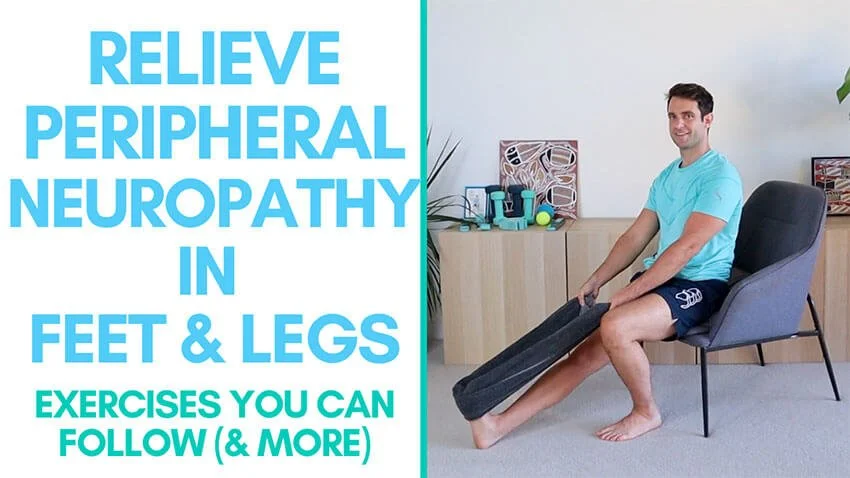
Exercises for neuropathy in feet and legs
PERIPHERAL NEUROPATHY EXERCISES FOR THE HANDS & ARMS

Exercises for neuropathy in hands and arms
MANAGING PERIPHERAL NEUROPATHY - TAKING PRECAUTIONS AT HOME
Peripheral neuropathy can have a great impact on your everyday life.
If you are suffering from this condition you are at a greater risk of accidents and injuries, when undertaking daily tasks.
There are certain precautions you can take to make your life safer while undergoing possible treatments for your condition.
Stop smoking and drinking alcohol, cut out unhealthy foods, and reduce stress.
Stay Active. You might be inclined to limit your activity levels due to muscle weakness and pain, but it’s important to keep active (without overdoing it). Aim to get moving more.
If symptoms of peripheral neuropathy are affecting your mobility and/or balance make sure you speak to your doctor or see a Physiotherapist so appropriate measures can be taken. You may need a walking aid.
If your balance is affected when walking, make sure to take your walking aid with you to reduce your risk of falls
Make sure to clear the paths around your house, to avoid tripping.
Wear well-fitted shoes at all times to help protect your feet from any injury, and make sure to regularly check your feet for cuts or sores that you may not have felt, especially after walking barefoot.
Take good care of your feet, trim your nails and see your Podiatrist as needed.
Avoid prolonged pressure on areas with nerve damage.
Keep your skin in good condition with a good moisturiser.
Shower and bath with caution. Avoid slips and falls by installing handrails in your bathroom and adding a non-slip mat on your bathroom floor. If you have a decreased sensitivity to touch, be careful when adjusting the water temperature when showering. Use your elbow to check the bathwater temperature before getting in.
Cook with caution. Again, if you have decreased sensitivity to touch, be mindful when dealing with hot objects in the kitchen at all times.
Pain and other symptoms associated with peripheral neuropathy are usually worse in colder climates. Keeping your hands and feet warm with a good set of gloves and socks can help reduce pain symptoms.

Easy And Delicious Beetroot Dip For A Healthy Snack
Here is an easy beetroot dip recipe that you can use as a condiment, as a snack with veggies or crackers or as a spread on a sandwich or toast. I hope you enjoy it.
Easy and Delicious Beetroot Dip Recipe
For those new to the group, I’m Mike’s sister, Lexie. I’ve been helping Mike over the years with More Life Health and this year, with my youngest having started school, I have a bit more time on my hands so you will see me here more often.
At the end of last year, Mike wrote a fantastic article on blood pressure, “Everything you need to know about Hypertension”. (You can find it here: EVERYTHING YOU NEED TO KNOW ABOUT HYPERTENSION)
For those who have read it, you may recall the one vegetable that stood out among all for its effects in helping to reduce blood pressure and that is the humble beetroot. Well today, I want to share with you some ways to add more beetroot to your diet…
Roasted- Beetroot is wonderful when roasted. Cut it up and add some to your other veggies next time you have a roast dinner.
In salads- Simply grate it and add it to your salad for vibrant colour and added nutrients.
In Spaghetti Bolognese- I know it’s going against tradition, but beetroot adds a delicious sweetness to Spaghetti Bolognese. Simply grate it (I usually use about 1 cup for a serving for 4 people) and add it when you add your tomato passata.
As a snack, condiment or spread- Here is an easy beetroot dip recipe that you can use as a condiment, as a snack with veggies or crackers or as a spread on a sandwich or toast. I hope you enjoy it.
Do you eat beetroot? What are some ways you enjoy eating it?
Lexie

Inspiring Seniors Health Stories: David’s Story - Avoiding Diabetes - Pre-Diabetic No More
Today I wanted to share with you an email I received from a reader/viewer, David.
David shares how with after his doctor telling him he is borderline diabetic he took charge of his health and fitness and is no longer a pre-diabetic: Enjoy!
“Thanks Mike for forwarding this new exercise program. I have included it in my list of favourites and I shall try it shortly. I already have quite a substantial list of your programs. I use a lot of them on a weekly basis, and I admit that I have quite benefited from many of them. I try to target the ones that help me the most.
I am now 80 years young. Several months ago, my doctor advised me that I had become a borderline diabetic. I was in shock because I had always been in relatively good shape for most of my life. I was blindsided by atrial fibrillations in my mid fifties. The condition was brought under control with meds for a time. I eventually had to be fitted with a pacemaker. that was implanted in 2013. This was a very welcomed procedure, as it then allowed me to resume almost normal daily activities.
When my doctor warned me about the possible nasty effects of full-blown diabetes, he added that with proper "behavior" I could stop it's onset. I told him to be blunt by suggesting a life change that would prevent the necessity of being on meds. Well, he was blunt. He said that I must make a serious effort to reduce my sugar intake, and to get off my "butt", and start doing some serious exercising to reduce my weight and keep it under control.
I started researching the web to find suitable exercises, only to discover that most programs were aimed at body builders. At my age, I had no intention of pursuing programs to develop the "body beautiful". I then stumbled on your site, and immediately started to get serious about becoming healthier so as not to disappoint my doctor. I also embarked on a walking program. Within a few weeks, I was able to walk up to 10 or 12 kilometers per day for five days per week on trails that consisted of hills and stairways. After 6 months my weight had decreased from 172lbs to 150. Subsequent tests revealed that my pre diabetic condition had disappeared.
Thank you, Mike, for helping me save my "butt". I have recommended your programs to some of my "elderly" friends who have found them quite beneficial.
Aside from physical activities, I have also embarked on "mind" stretching programs, to improve mental alertness. I am fluent in French (my mother tongue) and English, and I am starting to learn a third language. I have opted for Italian as it is very close to the French language. I remember a bit of German that I learned in my youth, and some Latin. I have always been an avid reader. I still read both French and English books for two to three hours per day. The reason I mention this, is that mental and physical alertness should go hand in hand.
Thanks again Mike. You have been most helpful.
Sincerely,
Dave”

Pelvic Floor Health And Exercises For Over 60s: A Complete Guide
Disorders of the pelvic floor, for both women and men, can range from pain, to more embarrassing issues such as inability to control the bladder and/or the bowel (known as incontinence).
Pelvic floor problems do become more common with ageing, however, just like many other problems (such as loss of balance, loss of strength, or falls) pelvic floor issues are also NOT a normal part of ageing.
There are many simple things that can be done to avoid any issues and keep your pelvic floor functioning at its best.
INCLUDES Exercises For The Pelvic Floor
If you’re a woman, you’ve most probably heard of the pelvic floor and know the importance of this area. You may have even been doing pelvic floor exercises for some time now.
If you’re a man, with pelvic floor issues more commonly affecting women, odds are you most probably haven’t heard too much about this before.
Women have a greater need to know of the pelvic floor as womenexperience a lot of stress and changes to the pelvic region throughout their life - during pregnancy, childbirth and menopause, and therefore more susceptibility to pelvic floor issues that need addressing.
However, men too have a pelvic floor and can experience pelvic floor issues as well, usually after surgery to this region.
Disorders of the pelvic floor for both women and men can range from pain to more embarrassing issues such as the inability to control the bladder and the bowel (known as incontinence).
Pelvic floor problems do become more common with ageing, however, just like many other issues (such as loss of balance, loss of strength, or falls) pelvic floor issues are NOT a normal part of ageing.
There are many simple things you can do to avoid any issues and help get your pelvic floor strong and functioning at its best.
In this article, we will cover everything about the pelvic floor, including - for those still wondering - what and where the pelvic floor is.
We’ll explain what happens to the pelvic floor as we get older and go into detail on the common dysfunctions that can occur in this area.
We’ll also introduce some essential exercises to help strengthen the pelvic floor muscles (for both women and men) and look at what you can do to keep this area functioning well so you can go about your days confidently.
Ready? Now let’s get started!
WHAT’S COVERED IN THIS ARTICLE:
WHAT IS THE PELVIC FLOOR
The pelvic floor (sometimes known as the pelvic diaphragm) is a group of muscles located underneath the pelvis that extend around the tailbone to the front of the pelvis (the pubic bone).
The pelvic floor muscles are generally firm and thick.
Although both men and women have a pelvic floor, a woman’s pelvic cavity is much larger than a man’s, as it needs to make room for the birth canal.
In women, the pelvic floor supports the small intestine, large intestine (colon and rectum), the uterus and the bladder.
Images: Women’s Pelvis - Pelvic Floor Muscles & Pelvic Organs
In men, the pelvic floor supports the pelvic organs, including the bladder, prostate, rectum, and seminal vesicles.
Image: Men’s Pelvis - Pelvic Floor Muscles & Pelvic Organs
So, what does the pelvic floor do?
The pelvic floor is a vital part of the human body, and it has a few essential functions:
It provides support for the abdominal and pelvic organs (bladder, rectum, uterus/prostate)
It controls the bladder and bowel movements
It maintains the optimal intra-abdominal pressure
It facilitates birth
PELVIC FLOOR DYSFUNCTIONS: WHAT CAN HAPPEN TO THE PELVIC FLOOR
The human body is a beautiful creation. The way we move, speak, eat, and even breathe is controlled by the ever so intricate muscular system.
We can control most of the muscle movements of our body - but not all.
The muscle groups that are under our conscious control are called voluntary muscles. Whilst those we do not have conscious control of are called involuntary muscles.
Although the pelvic floor is a part of the body we don't see and is very small, they are voluntary muscles. Meaning, we can control (and train) our pelvic floor just like our leg or arm muscles, for example.
When you are unable to control (or coordinate) the muscles of your pelvic floor, this is known as pelvic floor dysfunction.
Pelvic floor dysfunction manifests itself in several ways. Some of the symptoms include urinary or faecal issues, bowel strains or constipation, pain, as well as muscle spasms and pressure in the pelvic region.
Some women also experience extreme discomfort during sexual intercourse. For men, on the other hand, prostate problems and erectile dysfunction are some of the more common issues caused by a weakened pelvic floor and is most of the time due to surgery in the area.
Although the exact causes of pelvic floor dysfunction are still undetermined, many factors are known to weaken the muscles of the pelvic floor. Some of these include advancing age, obesity, pregnancy and childbirth, overuse of pelvic muscles (common in those with constipation), menopause, as well as injury to the pelvic region (E.G. a vehicle accident).
Another common risk factor is prostate surgery. Many men who undergo radiation therapy or surgery for prostate cancer have weakened pelvic floor muscles as a result of these treatments. It’s a common side-effect, but, as with many of these conditions, it can be effectively treated.
While pelvic floor disorders can affect people of all ages, it’s necessary to differentiate between conditions that affect the younger population and the problems that are more common in older age.
Our pelvic floor muscles are the strongest somewhere around our 20s, after which the muscles start to deteriorate.
In some instances, pelvic problems experienced in older age may be a result of conditions that occurred years before, usually from vaginal childbirth delivery.
Studies show that pelvic organ prolapse and urinary incontinence occur in almost half of all women who have given birth.
Women who have gone through pregnancy may experience pelvic problems around the time of birth, but the issues could manifest even later in life.
Let’s now look at pelvic floor issues commonly affecting those over 60.
The most common pelvic floor issues in seniors
OVERACTIVE BLADDER
An overactive bladder occurs when the muscles of the bladder contract involuntarily. The involuntary contractions cause a sudden and frequent need to urinate.
This urge to urinate can be generally difficult to keep under control.
One who experiences this has the feeling to urinate many times during the day and may also find themselves waking up in the middle of the night (one or more times) to urinate due to the increased urge. This need to urinate at night is known as nocturia.
Some medications and medical treatments may alleviate the symptoms of an overactive bladder. However, nerve stimulation and pelvic floor exercises (which we will cover later in this article) have also proven to be effective treatments for this condition.
URINARY INCONTINENCE
Loss of control over the urinary muscles is called urinary incontinence and is when urine leaks involuntarily.
This condition is one of the most common pelvic problems that affect seniors.
There are different types of urinary incontinence:
Stress incontinence is when the urine leaks out when the pressure increases in the abdominal area, pushing on the bladder - usually when laughing, sneezing or coughing.
It can also happen as a result of sudden movement or certain activities such as running, lifting weights or jumping.
Urge incontinence is another type of urinary incontinence and causes the urine to leak out just as the person experiences the need to urinate.
Other types include overflow incontinence or the inability to completely empty the bladder after urination, and functional incontinence, which is when the urine escapes before the person can reach the bathroom. Often due to mobility issues.
Finally, as the name suggests, mixed incontinence is a combination of the types mentioned above.
There are a variety of management options and treatments available for urinary incontinence, and they depend on the severity and type of condition, as well as its underlying cause.
Some solutions come in the form of behavioural training and pelvic strengthening exercises, while others may include medical devices and surgical procedures.
URINARY RETENTION
Urinary retention is a condition where one has a frequent need to urinate, but despite this are unable to empty the bladder fully.
Unlike the majority of pelvic floor disorders, urinary retention is much more prevalent in men than in women.
Research shows that urinary retention is ten times more common in males, especially those over the age of 60.
There are two distinct types of urinary retention: acute and chronic.
Chronic urinary retention occurs gradually and can span over the years. This type of urinary retention is usually a result of muscle or neurological damage.
Chronic urinary retention can go undetected for a long time but can cause complications in the long run.
Those who experience additional symptoms such as pain in the lower abdomen, discomfort, urge incontinence, or difficulty controlling their bladder should see their doctor as soon as possible.
Acute urinary retention, on the other hand, happens suddenly and can be extremely dangerous. It is when a person feels the urge but cannot urinate at all. This condition can cause a great deal of pain and should be addressed immediately.
FAECAL INCONTINENCE
Also known as bowel incontinence, faecal incontinence is a condition where a person cannot control their bowel movements, resulting in faecal matter leaking involuntarily from the rectum.
There are two different types of Faecal incontinence: urge and passive incontinence.
In the case of urge incontinence, people have a sudden need to use the bathroom, but when they suffer from passive incontinence, they might not be aware they need to use the facilities.
Faecal incontinence can manifest itself in several ways. The condition can go from sudden stool leaks while passing gas to complete loss of control over the bowel movements.
Bowel incontinence is not a life-threatening condition, but it can drastically affect quality of life. Studies show that faecal incontinence can have a profound impact on a person’s mental and emotional health, and those suffering from it may experience anxiety, shame, feelings of rejection and social isolation.
Depending on the exact cause and severity of the conditions, treatments include medication, dietary changes, exercise and therapy, as well as surgery.
CHRONIC CONSTIPATION
Chronic constipation is a gastrointestinal problem that affects between 2% and 34% of adults and is when one experiences infrequent bowel movements (fewer than three times a week).
Although multiple factors can cause the condition, the majority of those that suffer from chronic constipation also have pelvic floor dysfunction.
PELVIC ORGAN PROLAPSE
A condition commonly observed in women, pelvic organ prolapse occurs when the pelvic muscles are unable to support the organs of the pelvis (bladder, rectum, uterus, vagina, small bowel).
There are different types of pelvic organ prolapse, depending on which organ is affected.
One of the most common conditions by far is cystocele or the prolapse of the bladder into the vagina. A variety of factors can cause this condition, but most often is a result of childbirth, labour, and pregnancy.
While some women don’t experience any symptoms at all, others may have lower back pain, urinary problems, constipation, vaginal bleeding, as well as feelings of pressure in the pelvic area.
Although less common, pelvic organ prolapse can affect men as well. Usually as bladder or rectal prolapse.
Depending on the severity of the condition, your doctor may recommend different treatments, including pelvic strengthening exercises, mechanical treatments and in some cases, surgery.
SEXUAL DYSFUNCTION
Both men and women may experience sexual dysfunction as a result of pelvic floor dysfunction.
In women, symptoms of sexual dysfunction may range from reduced sex drive and reluctance to engage in sexual activities to experiencing pain during intercourse.
One study has examined the correlation between pelvic floor dysfunction and the quality of sexual life and found a significant decrease in women’s psychological, social, and sexual wellbeing.
Sexual dysfunction in men is often associated with erectile dysfunction, i.e. the inability to get or maintain an erection during sex.
In both cases, evidence suggests that physical therapy may be a valuable tool for treating the effects of sexual dysfunction.
Sexual rehabilitation is a combination of physical, pharmacological, and behavioural treatments.
Certain studies show that pelvic floor muscle exercises and biofeedback training are an effective treatment for those with erectile dysfunction.
CHRONIC PELVIC PAIN SYNDROME (CPPS)
Chronic pelvic pain syndrome is a condition characterised by long-term pain and discomfort in the pelvic region.

The condition can affect both men and women, although studies show that CPPS symptoms vary drastically between the two.
Women affected by this condition are said to have worse urinary symptoms, as well as an increased risk of systemic disorders, while men have a higher prevalence of infections (prostatitis).
In this condition, symptoms may come and go at different times.
Stress is often correlated to painful pelvic symptoms as the pelvic floor muscles contract in response to mental or physical stress.
Some form of therapy and medication has shown to be effective in treating chronic pelvic pain syndrome.
IMPROVING PELVIC FLOOR FUNCTION
CAN PELVIC FLOOR FUNCTION BE IMPROVED?
Although pelvic floor disorders are a common medical issue, it doesn’t mean you should accept them as a normal part of ageing.
With exercise, improved diet, and lifestyle changes, you can most definitely improve pelvic floor function!
We’ll now go through what you can do to ensure your pelvic floor is functioning at its best.
HOW TO STRENGTHEN THE PELVIC FLOOR
Strengthening the pelvic floor muscles are very important for various reasons, and even more so for older adults.
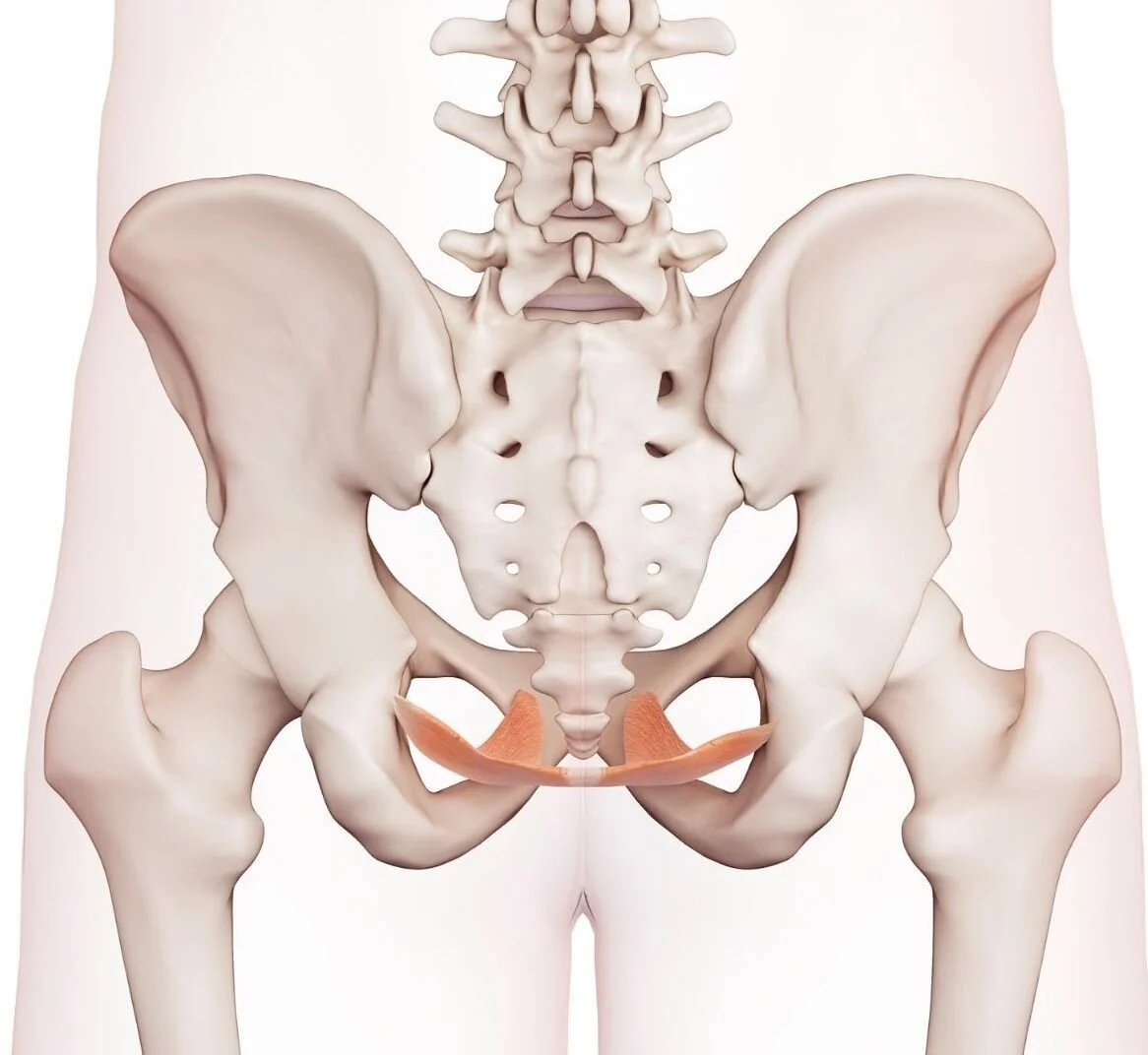
Rear View Pelvis - Pelvic Floor Muscles
Regular and targeted pelvic exercises can maintain proper bladder and bowel control, promote speedier recovery from prostate surgery in men, and reduce the risk of prolapse in women, among other things.
However, strengthening exercises might not be appropriate for everyone. Those with pelvic pain or muscle tightness may benefit more from exercises aimed to relax and loosen the muscles around the pelvis.
Improving the strength of the pelvic floor can sometimes be tricky, but it’s not impossible.
The biggest challenge we encounter when exercising these muscles is the fact that we can’t physically see them.
When we work on our abs, biceps or leg muscles we can see them and the feedback is instant; however, strengthening the muscles of the pelvic region is somewhat different.
At the end of this article, I’ll provide detailed instructions on how to perform these exercises - for both men and women.
Beyond specific pelvic floor strengthening exercises, there are other solutions that can help improve pelvic floor function. We’ll now explore the most effective solutions out there.
EXERCISE

By far the most effective natural method for improving the pelvic floor is.…. exercise!
We’ve already mentioned the importance of specific exercises for strengthening and relaxing the pelvic muscles (which we will get to later). However, doing isolated pelvic floor exercises alone will never be as effective as when used in addition to other exercise aimed at improving overall body strength and fitness.
Staying, or getting, physically active in general will do wonders for your pelvic health.
Remember everything of the body is connected, and you are not just a sum of parts. So get moving more, improve your health and your fitness and get in better shape to see best results with improving your pelvic floor function.
Evidence suggesting that mild-moderate exercise, such as brisk walking, decreases the symptoms of urinary incontinence and also faecal incontinence.
Please note: if you have symptoms of a weakened pelvic floor, high-intensity/impact workouts increase the odds of particular urinary or faecal incontinence during the exercise. High intensity/impact exercises include HIIT exercises, running, jumping, and any other type of strenuous activity, so if these types of exercise are of interest to you, it’s best to avoid these exercises until improvements are made.
WEIGHT MANAGEMENT
In perfect conditions, our pelvic muscles work together to support the organs of the pelvic floor, including our bladder and our bowels.
When overweight or obese, the added weight may be too much for the pelvic floor to bear, resulting in incontinence issues.
Studies have shown that with each 5-unit increase in body mass index (BMI), there is about a 20 - 70% increase in the risk of urinary incontinence.
Studies have also shown that women with a higher body mass index (BMI) have higher intra-abdominal pressure which can lead to incontinence and cause discomfort and pain.
Furthermore, research shows that a 5%-10% weight loss can significantly reduce the risks of urinary incontinence.
As you can see, weight loss is important, not only for improving overall health but should also be an initial treatment for improved pelvic floor function.
STRESS MANAGEMENT
You know that feeling when your muscles get all tensed up when you’re under a lot of stress? Well, your pelvic muscles are not exempt from this!
When we experience something stressful, our pelvic muscles slightly contract; this is perfectly normal as it signals our bodies not to release any urinary or faecal leakage.
However, in cases of chronic stress (whether physical or mental) and anxiety, our pelvic muscles continually remain in a semi-contracted state, which is known as hypertonic pelvic floor.
This increased muscle tone can cause a variety of symptoms including incontinence, incomplete emptying of the bladder and bowels, constipation and pelvic, hip and lower back pain.
You may have heard me many times before talk about reducing stress to decrease many symptoms one may experience. Stress has an immense effect on the body!
Learning how to reduce and manage stress can allow you to relax the muscles of the pelvic floor and significantly alleviate these symptoms. Among many, many other benefits.
Spend some time each day doing what makes you feel good, feel happy, and gets those stress levels down. Yes!… Each day!
HEALTHY EATING

Diet plays a major role in improving the pelvic floor function.
Certain foods and drinks may increase symptoms.
Alcohol, caffeine, citrusy and spicy foods may irritate your bowels and bladder.
A good idea is to keep a food diary, which can help you keep an eye out for foods and drinks that act as possible triggers for you.
Avoiding certain foods and drinks that may make the leakage worse is the first step towards maintaining control over your incontinence, whilst eating a diet high in real, nutrient-dense food.
A nutrient-dense diet will not only help improve strength when combined with the exercises but will also give all the nutrients the body needs for a healthy body overall.
BIOFEEDBACK
A special type of therapy aimed at pelvic floor muscle retraining, biofeedback treatment can help with learning how to strengthen or relax the pelvic muscles to improve bladder and bowel control, constipation and decrease pain in the pelvic area.
The technique utilises electrical sensors that are connected to your pelvic region by a therapist. Once connected, the therapist guides you through a series of exercises and based on your muscle activity, the device records this information.
The device identifies which muscles you are having trouble activating or overusing. Then the exercises can be practised with direct feedback, making it easier to learn how to activate or relax the correct muscles.
PELVIC DEVICES
Women with prolapse and incontinence can sometimes use vaginal pessaries to support their pelvic organs.
These devices are a safe, non-invasive solution and when inserted correctly, one can go about their activities as usual without any disturbances.
Depending on the issue, a doctor may prescribe either a support or a space-filling pessary.
Another option that has been getting a lot of attention are pelvic floor stimulators.
These devices are designed to activate the nerves and muscle mechanisms and are used to treat conditions such as incontinence.
However, the consensus is that pelvic floor stimulators alone are not effective in treating these conditions, but should be used as an addition to other therapies.
MEDICATION
Depending on the diagnosis and the severity of the condition, doctors can treat pelvic floor disorders with pharmaceuticals.
Muscle relaxants are often prescribed to treat certain pelvic floor dysfunctions, as are anti-inflammatory medications and injections.
Botox injections can be used for the treatment of overactive bladder or urge incontinence. Botox relaxes the muscles of the bladder so when the need to urinate comes on, it will give more time to get to the bathroom
In the case of constipation, laxatives are a common solution. However, one study, comparing the effectiveness of biofeedback therapy and laxatives in constipation patients with pelvic floor coordination issues, found that 80% of patients treated with biofeedback improved their symptoms, compared to the 22% of patients who used laxatives.
Remember, consult with a doctor before taking any kind of medication.
SURGERY
If a doctor determines that all other treatments have been unsuccessful so far, they might suggest a surgical procedure. There are various procedures available and they depend on the condition itself.
One of the most common surgeries is pelvic floor repair which is performed to treat prolapse symptoms in women.
Some women with uterine prolapse sometimes need to undergo a hysterectomy, a procedure where the whole uterus is removed.
In the treatment of bladder issues, catheterisation and stents, are some of the possible solutions to chronic urinary retention. Mid-urethral sling surgery is surgery often performed for stress incontinence. This procedure involves placing a surgical tape under or around the urethra to support it to prevent urine leakage.
When it comes to bowel issues, surgery may include repairing the anal sphincter muscle or injecting medication. Some surgeons also recommend inserting nerve stimulators to control the function of the bowels.
There are always risks when undergoing surgery and your doctor will discuss these with you. Remember, if unsure, it’s ok to get more than one doctor’s opinion.
MANAGING INCONTINENCE

Aside from natural and medical treatments, some helpful tools can also allow you to manage these conditions and make the whole ordeal less bothersome, or embarrassing whilst you work on the underlying cause.
Incontinence pads and pull-up pants are a simple and effective way to keep your incontinence in check until you receive proper treatment. You can always invest in some incontinence bedding as well if you’re worried about night-time leakage.
Men can also find relief by using urinary sheaths or urinals, especially if the symptoms are so severe that they cannot be controlled.
In case of pain and discomfort, some people can benefit from applying heating pads to their pelvic region or using pelvic support cushions to alleviate pressure and pain.
Finally, the most important thing to remember is not to lose hope! Most pelvic floor problems can be treated relatively easily and often without surgery.
However, it’s crucial to identify your problems first and get a proper diagnosis before diving into any of the treatments mentioned above. Consulting with your doctor or therapist is the first step towards regaining control over your life.
There are both men’s and women’s Physiotherapists who specialise in pelvic floor issues. Pelvic floor physiotherapists (PTs) can perform exams of the abdomen and pelvic area to assess if the muscles are weak or tight, and can then go about determining the best course of action for your symptoms and conditions.
PELVIC FLOOR EXERCISES
Have you ever heard of Kegel exercises?
I’m guessing that the majority of the female audience is currently nodding “yes”. Contrary to popular belief, Kegel exercises, also known as pelvic-floor exercises, are not aimed solely at women. They are beneficial for men also.
Although the technique differs a bit depending on the gender, the end goal is the same - to train and strengthen the pelvic floor muscles.
Of course, Kegel’s are not the only exercises that can help you in this journey to a stronger, healthier pelvic floor.
In this section, you can find some of the most effective exercises for strengthening and relaxing the pelvic floor.
Note: before attempting any of these exercises, consult with your Doctor or Physiotherapist (there are Women’s Health and Men’s Health Physiotherapists that specialise in this area).
LOCATING YOUR PELVIC FLOOR
Before starting the actual exercises, the first thing you need to do is identify the correct muscles you will be working on.
To begin this exercise we are going to start by sitting supported in a chair, or by lying down. Start by being seated or lying comfortably, once you get the hang of it, you can do them wherever you want.
Now breathe in gently, your pelvic should relax more so and gently exhale.
Focus on drawing these muscles down there inward, tightly.
Some ways to think about it:
Imagine stopping the stream of urine.
Imagine holding in gas.
Or lastly, for men…. “Suck in your nuts to your guts”
For women, you should feel a “squeeze and lift” in the muscles around your vagina and anus.
For men, you should feel a “squeeze and lift” in the area between your anus and scrotum.
Make sure you aren’t squeezing other areas of your body, straining or holding your breath. No one should be able to tell you’re doing these exercises. (Unless for some reason you want to tell them).
If you’re having trouble, you can try this by stopping the stream of urine next time you go to the bathroom. Do this for a second or two. If you can do this, you are using the correct muscles. Do not do this regularly however, only for the purpose of this exercise.
Once you feel the muscles working in this area, you have now successfully located your pelvic floor muscles. Congrats!
Now, we can get those muscles moving more!
KEGEL EXERCISES FOR SENIORS
Depending on what you’re trying to accomplish, you may try short or long Kegel exercises.
If your goal is to reduce leakage due to stress incontinence, then short Kegels are the way to go.
However, if you want to improve bladder support and storage, you should focus on longer Kegel exercises.
It’s also a good idea to try and combine the two for the most effective results.
And remember, although the pelvic floor muscles are a small region of the body, just like with any exercises, you don’t want to overdo it.
Start with a small number of repetitions and build it up. Be patient!
SHORT KEGELS
These exercises involve quick contractions of the pelvic muscles.
Begin with proper posture (either standing or seated)
Contract and relax your pelvic floor muscles swiftly
Repeat 10 times (once a day working up to 3x per day)
LONG KEGELS
These exercises involve holding the muscle contractions for a short period on each repetition.
Begin with proper posture (either standing or seated)
Contract your pelvic muscles and hold the contraction. If new to these exercises, start by holding for 3-5 seconds and work your way up to 10 seconds over time.
Rest for a few seconds between each repetition
Repeat 10 times (once a day)
The great thing about these exercises is that they can be done anywhere and at any given time! Yes, you read that correctly, you can perform these movements while you’re having a meal, watching telly, driving your car, or simply relaxing on the couch. Why not do them before getting started with other exercises you usually do, to make sure you’ve woken up these muscles!
OTHER EXERCISES TO STRENGTHEN THE PELVIC FLOOR
As mentioned earlier, your body is more than just the sum of its parts.
We want to not only do strengthening exercises that isolate the pelvic floor muscles, with Kegels. But also put some focus on strengthening exercises that work the pelvic floor AND muscles around the pelvis (hip, leg, abdominal, lower back and the glutes).
Four great exercises that do this are:

Bridge Exercise
(Click the links to access the exercises, and make sure to include them in your weekly exercise program also).
Another great video to follow along to which will help is Standing Core and Glute Exercise video, which will help strengthen these muscles as well.
PELVIC FLOOR RELAXATION EXERCISES FOR SENIORS
Pelvic floor disorders can differ, and sometimes, strengthening exercises may not be what’s required for you.
Sometimes pelvic muscles are too tense or tight, which can lead to pain and other symptoms, and strengthening exercises are not the answer.
It’s best to get an assessment from a pelvic floor specialist therapist who can determine appropriate treatment for you.
When the pelvic floor is too tense or tight, the most effective solution is to focus on pelvic floor relaxation.
Fortunately, numerous exercises can help relax and loosen the pelvic muscles and alleviate pain, discomfort, and symptoms of constipation.
ABDOMINAL BREATHING
Abdominal breathing is a simple and effective way to relax and loosen the pelvic muscles. These techniques allow your pelvic floor muscles to lengthen and expand.
Sitting up tall in your chair, or lying down on your back, bend your knees and place your feet firmly on the ground.
Put your left hand on the chest and the other hand on your stomach.
Inhale deeply moving your breath downwards toward your pelvic region.
Hold your breath for 3-4 seconds before exhaling.
Exhale slowly by allowing your breath to flow smoothly upwards. Imagine it moving up towards your mouth.
Pause for another 3-4 seconds before repeating.
Continue for up to 5 minutes (once a day).
PELVIC FLOOR STRETCHES
Various stretches can help relax the muscles around and in the pelvis.
A lot of these exercises are modified versions of common yoga stretches and should always be done consciously and never to the point of pain.
Practising these poses does not only relax the pelvic muscles but can ease the mind as well. They’re suitable for both men and women.
1. MODIFIED HAPPY BABY STRETCH
This exercise is a modified version of the happy baby exercise commonly practised in yoga.
It is a great exercise to help the pelvic floor muscles to let go of unconscious muscle tightening.

How to Perform:
Lie on your back, on the floor (if able) or on a firm bed.
Draw your knees up towards your chest.
Now place your feet together and hold onto your ankles.
Allow your knees to widen as far as comfortable.
Stay in this pose up to 60 seconds. Relax into it and focus on letting go of any tension in your pelvic region, your mid-section and then also your entire body.
2. KNEE TO CHEST/SHOULDER STRETCH
You can find this stretch demonstrated in the Exercise Library here.
How to Perform:

Lie on your back, or in a chair and extend your legs out in front of you.
Draw up one knee to your chest and hold it up to 60 seconds.
Repeat with the other knee.
Once you complete this, you can try bringing one knee towards the opposite shoulder and repeating with the other knee after 30- 60 seconds.
3. MODIFIED CHILD’S POSE
This exercise is a modified version of the child’s pose exercise commonly practised in yoga.
How to Perform:
Start seated upright in a chair.

Take a deep breath in slowly and whilst you exhale, curl your chin to your chest, and then curl down through your upper back.
Fold at the hips whilst bringing your hands towards the floor.
Hold up to 60 seconds, relaxing with some nice gentle breaths.
Once complete, slowly make your way back up by crawling your hands up until back in the upright seated position.
HOW OFTEN TO DO PELVIC FLOOR EXERCISES & WHEN YOU'LL NOTICE RESULTS
Pelvic floor exercises are an effective way to improve pelvic floor function.
Start with 10 repetitions, every day for the strengthening exercises. No more! You can then work your way up to doing them three times per day. This should take no more than 10 minutes each day.
Remember…. Do not overdo it!
Although it's essential to stay consistent with the exercise to see results, doing too much of these exercises can actually have the opposite effect.
If you overwork your pelvic muscles they can become fatigued, or tense up and may not function as well as they should.
Additionally, the exercises should never cause any type of pain or discomfort.
Most people should start seeing results after 2-6 weeks, but it’s also possible that it takes more time to notice any significant changes.
For the relaxation exercises, complete once per day.
Stay consistent! You will see results!
PELVIC FLOOR EXERCISE VIDEO

Pelvic Floor Exercise Video For Seniors
I’d love to know:
Have you been doing pelvic floor exercises already?
What exercises or other tips have you found that works best to keep your pelvic floor functioning well?
(You can answer below, or to me by email or in the More Life Health Facebook Community).
SOURCES https://www.healthline.com/health/pelvic-floor-dysfunction#causes https://www.medicalnewstoday.com/articles/327511#causes https://www.mayoclinic.org/diseases-conditions/overactive-bladder/symptoms-causes/syc-20355715 https://www.medicalnewstoday.com/articles/165408#types https://www.webmd.com/digestive-disorders/bowel-incontinence#1 https://www.webmd.com/urinary-incontinence-oab/pelvic-organ-prolapse https://physio-pedia.com/Physiotherapy_Treatment_After_Prostate_Cancer https://www.nichd.nih.gov/health/topics/pelvicfloor/conditioninfo/treatment
Everything You Need To Know About Hypertension!
High blood pressure (aka hypertension) is highly prevalent in today’s society.
According to the WHO, it is estimated 1.13 billion people worldwide are affected by this condition. More specifically, during 2015 – 2016, the prevalence of hypertension was 29%, with this number increasing to 63.1% in those 60 and over.
Fortunately, this condition CAN be successfully treated and also prevented.
In this article, we will cover everything you need to know about blood pressure and what you can do about it, including - what blood pressure is and the dangers and risk factors associated with it.
We will also look at some simple ways to check your blood pressure (and how to), we’ll cover the medical treatments available and go into depth on the natural ways to not only help bring your blood pressure down to healthy levels but will also help improve your overall health!
Includes How To Lower, and Prevent, HIGH Blood Pressure NATURALLY
High blood pressure (aka hypertension) is highly prevalent in today’s society.
According to the WHO, it is estimated 1.13 billion people worldwide are affected by this condition. More specifically, during 2015 – 2016, the prevalence of hypertension was 29%, with this number increasing to 63.1% in those 60 and over.
Most of the time high blood pressure can go undetected and people with high blood pressure don’t usually have any symptoms.
So why is high blood pressure a problem?..
When blood pressure is elevated, blood vessels are working a whole lot harder.
When blood vessels are constantly working much harder, there is increased risk of many chronic health conditions. These conditions include stroke, coronary heart disease, heart failure and chronic kidney disease.
Fortunately, with hypertension being largely caused by unhealthy choices and the stressors and circumstances of life, when changes are made blood pressure CAN improve… GREAT NEWS!
Along with this, there are many effective medical treatments also available.
With a good understanding of this condition and the right steps to take to better health, high blood pressure CAN be lowered and also prevented.
In this article, we will cover everything you need to know about blood pressure and what you can do about it, including - what blood pressure is and the dangers and risk factors associated with it.
We will also look at some simple ways to check your blood pressure, we’ll cover the medical treatments available and go into depth on the natural ways to not only help bring your blood pressure down to healthy levels, but also improve your overall health!
Let’s go!!
CONTENTS:
WHAT IS BLOOD PRESSURE
Putting it simply, blood pressure is the pressure of blood that circulates through our blood vessels. The pressure of our heart pumping blood!
As our heart pumps blood into the vessels, the blood circulates throughout the body distributing oxygen and nutrients to our organs so they are able to function properly.
When you measure your blood pressure, you look at two parameters: systolic (top) and diastolic (bottom) pressure. Systolic pressure is the maximum pressure recorded during one heartbeat. Diastolic pressure is the minimum pressure in the arteries, while the heart is resting.
Blood pressure is measured in millimetres of mercury (mmHg) and a normal blood pressure level is 120/80 mmHg.
If someone has a blood pressure reading of 120/80 mmHg, 120 mmHg is the systolic pressure and 80 mmHg is the diastolic pressure.
Blood pressure stages are summarised in the below graph.
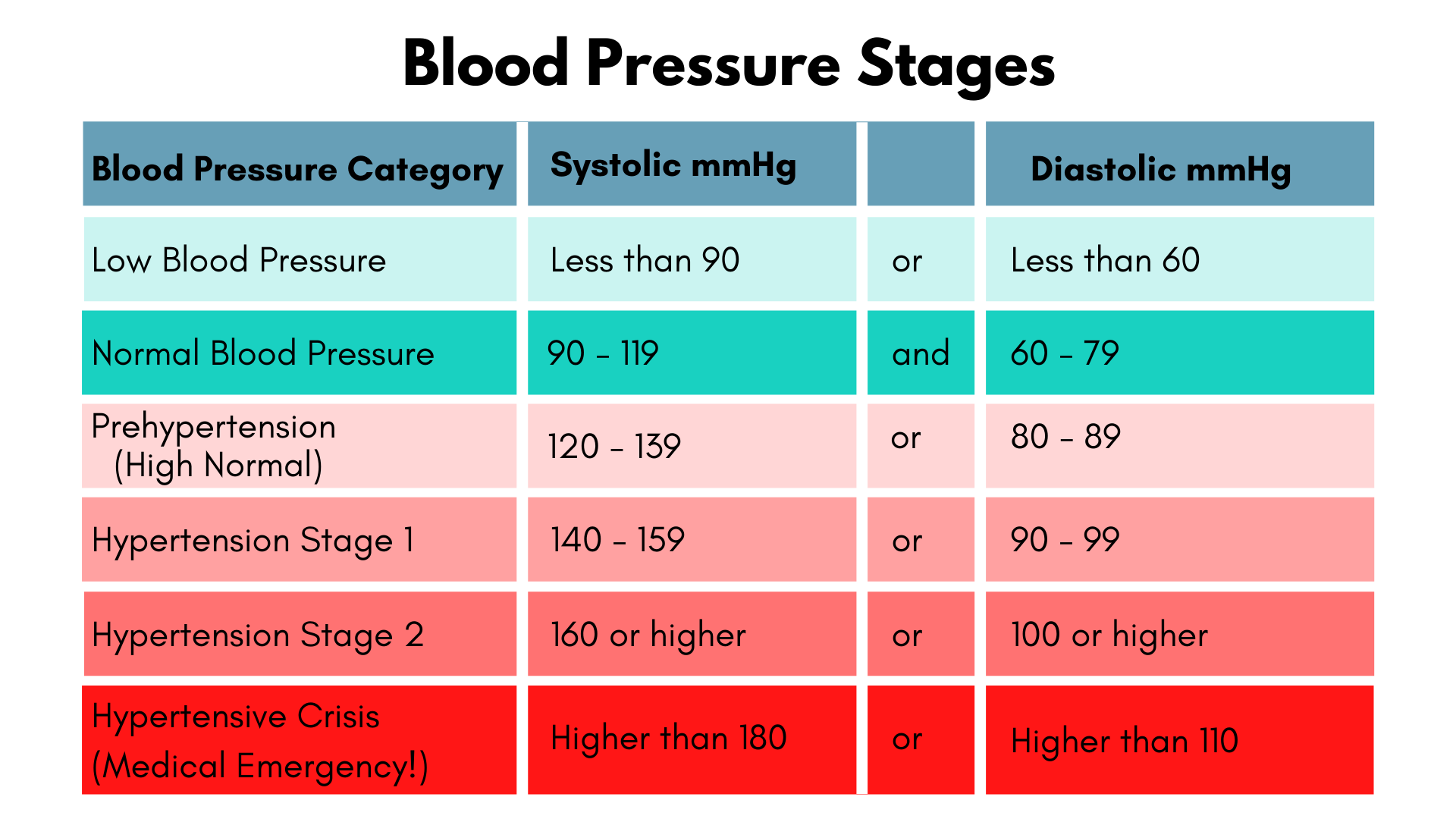
Blood Pressure Stages
So, what happens when these blood pressure levels spike up (high blood pressure or hypertension)?
The increased blood pressure makes the heart pump much harder than usual which places too much stress on the walls of the arteries.
This can lead to damaging of the arteries, making them more vulnerable to narrowing and what’s known as atheroma (a buildup of materials that adhere to the arteries), which can limit the flow of oxygen to the heart.
As mentioned at the start of this article, high blood pressure can go undetected for years without any symptoms, which is why it is often referred to as the silent killer.
Uncontrolled hypertension can lead to serious complications such as aneurysms, heart failure, strokes, kidney failure, and even blindness.
Now that we know the severity of this condition, you may be thinking “why does blood pressure increase?”
Causes of High Blood Pressure

There are two types of hypertension. Essential hypertension, which is responsible for more than 90% of hypertension cases and doesn’t have any clear identifiable cause.
In the case of secondary hypertension, other underlying medical conditions are the cause. The most common causes of secondary hypertension in older adults are hypothyroidism, renal failure, and atherosclerotic renal artery stenosis.
Although the exact causes of essential hypertension are still unknown, there are several risk factors known to contribute to this condition.
Some of the most common risk factors associated with essential hypertension are:
INCREASING Age
The risk of developing high blood pressure increase with age, mostly due to structural changes in the arteries.
The most common type of hypertension in those over the age of 50 is called isolated systolic hypertension, which is an elevation in systolic but not in diastolic pressure.
Although high blood pressure affects both genders equally, it is said that women are more likely to develop hypertension after the age of 65, while men tend to develop it much earlier.
People over the age of 40 should check their blood pressure at least once a year in order to detect any changes and take appropriate action if needed.
We’ll talk more about how to check your blood pressure later on in this article.
Stress
With everything going on in the world, along with daily stressors like work, finances, emotional troubles, etc, stress can be hard to get on top of and can take its toll on our health.
Don’t get me wrong, a healthy dose of stress is completely normal and natural. When we feel threatened, anxious, or upset, our nervous system releases a bunch of stress hormones so our body can assess the situation and act accordingly.
But what happens when the stress is constant and becomes a huge part of our lives?
Studies show that exposure to chronic psychosocial stress can contribute to the development of hypertension. Moreover, there’s evidence that supports that even thinking about stressful events can cause a delay in blood pressure recovery. This is a common trait in people who suffer from conditions such as depression and anxiety.
Another factor that contributes to hypertension is how we deal with stress.
Finding better and healthier coping mechanisms might be the key to reducing blood pressure levels and safeguarding your health.
You can find some great tips for reducing stress at the end of this article.
Physical Inactivity
Indulging in an overly sedentary lifestyle could also put you in a higher risk of developing essential hypertension.
A study evaluating the progression from prehypertension to hypertension in middle-aged and older males found that lack of physical activity significantly increases the progression of hypertension.
Participants who were in the lowest-fitness category were said to have a 36% higher risk for developing hypertension compared to those in the high-fitness category.
Lack of exercise is also directly linked to obesity, which is another risk factor for hypertension.
Obesity
Being overweight, or obese, increases the blood volume that circulates through the blood vessels, putting additional pressure on the arterial walls.
According to The Framingham Heart Study, people with a BMI (Body Mass Index) over 25 more commonly suffer from high blood pressure compared to those whose BMI falls into an optimal range. This study also estimates that obesity could be responsible for 28% of cases of hypertension in women and 26% in men.
Another study suggests that for every kilogram lost, systolic and diastolic blood pressure decreases by about 0.5 to 2 mmHg.
Gradual, healthy weight loss is essential for the prevention and treatment of hypertension.
Unhealthy Diet
Various studies have supported the link between sodium (salt) intake and hypertension.
Now, let’s be clear on one thing - a moderate amount of sodium is absolutely necessary for the body to function properly.
However, regularly consuming too much sodium, leads to water retention. At this point, your body will try to flush out the excess water by making your heart pump faster, resulting in...yup, you’ve guessed it - higher blood pressure.
So, how much sodium is too much?
Research shows that Australians eat on average between 2,500mg and 5,500mg of sodium each day. Most of the sodium comes from processed and prepackaged foods like bread, processed meat, boxed cereal, etc.
It is recommended adults consume no more than 2,300 milligrams (mg) of sodium per day. However, in ideal circumstances, that amount would be closer to 1,500 mg per day for most adults.
Rather than focusing on reducing salt intake to help with lowering blood pressure, put your focus on making the switch from processed foods to eating real, whole foods.
Whole foods such as fresh fruits and vegetables, legumes, nuts, seeds, dairy, poultry, and meats are packed with essential nutrients such as potassium, magnesium, and other important minerals that your body needs to function properly.
By making a conscious choice to make this switch, your sodium intake will decrease and your health will also improve ten-fold. (We will discuss this further, later in this article).
Of course, sodium isn’t the only culprit responsible for increasing blood pressure.
Drinking too much alcohol can also lead to hypertension. Although the reasons why are still unclear, it is believed that inflammation and oxidative injury are the major contributors to alcohol-induced hypertension.
Of course I’m not going to say you have to ditch alcohol altogether. You can still enjoy a cold pint of beer, or a nice glass of wine every now and then, just make sure you’re not overindulging too frequently!
Another healthy tip on sodium. When you’re seasoning your food, choose a quality sea salt (sea salt contains many important minerals), over general table salt.
Smoking
We all know the health effects of smoking. In my last article I discussed the effects smoking can have on eye health, and smoking comes up again this week
Nicotine found in cigarettes and similar tobacco products can increase blood pressure and heart rate, as well as narrow the arteries.
Tobacco products are also packed with harmful chemicals that can damage the heart and blood vessels. Furthermore, research suggests that secondhand smoke also increases the risk of hypertension, as well as the build-up of plaque inside the arteries.
If you’re a smoker, there are some great programs out there that can make quitting smoking much easier. Speak to your doctor about this on your next visit.
Genetics
Genetics may play some role in hypertension.
There is evidence to show that certain ethnicities have a higher risk of developing hypertension and generally tend to develop it at an earlier age.
However, if hypertension runs in your family, it’s most possibly due to similar environmental and lifestyle factors you share with your predecessors.
It’s very common for many chronic health conditions to be put down as hereditary alone, when there are modifiable risk factors also to blame.
HOW TO CHECK YOUR BLOOD PRESSURE
Monitoring your blood pressure regularly is the only way to detect any changes and identify whether you’re at risk of developing hypertension.
Even if your blood pressure is within normal parameters, you should get it checked at least once per year.
However, if you already suffer from hypertension or have some pre-existing diagnosis that would put you at higher risk, you should make a habit of checking your blood pressure at least daily (or twice - morning and night) until under control and monitor it.
Checking your blood pressure isn’t all that complicated or difficult.
You can always make an appointment with your doctor, or you could decide to monitor your levels by yourself.
If you already have been diagnosed with high blood pressure, then home blood pressure monitoring might be a more convenient option for you.
CHECKING YOUR BLOOD PRESSURE AT THE Doctor

During a routine check-up your doctor will check your blood pressure.
Make sure you avoid caffeine, nicotine, and exercise at least an hour before the appointment. These activities can raise your blood pressure levels temporarily, so the test results might not be entirely accurate.
Your doctor will use an automated blood pressure machine or what’s called a sphygmomanometer and also an arm cuff (see picture below) to measure your blood pressure.

Aneroid Monitor with Sphygmomanometers
The inflatable rubber cuff is wrapped around the top of your arm. As the rubber cuff inflates, it constricts your arteries, cutting off the blood flow for a moment. Once the air is released, the doctor will be able to measure both your systolic and diastolic pressure either by using a stethoscope or by taking the reading fro the automated blood pressure monitor.
The whole procedure shouldn’t take longer than a couple of minutes and the results are available immediately.
Depending on your results, the doctor will recommend further action if needed. This could be simple lifestyle changes (discussed below) or the use of medication.
CHECKING YOUR BLOOD PRESSURE AT HOME
Measuring your blood pressure from home doesn’t differ too much from what your doctor would do.
There is a variety of blood pressure monitors available for purchase that are reasonably priced and are accurate. You can pick up a quality digital monitor at a reasonable price online.
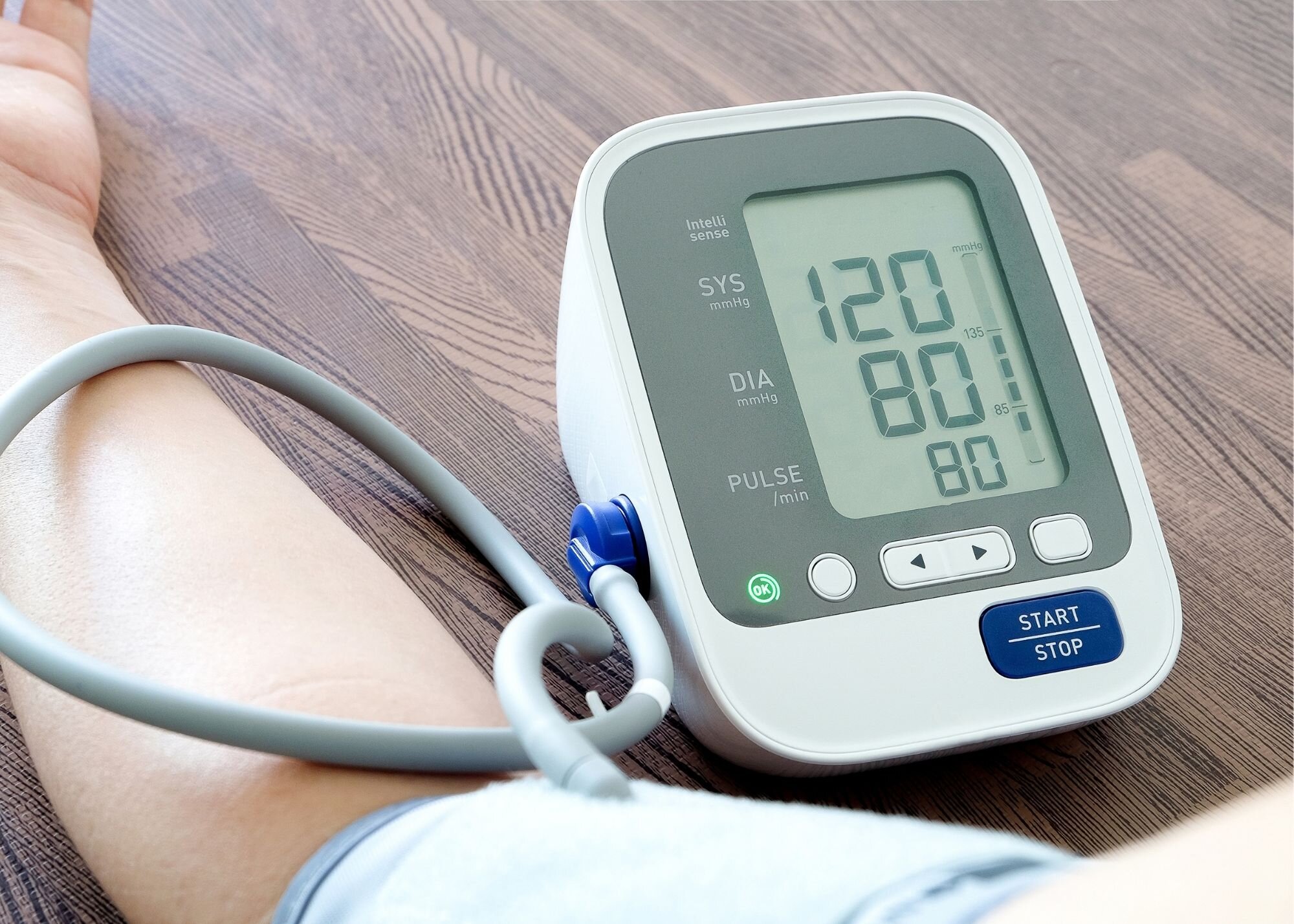
Digital Blood Pressure Monitor
Digital monitors do most of the work for you and a stethoscope is not needed. In some cases, you still need to inflate the cuff manually, but some models inflate automatically. The numbers are readily available on a small screen. These monitors are very easy to use and many are very accurate.
Some people prefer to use a wrist monitor to measure their blood pressure, but the general opinion is that these machines are not as reliable as upper arm monitors and I do not recommend them.
A few pointers for checking your blood pressure at home:

If you have high blood pressure, check your blood pressure at least once or twice a day (morning and evening).
Avoid food, caffeine, exercise, and nicotine at least 60 minutes before measuring.
Make sure your arm is supported and at the level of your heart.
Sit straight with your legs uncrossed and feet flat on the ground.
Try to relax before measuring. Spend 5 minutes relaxing.
Take a few readings each time to get the most accurate results.
Make sure to document your results every time you measure your blood pressure so you can closely monitor your condition.
If you have concerns or questions about your results, make sure to contact your doctor.
HOW TO LOWER (OR PREVENT) HIGH BLOOD PRESSURE
MEDICAL TREATMENTS
There’s no one-size-fits-all when it comes to hypertension and medical treatment. Treatment varies based on various factors.
In most cases, your doctor will recommend healthy lifestyle changes that could help lower your blood pressure naturally. We’ll discuss these natural treatments, as well as prevention in the next part of this article.
Once the doctor determines your current situation, they might recommend certain medications as a part of your individual treatment plan.
More often than not, those suffering from hypertension are prescribed diuretics. This medication is also sometimes referred to as water pills, as their aim is to help remove excess water and sodium from your body.
ACE (Angiotensin-converting enzyme) inhibitors are another type of medication which help relax the blood vessels by blocking the natural chemicals that restrict them. Angiotensin II receptor blockers (ARBs) and calcium channel blockers are also sometimes recommended for people suffering from high blood pressure.
Alpha, Beta, and Alpha-Beta Blockers are additional medications sometimes used in the treatment of hypertension. These blockers are made to reduce nerve impulses to blood vessels and can help decrease the workload on your heart.
In some situations a combination of several medications, may be recommended by your doctor.
Finding the right combination of meds can be difficult and take time. Not everybody will react in the same way to certain medication, so it’s important to be patient, keep an open mind and trust your doctor.
NATURAL TREATMENTS AND PREVENTION OF HYPERTENSION
Up until this point, we’ve only discussed the ugly side of hypertension: risks, dangers, complications, consequences, etc.
Of course, all of these aspects are essential for understanding how high blood pressure can affect a person’s health.
However, there is a silver lining in all of this!
In most cases, high blood pressure can easily be managed by making some healthy and conscious life choices.
There are a number of things you can do to keep hypertension at bay.
Implementing these changes in your life can help lower your blood pressure naturally, so you might not even need medication.
DECREASING STRESS & MINDFULNESS
Stress-management is one of the most instrumental parts of managing your blood pressure.
Chronic exposure to stress can constrict your blood vessels and increase the heart rate, but it can also be a getaway to some other unhealthy behaviours.
Practising mindfulness can be the very first step towards lowering your blood pressure levels. Research shows that meditation has proven to be an effective tool for combating stress and anxiety which is important in decreasing blood pressure
Additionally, experts found evidence that listening to soothing music can lower both systolic and diastolic pressure in both men and women.
Decreasing stress can be challenging but it’s far from impossible. Try to find time each day to indulge in activities that bring you joy.
Keep a journal of the things you’re grateful for, fix yourself a relaxing bath and turn on some of your favourite tunes. Self-care is all about learning to love, respect and nurture both your body and your mind.
When you find yourself making this a priority, you’ll see and feel the benefits.
MAKE SLEEP A PRIORITY
Although often neglected, sleep is a fundamental part of a person’s overall health.
Our bodies need rest to recharge and prepare us for the days ahead.
Sleep deprivation and sleep disorders such as insomnia are associated with hypertension, especially during middle age. Not getting enough sleep can hinder your body’s ability to regulate stress hormones, which can lead to increased blood pressure.
According to the CDC, about 35% of adults report not getting enough sleep.
So, how much sleep do we actually need?
The short answer? It varies. The amount of sleep a person needs changes with age. An average adult should aim at getting 7-9 hours of quality sleep each night.
Many underlying conditions could affect your ability to sleep well. However, with the right mindset and a few simple changes to your lifestyle, you can easily form healthy sleeping habits.
You can read more about how to get a good night’s sleep HERE.
GET IN NATURE MORE + GET SUNLIGHT
Did you know that spending more time in nature could lower your blood pressure? I know what you’re thinking - it can’t be that simple, can it?
Well according to some research, exposure to green spaces can reduce the risk of cardiovascular disease, stress, high blood pressure, as well as type II diabetes and premature death.
Additional studies link sunlight exposure to lowering blood pressure. One study, published in the Journal of the American Heart Association shows incident solar UV radiation is associated with lower systolic blood pressure.
This, of course, doesn’t mean you should spend your days sunbathing at the beach. On the contrary, overexposure to UV rays could actually do you more harm than good. Spending just 20 minutes each day strolling in the park should do the trick. Make sure to not over do it and be sure to avoid the hottest part of the day.
EXERCISE AND BLOOD PRESSURE
As we’ve mentioned before, obesity and physical inactivity are big risk factors for high blood pressure.
Controlling your weight by exercising regularly should be on the top list of your priorities.
Studies claim that the combination of aerobic exercise and resistance training has shown remarkable results in lowering BP.
Furthermore, HIIT (High-Intensity Interval Training) and walking are said to be beneficial for reducing both systolic and diastolic pressure.
According to a meta-analysis study, indulging in such activities for 150 minutes per week can help lower BP and improve your heart health.
The key is finding activities you actually enjoy doing. Don’t over think it, don’t try and be perfect, just get moving! Try your hand at cycling, power walking, swimming, or dancing. Whatever it is…. And stay consistent with it! Exercise is something that should be done regularly.
And for free exercise videos for seniors head over to the exercises page.
Eating Healthier - 5 Ways To Decrease Blood Pressure Through Healthy Eating
We’ve already established, earlier in this article, that cutting back on sodium and alcohol can do wonders for your blood pressure. The question now is, what other dietary changes can you make to lower your BP?
We’ll now touch upon some of the most important dietary habits for improving and preventing high blood pressure.
1. CUT OUT THE JUNK FOOD - REPLACE WITH WHOLE FOODS.
The reason why so many health professionals, myself included, advise against processed and prepackaged foods is because they contain excessive amounts of sodium, sugar, bad fats, and are loaded with many harmful additives. On top of this, many of them have little to zero nutritional value.
Maintaining a diet relying heavily on processed foods can increase the risk of obesity, diabetes, heart disease and as we already know - high blood pressure.
Evidence shows that sugary drinks and foods are linked to higher blood pressure. Data suggests that those who drink one or more sugary drinks daily have a 12% higher risk of developing hypertension. Another study found a significant association between increased sugar and increased blood pressure in older women.
Does this mean you can’t eat sweets anymore? Or that you need to stop enjoying your favourite snacks altogether?
Absolutely not!
The first step towards improving your health is cutting out the junk from your diet. There are still plenty of sweets and snacks that can satisfy your cravings without endangering your health.
This is where real, whole, nutrient-dense foods come in.
Finding the right balance between healthy and unhealthy foods can be challenging, especially nowadays when our supermarket shelves are packed with all sorts of colourful snacks and treats. However, healthy alternatives do exist and it’s entirely possible to make some necessary changes that will turn your whole life around.
Nobody expects you to immediately cut out all the bad stuff from your diet and start with a clean slate...or should I say plate?
The changes don’t need to be drastic and abrupt. Making minor changes in your eating habits could make a world of difference. Replace sugary drinks with unsweetened tea, snack on fruits and nuts instead of chips, and cook using real, fresh ingredients.
Here are some examples healthy foods and their nutrients :
Salmon and Sardines (omega-3s, protein, vitamins, and minerals)
Kale and other Leafy Greens (vitamins C, A, K1, B6, as well as potassium, magnesium, calcium)
Garlic (vitamins C, B1, B6, calcium, selenium, manganese, potassium)
Shellfish and Seaweed (vitamins C, B12, zinc, copper)
Potatoes (vitamins C, B, iron, potassium, manganese, magnesium)
Egg Yolks (lutein, zeaxanthin, choline)
Dark Chocolate (fibre, iron, manganese, antioxidants)
Blueberries and other Fruits (vitamins, minerals, and antioxidants)
Once you get into the habit of eating whole foods, your cravings towards processed foods will eventually diminish.
If you do need additional help and information on how to start eating healthier, you can find more tips right here.
2. POTASSIUM
Evidence suggests that eating foods rich in potassium may help regulate blood pressure. This is achieved by helping the body reduce excess sodium. Some of the best sources of potassium include:
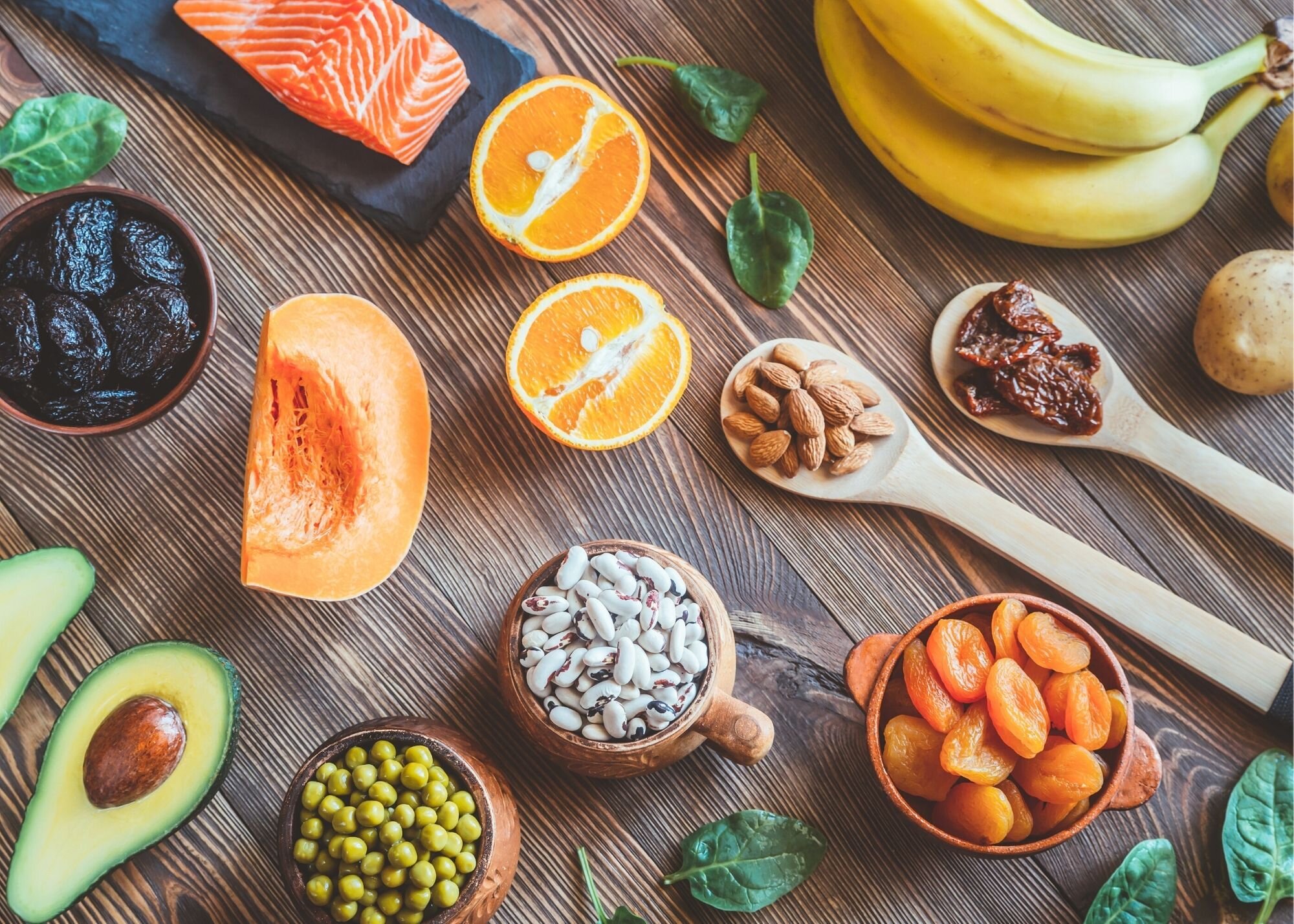
Vegetables (potatoes, leafy greens, carrots, celery, tomatoes)
Fruits (bananas, melons, apricots, citrus fruits, berries, kiwi)
Dairy Products (milk and yoghurt)
Nuts, Seeds, and Beans (pistachios, almonds, hemp and pumpkin seeds, lima, pinto, kidney beans, lentils)
Fatty Fish (tuna, cod, trout, salmon)
Herbs and Spices (turmeric, thyme, cumin, paprika, cayenne pepper, dill)
PLEASE NOTE: Eating a lot foods that are high in potassium may cause problems, especially in people with kidney disease. Make sure to check with your doctor or dietitian on how much potassium is right for you.
3. OMEGA 3s
Numerous studies show the link between omega-3s and decreased blood pressure. Regular intake of these fatty acids can protect the dynamic function of vascular cells, which promotes optimal blood pressure.
Oily fish are the best source of omega-3s, or more specifically EPA (eicosapentaenoic acid) and DHA (docosahexaenoic acid.)

These two compounds have been shown to have positive effects on blood pressure and have a range of health benefits.
Sources of omega-3s include:
Fatty Fish (mackerel, salmon, cod, herring, sardines, anchovies)
Oysters
Caviar
Flax and Chia Seeds
Walnuts and Legumes
4. VITAMIN C
Vitamin C is one of those miracle vitamins we always turn to whenever we have an ailment. Runny nose? Minor cold? Running a fever? Let’s stock up on lemons and oranges! And there’s a good reason why we do these things.
Vitamin C, known also as ascorbic acid, contributes to a wide range of body functions. It supports our immune system, maintains our skin, bones, and blood vessels, and protects us from an onset of diseases.

Another amazing benefit of vitamin C is its ability to reduce the effects of hypertension. A meta-analysis study found that vitamin C supplementation can significantly reduce both systolic and diastolic blood pressure. It is believed this is due to its diuretic properties, where the vitamin helps remove the excess fluids from your body, which in turn lowers the blood pressure.
As we already know, citrus fruits are some of the best sources of vitamin C, although tomatoes, potatoes, broccoli, and brussels sprouts also contain significant traces of this essential vitamin.
5. BEETROOTS
When researching for this article I noticed this vegetable popping up for its effects on lowering blood pressure.
Although not one of my favourite vegetables, this colourful vegetable is loaded with essential nutrients and contains high levels of potassium, iron, vitamin C, folate, manganese, and fibre.
Specifically, beetroot juice has been linked to a number of health benefits, and is used to treat issues relating to blood and digestion.
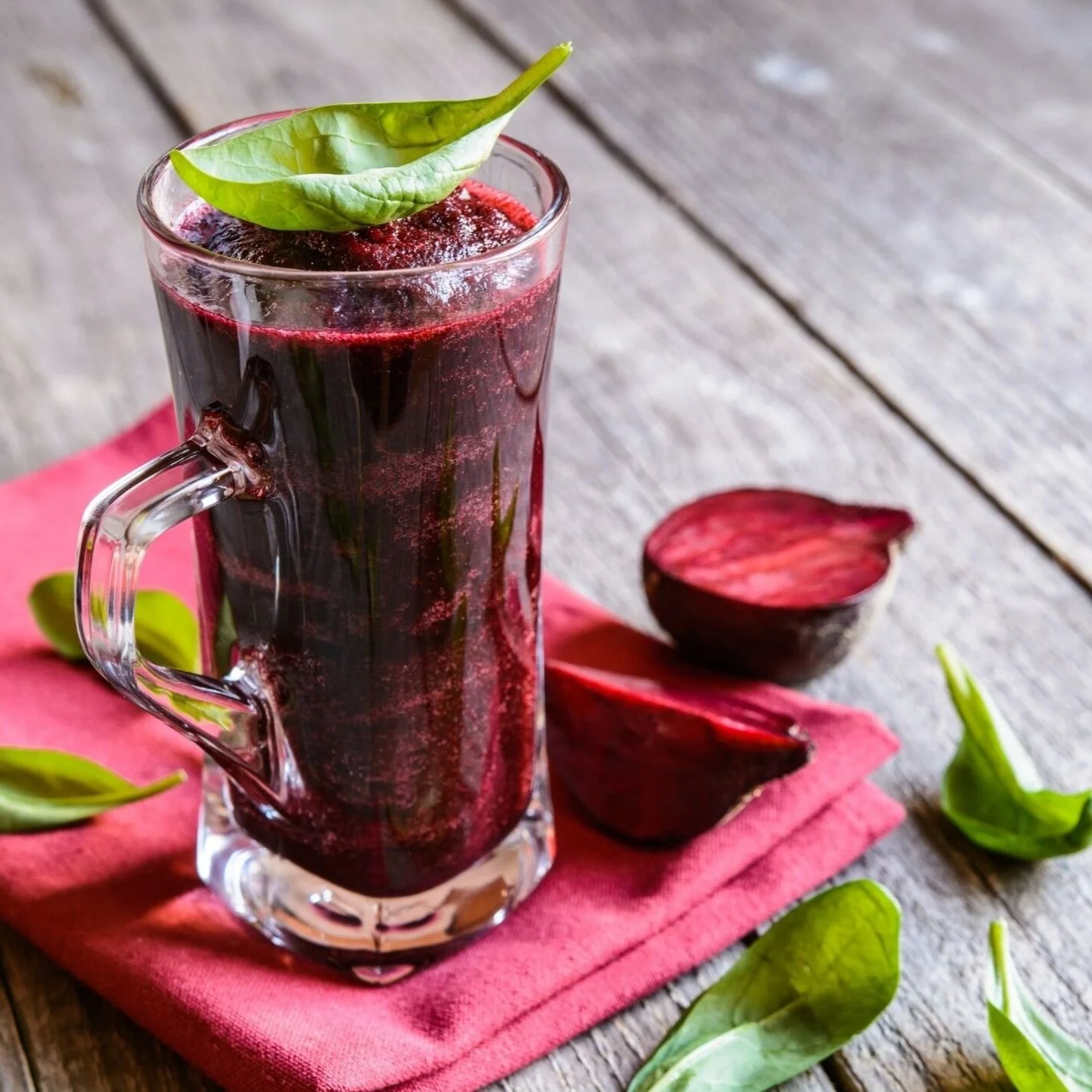
One study shows that consuming beetroot juice can potentially improve systolic and diastolic blood pressure in healthy older adults.
Other research found that beetroot juice has great potential to reduce Systolic BP and Diastolic BP, both in healthy individuals, as well as those with cardiovascular risk.
Scientists believe this is due to high levels of dietary nitrate found in beetroots. When consumed, the body converts this compound into biologically active nitrite and nitric oxide, the latter which is responsible for dilating and relaxing blood vessels.
I’ve been experimenting with beetroot juice recipes, which I’ll share when I’ve found a great concoction. If you’ve got any good beetroot juice recipes make sure to share it with me.
I’d love to know:
Have you had any issues with your blood pressure?
Have you successfully lowered your blood pressure naturally or with medical means?
Do you have any tips that worked for you in lowering your blood pressure?
Has beetroot juice helped you by any chance?
(You can answer below, or to me by email or in the More Life Health Facebook Community).
SOURCES
https://www.webmd.com/hypertension-high-blood-pressure/guide/blood-pressure-causes#1
https://www.mayoclinic.org/diseases-conditions/high-blood-pressure/symptoms-causes/syc-20373410 https://medlineplus.gov/highbloodpressure.html https://www.heart.org/en/health-topics/high-blood-pressure https://www.webmd.com/hypertension-high-blood-pressure/guide/diastolic-and-systolic-blood-pressure-know-your-numbers#1
https://www.nhs.uk/conditions/high-blood-pressure-hypertension/treatment/

How To Care For Your Eyes After 60
It’s been a long time coming since I had the idea to write an article on the eyes. After all, vision changes and vision loss are one of the many problems we encounter as we get older.
Although we understand perfectly well that these issues are a natural part of ageing, it can be frustrating having to deal with vision loss. For example, not being able to read small text, like you once could.
Now at this stage. You may be thinking. “But Mike, you’re a Physiotherapist what do you know about the eyes?”
And well, yes, this is true! But I do know health and I do know exercise.. And, fortunately I also have a Sister, Lexie (who you have seen floating around in the More Life Health Facebook Community), who just so happens to be an Orthoptist.
So with our powers combined, we bring you this guide to caring for the eyes after 60.
KEYS TO HEALTHIER EYES FOR SENIORS
After all, vision changes and vision loss are one of the many problems we all encounter as we get older.
Although we understand perfectly well that these issues are a natural part of ageing, it can be frustrating having to deal with vision loss. For example, not being able to read small text, like you once could.
So I wanted to cover this topic in quite some detail!
Now at this stage. You may be thinking. “But Mike, you’re a Physiotherapist what do you know about the eyes?”
And well, yes, this is true! But I do know health and I do know exercise.. And, fortunately, I also have a Sister, Lexie (who you may have seen floating around in the More Life Health Facebook Community), who just so happens to be an Orthoptist.
So with our powers combined, I bring you this guide to caring for the eyes after 60.
In this guide we will cover the eye in detail, including - the anatomy of the eye, common eye conditions that affect seniors, we will also look at what spending time on screens (iPhones, laptops, computers, TVs etc) does to our eyes and we will also cover all that you need to improve your eye health and maybe even your vision.
Let’s get into it!
WHAT IS COVERED IN THIS GUIDE:
HOW YOUR EYES WORK - ALL YOU NEED TO KNOW

Our eyes are one of our most precious organs.
Not only are they, in my opinion, the most beautiful part of the body, they also allow us to see the world around us.... And yes - eyes are, in fact, organs of the visual system.
And just like any other organ in the body, eyes are comprised of an intricate network of nerves, vessels, and muscles.
So, how do our eyes actually work? To get a better grasp of this, let’s dive a bit into the anatomy of the eyes.

Extraocular Muscles Of The Eye
The eye socket, also known as the orbit, is connected to six muscles that allow our eyes to move up and down freely. These muscles are called extraocular muscles and they’re attached to the sclera, a layer of tissue that stretches around the eyeball.
Following so far? Okay, let’s dig a bit deeper.
The most superficial layer of the eyes is a clear membrane that covers the front. This is called the conjunctiva. Its function is to protect and lubricate the eyes by producing tears and mucus.
Now, if we look at the front of eye, we first find a clear layer called the cornea, whose job is to refract light.
Behind the cornea is the anterior chamber, a space filled with a fluid called aqueous humour. Despite its name, there is nothing funny about the aqueous humour; this clear fluid is actually responsible for maintaining the pressure in our eyes and nourishing the lens.
Anatomy of The Eye
Right behind the anterior chamber, we can find the iris and the pupil. It’s the iris that people refer to when they compliment the beautiful colour of your eyes. This is also the part of the eye where most of the magic happens. Depending on how much light enters the eyes, the muscles of the iris will either dilate (widen), or constrict (narrow) the pupils.

The lens is situated right behind the pupil. The lens works together with the cornea to refract the light that enters the eye. What’s also interesting, is that the lens can change its shape to help maintain focus on close objects.
Between the lens and the back of our eyes, we can find the vitreous cavity. Inside the cavity, there’s a substance called vitreous humour whose role is to nourish the eyes and help them retain their shape. Once light enters our eyes, it passes through the lens and the vitreous humour until it reaches the retina.
The retina is a thin layer of tissue on the back of the eye. It is one of the major players in the eye, as it gives us our central and peripheral vision. It’s comprised of photoreceptors, cells which process colour and black and white shades (that help us see in the dark.)
The retina is also responsible for converting light into signals that are then transmitted to the brain through the optic nerve. The optic nerve is the final stage - it uses its nerve fibres to send the electrical impulses into the visual cortex. Once there, our brain converts this information into images and we are able to see.
Easy peasy, right?
The easiest way to understand vision and sight is to think of the eyes as a camera device. The cornea of the eye and the lens of the camera work in a similar way.
They both have a spherical curvature that allows them to see what’s in front of them. The iris (coloured part) of the eye can be compared to a camera’s aperture (opening of the lens). Their function is to control how much light enters the eye (or the camera) so they will narrow or widen accordingly.
More similarities can be found when we consider things like focus, scope, and film. Both the eye and the camera can focus on single objects and blur out the rest. Thanks to the curvature of the eyes and the device lens, they’re also able to widen their field of view.
Finally, the film in a camera device has the same function as the retina. It collects the reflected light and converts it into images.
Amazing, isn’t it?
Now that we understand how the eyes work, we can now take a look at what happens to these eyes as we get older and then get to conditions in the eyes.
THE AGEING EYE: WHAT HAPPENS TO OUR EYES AS WE GET OLDER
As we grow older, we experience an onset of changes all over the body.
Some of these changes are more obvious, while others tend to creep up on us when we least expect them. Many of these bodily transitions occur gradually, spanning over a course of years. This is exactly what happens with our eyes.
Our eyes, just like every other organ in our body, deteriorate with age. It’s nature.
Although every person is different, most people tend to experience the first changes somewhere around the age of 40. This is the time when the eye lens loses its elasticity and is not able to focus on close objects anymore. This is the reason why most middle-aged people hold their phones farther away when trying to read text messages, for example.
We call this condition presbyopia and it is nothing to be afraid or ashamed of. Presbyopia occurs naturally in every living person over the age of 40.
Similarly, myopia or nearsightedness is a condition in which you’re unable to focus on faraway objects. And hyperopia or farsightedness in which you are unable to focus on near (and sometimes far away) objects. This is the time when you’re most likely to visit your Optometrist and get a prescription for eyeglasses or contact lenses.
Although presbyopia, hyperopia and myopia are quite common, they can be managed. Prescription eyeglasses and contact lenses, as well as corrective surgery, can greatly alleviate these issues, as well as keeping yourself in the best possible health.
However, there are some more conditions that can affect vision and eyesight, which are more severe and can result in complete vision loss.
As time goes by, you might notice other issues with your eyesight as well.
We’ll discuss these conditions in more detail in the following chapter.
EYE CONDITIONS IN SENIORS
Let’s now dig a bit deeper into some eye conditions that affect seniors so you have the knowledge of what to look out for which can help prevent any serious eye issues.
DRY EYE
If your tear ducts are unable to produce enough moisture, you’re most likely suffering from dry eyes. Even though the condition doesn’t sound too serious, it can cause a lot of discomfort and irritation.
As we get older, we experience a lot of hormonal changes in our body. Loss of tears in our eyes is one of the changes that occur with old age. While dry eyes can affect both men and women, the condition is more prevalent in women who have gone through menopause.
Dry eyes are fairly common and there are multiple ways to prevent the symptoms of this condition. Creating a suitable environment in your home or office is one of the first steps towards preventing dry eyes. This includes controlling the amount of moisture in the air (using a humidifier,) or avoiding direct exposure to the AC, blow dryers, fans, heaters, etc.
Protective eyewear is also a suitable solution, especially in settings with a lot of dry air or wind. Another thing you can do to alleviate the symptoms of dry eyes is to take regular breaks from electronic devices. Avoiding cigarette smoke and using artificial tears (lubricating eye drops) is also a good idea for dealign with dry eyes.
For severe dry eye, plugs can be inserted into the tear ducts to keep tears within the eye and prevent them draining away. If you are suffering from severe dry eye, speak to your optometrist or ophthalmologists as to whether this may be a suitable solution for you.
BLURRED VISION
Blurred vision, or not being able to see objects in fine detail could be a result of something minor such as incorrect eyeglass prescription, presbyopia, hyperopia cataracts or myopia, but it could also signify some underlying diseases as well.
Some risk factors associated with blurry vision include diabetes, high blood pressure and certain immune disorders. If you suffer from such conditions and start exhibiting vision problems, make an appointment with your appropriate medical professional.
However, if you experience a sudden onset of blurry or double vision, you’ll want to contact your doctor immediately. This is especially important if you get accompanying symptoms such as eye pain, headaches, dizziness, nausea, etc. These could be signs of strokes, brain tumours, multiple sclerosis, and other severe illnesses.
CATARACTS
Cataracts are considered of the more common eye conditions. They usually develop over the course of years and often occur as a result of old age.
According to the National Eye Institute more than half of all Americans ages 80 or older either have cataracts or have had surgery to get rid of cataracts.
Some cataracts also occur as a result of heavy drinking, smoking, eye surgery, or other conditions such as diabetes. Although many people don’t experience any changes in the early stage, as cataracts grow larger, they may cause cloudy vision, faded colours, light sensitivity, and double vision.
Cataract surgery is a very common and safe procedure where the cloudy lens is replaced with a new artificial lens which will help restore eye sight.
FLOATERS AND FLASHES
You may have seen dots, squiggly lines or even cobwebs in your eyes at some time in your life. These become more noticeable when staring at a blank wall or sky on a clear day. These are known as floaters.
Floaters appear to quickly move away when you try to focus your gaze at them, and slowly drift when your eyes are still.
Flashes, as the name suggests, look like flashing lights or streaks of light in your field of vision.
Floaters and flashes are usually harmless and can disappear on their own over time. If you are getting them regularly or have a sudden increase in both or notice any changes with them it’s best to get checked by your eye doctor as it could indicate retinal damage.
AGE-RELATED MACULAR DEGENERATION (AMD)
Considered one of the main causes of permanent vision loss, age-related macular degeneration happens when the macula, the centre part of the retina, breaks down.
There are two types of macular degeneration - dry and wet. Dry macular degeneration manifests itself as small yellow residues in the macula. People with milder cases may experience dimmed or distorted vision, but the condition can worsen. If this occurs, it can lead to blind spots and loss of central vision.
The wet form, although less common, is also more severe. Wet macular degeneration happens as a result of blood vessels growing from underneath the macula. As the blood vessels rupture, they form scars, which results in permanent vision loss.
Those suffering from AMD may experience symptoms such as blurry or distorted vision, difficulty seeing in dim light, sensitivity to glare, seeing spots, as well as seeing straight lines appear wavy.
Although this condition is most common in those over the age of 50, other factors can also increase the risk of macular degeneration. Genetics, obesity, smoking, and cardiovascular disease are known risk factors for AMD. It is also believed that Caucasians are at greater risk of developing these conditions compared to other races.
GLAUCOMA
Although glaucoma can affect people of all ages, it is most prevalent in older adults. This condition happens due to pressure build-up in the eyes, which damages the optic nerve. Glaucoma causes a gradual loss of sight and blindness, and unfortunately is not curable.
The most frightening thing about glaucoma is that it isn’t curable.
Most people suffering from glaucoma don’t experience any symptoms until it’s too late, so it’s best to know to look out for.
Depending on the type and stage of glaucoma, the condition can manifest itself in several ways. Tunnel vision and blind spots are common symptoms of open-angle glaucoma. Those suffering from narrow or acute angle-closure glaucoma may experience eye pain and redness, headaches, nausea, and blurred vision.
Black, Asian, and Hispanic people are more commonly affected by glaucoma than other races. Other risk factors include genetics, unhealthy lifestyle, high internal eye pressure, eye surgery, prolonged use of corticosteroids and eye drops, etc. Getting regular eye examinations can help detect glaucoma early on and possibly prevent more serious problems.
EYE MELANOMA
Eye or ocular melanoma is a type of cancer that affects the middle layer of the eye, called the uvea. There are many risk factors connected to eye melanoma, but the risks increase substantially with old age. Sometimes, people with this condition don’t have any symptoms, however, those that do may experience floaters, poor or loss of vision (especially peripheral) misshapen pupils, or dark spots on the irises. Eye melanoma often causes vision loss.
Some professionals believe that limiting sun exposure and wearing UV-protected sunglasses could reduce the risk of developing eye cancer.
DIABETIC RETINOPATHY
Although not the most common of eye diseases, diabetic retinopathy occurs in some diabetic patients as a result of diabetes complications.
Diabetic retinopathy occurs when the blood vessels in the retina are damaged and can be present in people who suffer from either type of diabetes – type I or type II. While this condition isn’t exclusively linked to seniors, older age is a definite risk factor in developing type II diabetes.
This eye condition may cause blurred or fluctuating vision, dark spots, colour changes as well as vision loss.
Good and consistent control of blood sugar levels will significantly reduce the risk of long term vision damage. This can be achieved through regular exercise and good nutrition and medication (if required).
POSTERIOR VITREOUS DETACHMENT (PVD) and RETINAL DETACHMENT
Retinal detachment is a severe condition that causes no pain. It’s a situation where the retina pulls away (detaches) from its supportive tissue. Those who experience this emergency may see floaters and flashes and should contact their eye specialist straight away. There are three types of retinal detachment.
Remember earlier in the article we were looking at different structures within the eye and the substance called vitreous humour
Well as we age, the vitreous humour shrinks and pulls away from the retina. Usually it separates without any complications. This is a condition called “posterior vitreous detachment”. However sometimes, it can cause a tear allowing fluid to form between the layers of the retina, causing it to detach. If left untreated, a retinal detachment can cause blindness.
Retinal detachments can also be caused by eye injuries so it’s always important to wear protective goggles when playing certain sports (e.g. squash) or working with certain tools.
EPIRETINAL MEMBRANE (OR MACULA PUCKER) and MACULA HOLES
These can develop similarly to a retina detachment in that irritation and scar tissue (epiretinal membrane) or a hole can form in the central part of the retina- the macula, when the vitreous humour is pulling away from the retina.
Sometimes when the vitreous is detaching, it can rub and irritate the macula then as it heals, it forms a scar tissue over the macula. This scar tissue can cause the macula to wrinkle or pucker.
As the macula is involved, symptoms can be similar to that of AMD such as trouble reading smaller print, blurry and distorted vision, straight lines appearing kinked or wavy, grey shadow/spot in central vision.
There is nothing that can prevent an epiretinal membrane or macula hole and in most cases, the best treatment is monitoring them (early stages) or surgery (later stages) however regular eye check ups can ensure they are detected early.
EPIPHORA
Sometimes also known as watering eyes, epiphora is characterised by an overproduction of tears. In the case of epiphora, the tears will flow down the face, instead of through the usual nasolacrimal system.
There are a few factors that can cause watering eyes, but an obstructed tear outflow tract or misaligned tear ducts, caused by sagging of the lower eyelid(s) away from the eyeball, are often the cause and are a result of ageing.
Some cases of epiphora can be treated with antibiotics or by probing in the ophthalmologists rooms, while others may require surgery.
Some types of epiphora may go away on their own without any treatment. Epiphora may occur as a result of allergies, common colds, or an eyelid stye and generally passes without medical intervention.
If there are other symptoms present such as pain, yellow or green discharge or vision changes, it may be a sign of infection. Make sure to clean your contact lenses and wash your hands regularly as to avoid spreading germs to your eyes, and make sure to see your doctor.
ECTROPION AND ENTROPION
The most common cause of these two eyelid conditions is ageing. As we get older, our eyelids can lose tension due to weakening of the muscles and tendons that support them, causing the lower eyelids to sag down (ectropion) or roll inwards (entropion). Symptoms of these conditions include watery and/or dry eyes, irritated eyes, sensitivity to light and in more severe cases - corneal ulceration.
Temporary relief from symptoms can be achieved through ocular lubricants (eye drops, gels or ointments). Taping of the eyelids with special skin tape to help support them or prevent them from rolling in can also help, especially while sleeping. (Be sure to speak to your doctor or optometrist who can show you the safe and correct way to do this before attempting it yourself). Surgery may also be recommended as a more definitive treatment option.
TIA (TRANSIENT ISCHAEMIC ATTACK)
TIA is a type of mini-stroke that usually lasts only for a couple of minutes. In most cases, TIA doesn’t cause any permanent damage, but one of its symptoms includes blurred vision or blindness. Some professionals believe that these brief attacks are early warning signs of future strokes. It is said that the risk of transient ischaemic attacks increases after the age of 55.
There are certain precautions you can take to lower the chances of experiencing a transient ischaemic attack. Limiting cholesterol, sodium, alcohol and fat intake is said to reduce the risks of TIA. Also, healthy eating and regular exercise can help keep your blood pressure in check, which can lower the chances of both TIA and strokes in general.
RETINAL VEIN OCCLUSION
Often referred to as a “stroke in the eye”, a retinal vein occlusion is caused by a blood clot in a retinal vein.
It is a less common condition, affecting 1-2% of people over the age of 40 although most cases occur in people over the age of 60. The amount of vision loss is significant and risk factors other than age include high blood pressure, cholesterol, diabetes, smoking and being overweight. Therefore, the precautions you can take are similar to those precautions for TIA above.
PTERYGIUM
Pterygium, conjunctiva, eye web, or surfer’s eye are all used to describe a condition in which a tissue growth appears on the conjunctiva and sometimes the cornea. While the true causes of pterygium are unknown, it is believed that sun exposure, geographic setting, and age are risk factors for this condition. Surfer’s eye can usually be treated with lubricants, although some more serious cases may require surgery.
Being exposed to certain elements such as wind, sand, pollen, and smoke can increase the chances of pterygium. The most effective solution for preventing the development of pterygium is to wear protective gear (sunglasses, hats, etc.) and to limit your exposure to the previously mentioned elements.
BLEPHARITIS
A common eye disorder which affects the eyelids, eyelashes and sometimes tear production. Blepharitis is characterised by inflamed, red, and scaly eyelids.
Treatments such as antibiotics and steroid eye drops do exist however the condition is chronic in nature and tends to come back. Eyelid inflammation affects both men and women and the average age of those affected is around 50.
Most of the time, blepharitis is a result of excessive amounts of bacteria found in your eyelids. To minimise the symptoms of this condition, professionals recommend regularly washing your hands and face and not touching irritated eyes with fingers, and also practicing good eyelid hygiene.
Wearing eyeglasses instead of contact lenses is also known to help with symptoms of blepharitis.
This is a common condition in seniors, and proper daily, long term eyelid hygiene is very important for its management and overall eyelid health. If you suffer from this condition, ensure you have spoken to your Optometrist or Opthalmologist about proper eyelid hygiene techniques and you are undertaking it daily.
TEMPORAL ARTERITIS
A condition in which the temporal arteries become damaged or inflamed is called temporal, cranial, or giant cell arteritis.
According to the American College of Rheumatology, people over the age of 50 are more likely to suffer this condition. Temporal arteritis can cause serious complications if left untreated such as blindness, vision loss, internal bleeding, and even death.
Double vision, fatigue, loss of appetite, shoulder and jaw pain are all associated with temporal arteritis. Those experiencing such symptoms should seek immediate medical assistance. Temporal arteritis is not curable, but there are certain treatments aimed at minimising tissue damage.
Depending on the severity of the condition, your doctor may prescribe medication, but also some lifestyle changes. Quitting smoking and getting the right amount of exercise could be beneficial in some cases.
As you might have noticed, this list includes some common eye conditions, but also several rare and more severe diseases that could affect your vision.
However, one thing that they all have in common is their prevalence among the elderly. While this is certainly disheartening, it does not mean that there’s nothing you can do about it.
THE EFFECT TECHNOLOGY HAS ON OUR EYES

Another factor, that can cause issues with the eye, is the overuse of technology…..
I can still remember my parents yelling at me not to sit too close to the telly so I wouldn’t go blind.
At first, I wrote it off to those old wives’ tales adults used to scare children with, but as I got older I started reading into it more.
It’s no secret that we are spending way too much time on screens. Most of us can spend over one-third of our day in front of a screen.
We have become overly dependent on technology; social networking, online banking, paying bills - nowadays, we all use apps and online services for almost everything.
So how does this relate to our eyesight? Computer Vision Syndrome (CVS), also known as digital eye strain, refers to a group of eye-related issues caused by excessive use of electronic devices, such as smartphones, computers, tablets, etc.
Although eye strains are not considered a disease on their own, they do cause a fair share of vision problems like blurred vision, dry eyes, and severe discomfort.
What is it about electronic devices that cause so much harm?
Two words - blue light.
Blue light is everywhere around us. Sunlight is the biggest source of blue light, but it can also be found in some man-made devices; these include fluorescent lights, CFL and LED light bulbs, flatscreen TVs, smartphones, tablets, etc. Now, blue light isn’t all that bad, it can elevate mood and increase awareness, regulate the circadian rhythm, and even promote healthy eyesight development in children.
But, there is a limit to everything and blue light is not an exception to the rule. The amount of time we spend absorbing these rays and the proximity of these devices are what causes unwanted effects.
Research suggests that prolonged screen time can cause slow degeneration of the retina, which can lead to more serious problems such as cataracts, and age-related macular degeneration.
The best thing to do for your eyes to avoid any digital eye strain, is to spend less time on screens. Get outdoors, preferably into nature and look far into the distance.
With the lifestyles we live today it may be difficult to spend less time looking on screens.
Fortunately, there are ways to alleviate the symptoms of digital eye strain by implementing some minor lifestyle changes (which we will cover in the chapter below).
In the following few sections, we’ll discuss what you can do to preserve your eyesight and protect it from harm, and we’ll also go through some exercises you can do to keep your eyes healthy.
CARING FOR YOUR EYES: WHAT YOU CAN DO!
Although we aren’t able to bend the laws of nature and stop the natural degeneration of our body, we can do many things to keep ourselves in the best possible health and CAN prevent certain issues.
Along with old age, multiple factors can affect one’s vision. With advances in technology and new knowledge, there are many tools that can be utilised and new, healthier habits can be incorporated into your life that will go along way in helping you keep those eyes healthy long into the future.
Some of the following eye care tips are more obvious than others, but they’re all equally important when it comes to keeping your eyes in top-notch condition.
ORGANISE REGULAR EYE CHECKS
It’s important to have your eyes checked regularly by an eye doctor.

Make sure you get a comprehensive dilated eye exam, even if you notice no problems, every couple of years. Many eye conditions, even serious ones, don’t have noticeable symptoms.
With regular eye checks these conditions can be detected and appropriate treatment can be given.
Additionally, the right corrective lenses can help you see better, which will make life much easier and decrease your falls risk.
LOOK AFTER YOUR EYES WHEN USING TECHNOLOGY
When spending a lot of time looking at a screen of any sort, here is what you can do.
Keep a distance of about 60-65 cm between yourself and the device you’re using.
Take frequent breaks to allow your eyes to rest (every 20 minutes or so).
When taking breaks look far into the distance, to give your eyes a rest from looking so close to a screen. Follow whats known as the 20-20-20 rule. That is, if you find yourself on a screen for a long time, every 20 minutes, look at least 20 feet into the distance and hold for at least 20 seconds.
Reduce the brightness levels on your screen by using proper ambient lighting in your home/office. (Switch from fluorescent bulbs to soft white LED bulbs).
Reduce exposure to blue light. Screen filters for electronic devices and computer glasses with yellow-tinted lenses are said to be effective against blue light.
If you already use eyeglasses, invest in an anti-reflective lens coating. It minimises the amount of reflected light off the lens surface.
Blink more! We blink less often when staring at the screen and this can lead to dry eyes. Using a humidifier and artificial tears are also known to alleviate the symptoms of dry eyes.
Do eye exercises (covered below).
GET BETTER QUALITY SLEEP
Sleep is one of the, if not the most important component of a person’s health. It doesn’t come as a surprise that lack of sleep or low-quality sleep can take a toll on our eyes as well. Contrary to what you might believe, dark circles and puffy eyes should be the least of your worries when it comes to sleep deprivation.
Some of the most common eye-related issues caused by lack of sleep include dry, sensitive, or itchy eyes. However, eye muscle spasms are also a regular occurrence with those who don’t get enough sleep.
Studies show that obstructive sleep apnea (OSA) a condition in which breathing stops involuntarily for short periods during sleep, is a major risk for developing glaucoma. If you suffer from OSA or experience any related symptoms, it’s vital to consult with a doctor or a sleep specialist to evaluate the severity of the condition.
Getting a good night’s sleep can drastically decrease the chances of falling victim to such conditions.
For tips on getting a good night’s sleep, CLICK HERE.
DECREASE STRESS
Have you ever noticed that your eyes start twitching when you’re really upset or under a lot of stress? Or perhaps how the pupils dilate when you’re nervous or anxious? This is your body’s way of trying to communicate that something is wrong and you might not even be aware of it!
However, eye tremors aren’t the worst thing that can happen as a result of ongoing mental stress. Research suggests that high levels of cortisol, the stress hormone, is one of the leading causes of severe vision disorders such as optic neuropathy, glaucoma, age-related macular degeneration, and diabetic retinopathy.
While stress is something all of us deal with on a daily basis and we can’t completely isolate it from our lives, there are ways to reduce it. Decreasing stress is essential, especially in older age, and it can be done with just a bit of patience and effort.
For tips on how to decrease stress, CLICK HERE.
QUIT SMOKING
You probably don’t need me to tell you about all the negative effects smoking has on your health. But if the increased risk of the many health issues haven’t been enough to persuade you to finally cut down, or quit the habit, perhaps the fact that smoking can lead to vision loss may do so.
Research published in the journal Psychiatry Research suggests that “excessive use of cigarettes, or chronic exposure to their compounds, affects visual discrimination, supporting the existence of overall deficits in visual processing with tobacco addiction.” The study shows that consuming these neurotoxic chemicals found in cigarettes may cause overall colour vision loss, as well as a reduced ability to discriminate contrasts and colours.
Studies also show that heavy smoking increases the risk of developing dry eye syndrome, glaucoma, diabetic retinopathy, age-related macular degeneration, and cataracts.
I’m no expert on how to quit smoking, but if you’re a smoker, you’re going to experience tremendous health benefits by quitting. Your doctor can help with this so speak to them about quitting on your next visit.
WEAR SUNGLASSES
Another simple measure you can do to protect your eyes is to wear sunglasses when you’re outside.
Ultraviolet (UV) lights can greatly harm your lens, retina, and cornea, and wearing protective gear can alleviate the effects these harmful rays have on your eyes.
This is especially important for those living in places with higher UV rays. Here in Australia, we are exposed to up to 15% more UV rays than those living in Europe, for example.

Not to mention that with the right shades, your coolness levels increase exponentially! That could be reason enough to invest in a quality pair of sunglasses, don’t you think?
EAT A HEALTHY DIET
The importance of a well-balanced diet is indisputable.
Eating healthily isn’t just about maintaining the optimal weight; it can reduce the risk of chronic diseases and allow us to feel better physically, mentally, and emotionally.
Our vision is also impacted by the foods and drinks we consume, and the sooner we start implementing some healthy dietary changes, the sooner we’ll be able to see the positive effects. And in this case, I really mean SEE the effects.
Unfortunately, maintaining good eyesight isn’t as easy as simply munching on carrots all day. Maintaining a diet full of nutrient dense foods can greatly improve your eye health and protect your eyes from harm. Similarly, cutting out certain foods can also benefit your vision in the long run.
So, should we start with the good news or the bad news first?
A study published in the British Journal of Ophthalmology links Western-pattern diets to late-stage Age-related Macular Degeneration. People who regularly consume processed junk foods (think fast food, cakes, biscuits/cookies, potato chips, sweets, and soft drinks) are said to be in a higher risk of developing age-related macular degeneration.
What do most of these foods have in common? (Something I have written on before and the number one food you should be minimising and cutting out of your diet). They are highly processed, full of sugar amongst many other artificial ingredients and not to mention the high amount of refined vegetable oils.
The increased consumption of these highly processed and highly inflammatory oils may contribute to vision loss and have been shown to increase the risk of age-related macular degeneration.
Refined carbohydrates are also shown to be disadvantageous to eye health. Researchers report that consuming diets with a higher glycemic index can significantly increase the risk of developing advanced AMD. However, the study concludes that by improving the quality of carbohydrates we consume could diminish the negative effects. Simple changes such as replacing white bread with whole-grain bread could be a step in the right direction.
Nevertheless, certain nutrients have proven to be effective in diminishing and reducing the risks of these eye-related conditions.
Two eye-related eye disease studies, published in 2001 and 2013 found that vitamins E and C can reduce the risk of age-related decline in vision by up to 25%. The studies also found that nutrients like iron, lutein and zeaxanthin can counter the damage of free radicals and blue light.
Furthermore, a meta-analysis research associates vitamin E supplements with decreased risk of ARC (age-related cataracts.)
Multiple studies have also suggested diets high in vitamin A may be associated with decreased risk of age-related macular degeneration (AMD) and cataracts.
A lack of vitamin A causes drying of the cornea, leading to a cloudy cornea, corneal ulcers and vision loss.
Zinc is found in high levels in our eyes and has been shown to protect against macular degeneration.
A diet rich in omega-3 fatty acids could prevent proliferative retinopathies and restrict the progression of AMD, concludes a study published in the Nature Medicine.
Nutrient-dense real foods are recommended over supplements for better eye health (and general health). And before supplementing with any nutrient it’s always best to speak to your doctor.

SOME OF THE BEST FOODS THAT SUPPORT EYE HEALTH INCLUDE:
Fish & Shell Fish (High in zinc and many other vitamins and minerals. Rich in omega-3 fats)
Good quality meat (bone broth, liver etc) - (high in many vitamins and minerals)
Eggs (contain omega-3s, lutein, and vitamin E)
Dairy (high in many vitamins and minerals including vitamin D and K)
Nuts and seeds (cashews, walnuts, Brazil nuts, hemp and chia seeds are excellent sources of vitamin E and omega-3s)
Leafy greens and broccoli (high in many vitamins and minerals, rich in vitamin C, lutein and zeaxanthin)
Citrus and Tropical fruits (high in many vitamins and minerals, great sources of vitamin C).
FOODS TO AVOID:
Processed foods (eat real, natural food)
Refined vegetable oils
Refined carbohydrates
Sodium-rich foods (research suggests a high sodium diet could lead to cataracts)
Diet soda (study found a connection between diet soda and proliferative diabetic retinopathy)
High sugar foods
To read more about healthy eating, including which foods to avoid, CLICK HERE.
GET MOVING MORE - GENERAL EXERCISE
I’m sure you’d have known that there is no way I’d skip the importance of being active/exercising on improving the health of your eyes!
Studies suggest there is a strong correlation between inactivity and Glaucoma, Age-Related Macular Degeneration, and DR (diabetic retinopathy). Those who exercise regularly are less likely to develop these eye conditions.
Eye issues in all age groups are on the rise! This information shouldn’t come as surprise though; when we look to our modern lifestyles, we can notice an obvious change in physical activity and changes in diet.
The modern era brought plenty of great things with it, but it has also created this so-called sedentary lifestyle that many of us became slaves to.
We spend half of our days slouched in front of a computer screen and then proceed to relax on the couch while scrolling on our phones, tablets, and e-readers. Some researchers have found myopia isn’t solely inherited, as previously believed, but that it’s also a product of our technologically-induced environments.
Introducing more physical activity can do wonders for not only your health and with that comes healthier eyes.
It has also been shown that exercise can directly help with certain eye-related conditions such as glaucoma.
Exercise increases blood flow to the eye. Aerobic activities can also help reduce the pressure inside your eyes, which can protect the retinal ganglion cells.
Additionally, eye issues are usually linked to other chronic health issues for example diabetes, high blood pressure or cholesterol, and both of these conditions can be kept in check with regular exercise.
So we now understand that general exercise for the whole body, regularly can he helpful for those eyes. You may also be thinking, are there any specific eye exercises that can be done to keep our eyes in better shape also. And the answer is…. yes!
Although there is no real science to show that eye exercises can improve the vision. There is no harm in doing them to keep the eyes healthy and the muscles of the eyes and focusing strong.
As with all exercises, it is best to check with your doctor before doing them and build up to doing more repetitions and the more frequency of doing them, so you’re not overdoing it.
So let’s look at some specific eye exercises now.
EYE EXERCISES FOR STRONGER, HEALTHIER EYES
Eye exercises are designed to help strengthen the eye muscles and can be a great tool for fixing some common eye problems.
These exercises can also help stimulate your brain’s vision centre and allow you to improve issues like blurred vision, eyestrain, focus and light sensitivity.
1) BLINKING
One of the easiest and probably most important exercises you should do is...well, blinking.
Keeping your eyes well-lubricated is essential for maintaining healthy vision. Blinking more often can help produce more tears, keeping your eyes moist and healthy. This is a great exercise for reducing the effects of dry eyes.
To make the most out of this exercise, try to blink slowly and keep your eyes closed for at least 5 seconds between each blink.
Repeat this routine 10 times in a row, once you wake up and before you go to bed.
2a) FOCUSING

Sit comfortably and hold your finger about 30cm away from your face, and hold your gaze on your finger. Now slowly bring it towards your nose.
Stop just short of your nose and now move the finger slowly away from the face, whilst continuing to hold your gaze on your finger.
Have a little break and repeat this exercise 2-3 times for best results.
2b) CONVERGENCE
A Slight variation of the above exercise.
Sit comfortably and hold your finger about 30cm away from your face, and hold your gaze on your finger. Now slowly bring it towards your nose.
Do your best to focus to stop yourself from seeing double.
If you do see double, stop your finger there and try to focus to make it single.
Keep moving your finger towards your face, until a few centimetres from your nose.
Now slowly move your finger back to the starting position, whilst you continue to maintain your focus on your finger.
Have a little break and repeat this exercise 2-3 times for best results.
3a) ALL FOURS
Finally, this exercise will help strengthen the optical nerves and muscles in your eyes.
Sit up straight facing forward. Keeping your head facing to the front, bring your eyes to your left and hold for a few seconds and then return back to the front. Now do the same to the right, hold for a few seconds and then bring to the front
Now do the same looking up, hold, return to the front and then repeat for looking down.
Remember to keep your head and neck still, all movement comes from the eyes.
Repeat each position 2-3 times.
3b) UNION JACK EXERCISE
A slight variation of the above exercise, in which you move your eyes in all directions like a union jack.

Sit up straight facing forward. Keeping your head facing to the front, bring your eyes to your left and hold for a few seconds and then return back to the front.
Now do the same for all directions, just like a union jack. That is: Down and left. Down. Down and right. Right. Up and right. Up. Up and left.
Make sure to return to front after each exercise.
Repeat each position 2-3 times.
4) PALMING

Another great exercise that can alleviate the symptoms of eye strains is called palming. The process is simple - sit in a chair and place your palms on your lap.
Proceed to place your palms over the eyes and hold it for a couple of seconds. Make sure not to apply too much pressure, gently covering the eyes will suffice.
This exercise can be performed for a few seconds or for 5-8 minutes.
Doing this exercise once or twice a day can help relieve tension and stress in your eye muscles.
5) LOOK INTO THE DISTANCE
Spend at least 2 minutes, each day (if you can do more, great) looking into the distance.
Try and see what’s furthest away. Look at building, houses, look at nature, look at the sky, look at the horizon if you can, look at wave, or mountains..
Remember to blink . If your eyes start watering let them water, if your vision goes blurry or fuzzy, let it be blurry or fuzzy.
If you wear glasses or contacts, why not take them off for a short time, look into this distance and just relax.
Just relax, don’t strain, look into the distance as far as you can.
VIDEO: EYE EXERCISES FOR SENIORS
If you refer exercises you can just follow along with, you do this with this eye exercise routine in the video below.

So there we have it, a complete guide for the eyes for seniors!
I hope you enjoyed reading this article and you got something out of it.
Have you found or heard anything to be helpful for your eyes?
Have you tried eye exercises before? or do you regularly do them?
I’m interested in hearing from you. Let me know in the comments below or in the More Life Health Facebook Community (click to join) or you can always send me an email.
And sign up below for regular emails, with article and video for seniors to help you improve your health and fitness.
SOURCES:
https://www.aao.org/eye-health/anatomy/parts-of-eye https://www.webmd.com/eye-health/picture-of-the-eyes#1 https://www.medicinenet.com/image-collection/eye_anatomy_detail_picture/picture.htm https://www.aao.org/eye-health/diseases/what-is-glaucoma https://www.aao.org/eye-health/diseases/glaucoma-symptoms https://www.mdfoundation.com.au/content/diabetic-retinopathy-about https://www.mdfoundation.com.au/content/how-prevent-diabetic-retinopathy
https://www.mayoclinic.org/diseases-conditions/ectropion/symptoms-causes/syc-20351164
https://www.mayoclinic.org/diseases-conditions/entropion/symptoms-causes/syc-20351125 https://www.nhs.uk/conditions/ectropion
https://www.aao.org/eye-health/diseases/detached-torn-retina
https://www.mayoclinic.org/diseases-conditions/retinal-detachment/symptoms-causes/syc-20351344 https://www.mdfoundation.com.au/content/macular-hole https://www.mdfoundation.com.au/content/epiretinal-membrane-macular-pucker-0
https://www.mdfoundation.com.au/content/about-retinal-vein-occlusion https://www.aao.org/eye-health/diseases/what-is-blepharitis
Senior-Friendly Quadriceps Stretches for Enhanced Mobility and Balance
How To Stretch the Quadriceps - Although stretching out the quadriceps seems like a fairly straightforward way to ensure muscle tightness does not develop in this area, the quadriceps can be difficult to stretch. This is due to having to bring the knee up and balance with one leg, which can be an issue if mobility issues are present in the knee or shoulder, or balance issues are present.
To make stretching out the quadriceps a little easier, here are 4 simple and effective stretches that you can do to get a good stretch in your quadricep muscles.
WHAT THE QUADRICEPS ARE AND WHY YOU SHOULD STRETCH THEM!
The quadriceps (commonly referred to as the quads), are a group of 4 muscles which run down the front of the thighs.
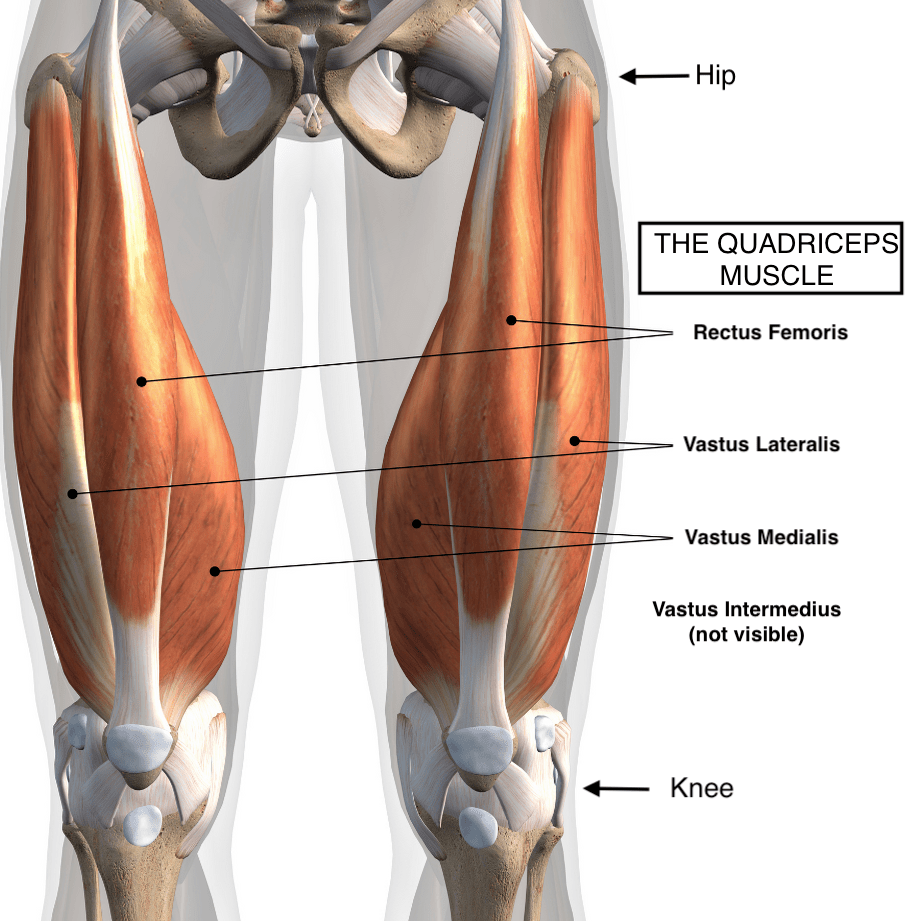
The quadriceps assist in extending the knees, and are used in every day activities such as getting up from a chair, walking and climbing stairs.
As we rely on the quadriceps to complete many every day activities, and if we spend a lot of time sitting, they can become an area of tightness.
In turn, although stretching out the quadriceps seems like a fairly straightforward way to ensure muscle tightness does not develop in this area, the quadriceps can be difficult to stretch. This is due to having to bring the knee up and balance with one leg, which can be an issue if mobility issues are present in the knee or shoulder, or balance issues are present.
Regardless of your current physical capabilities, the quadriceps are an important area of the body to stretch out and shouldn’t be neglected.
To make stretching out the quadriceps a little easier, here are 4 simple and effective stretches that you can do to get a good stretch in your quadricep muscles.
THE IMPORTANCE OF STRETCHING FOR SENIORS
Did you know that stretching is like a secret potion for keeping our bodies youthful and agile? As we age, our muscles tend to become shorter and lose elasticity. Think of them as rubber bands that need a good stretch to get back to their springy selves. Regular stretching is key to maintaining mobility, ensuring you can enjoy those lovely walks in the park and boogie down whenever the mood strikes.
Beyond keeping us limber, stretching plays a vital role in safety. It's our ally in the fight against falls and injuries, enhancing balance and coordination. This makes us more stable and sure-footed, which is incredibly important as we navigate our golden years.
PREPARATION FOR STRETCHING
Before we jump into the stretches, let's talk about doing it right. Timing and safety are paramount. Always warm up those muscles a bit before stretching - a light walk or gentle warm-up does wonders. Remember, stretching should feel good; it's not a competition. Listen to your body, take it slow, and breathe deeply. It's all about enjoying the process and feeling great.
QUADRICEPS STRETCHES FOR SENIORS
1) COMMON STANDING QUADRICEPS STRETCH
HOW TO:
Standing up tall holding on to a sturdy surface to ensure you’re steady.
Bring your foot up to your buttocks while reaching back and holding on to your foot.
Ensure your knees are in line with each other and you remain standing up tall.
Hold for the set time and repeat on the other leg.
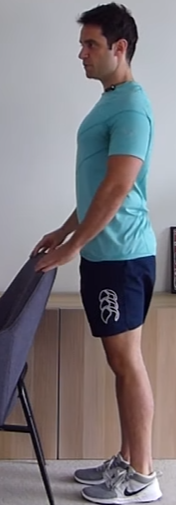
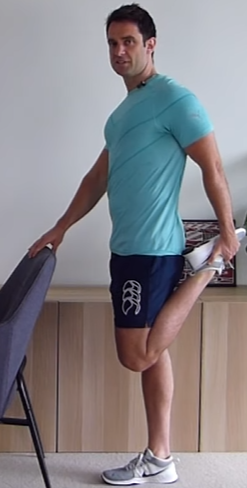
2) DYNAMIC STRETCH
For those not familiar with dynamic stretches, dynamic stretches consist of a movement-based type of stretching, where the muscles themselves are used to bring about a stretch.
HOW TO:
Standing up tall with your shoulders back and down and your feet hip-width apart.
Bring your foot up behind you as far as you feel comfortable, and then bring it back down.
Repeat on the other leg.
Continue alternating legs while completing this movement for the set time.
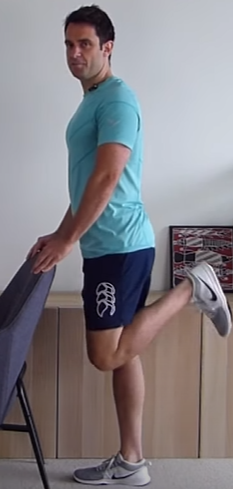
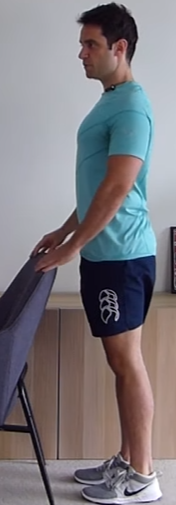
3) SIDE LYING STRETCH
HOW TO:
Lying on your side on your bed or floor in the position that is most comfortable for you.
Bring your ankle to your buttocks while bringing your arm back and holding on to your foot.
Gently bring your foot into your buttocks, feeling the stretch in the front of your thighs.
Hold for the set time and repeat on the other leg by safely rolling over and doing the same on the other side.
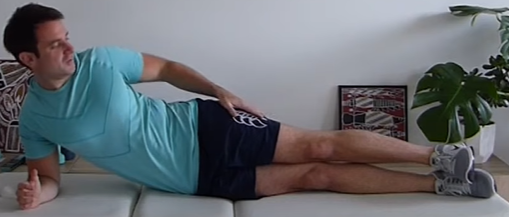
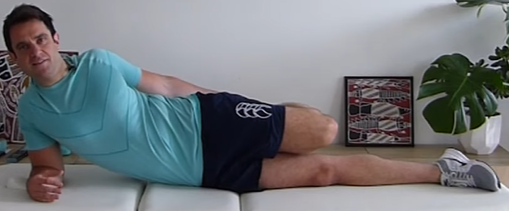
4) PRONE STRETCH (ON STOMACH) - WITH BELT
While effective when completed on the stomach, this stretch can also be completed in a side lying position.
HOW TO:
Place the end loop of the resistance band or belt around your ankle, facing behind you.
Lying on your stomach on your bed or floor in the position that is most comfortable for you.
Lift your leg up and place the resistance band or belt over your shoulder.
Gently pull on the resistance band or belt until you feel the stretch in your quadriceps.
Ensure your leg is coming directly up, and not pointing in ways or out ways.
Hold for the set time and repeat on the other leg.
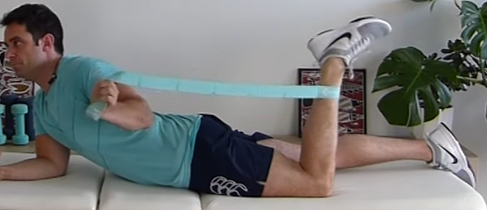

You can also see the stretches performed in video below!

Order the resistance band used in this video.

The Squat: Perfecting The Best Exercise For Your Legs
How to squat correctly - Perfect your squat and get the most out of it.
How to Squat For Seniors
The squat is one of the most effective exercises to keep your legs strong. It works all the muscles in the legs and activates the core.
It's also a movement that you undertake throughout your day; when you lift things, and when you are standing in certain postures. Remember, we never bend at the back to pick something up, or to move something heavy. We use our stronger muscles - our legs and our glutes (buttocks).
You want to get your squat technique correct to work the muscles effectively, and to not put excess strain on areas you shouldn't be.
So, without further ado, here is how to squat correctly. (why not get up and practice it now - it's an important exercise that will benefit you greatly).
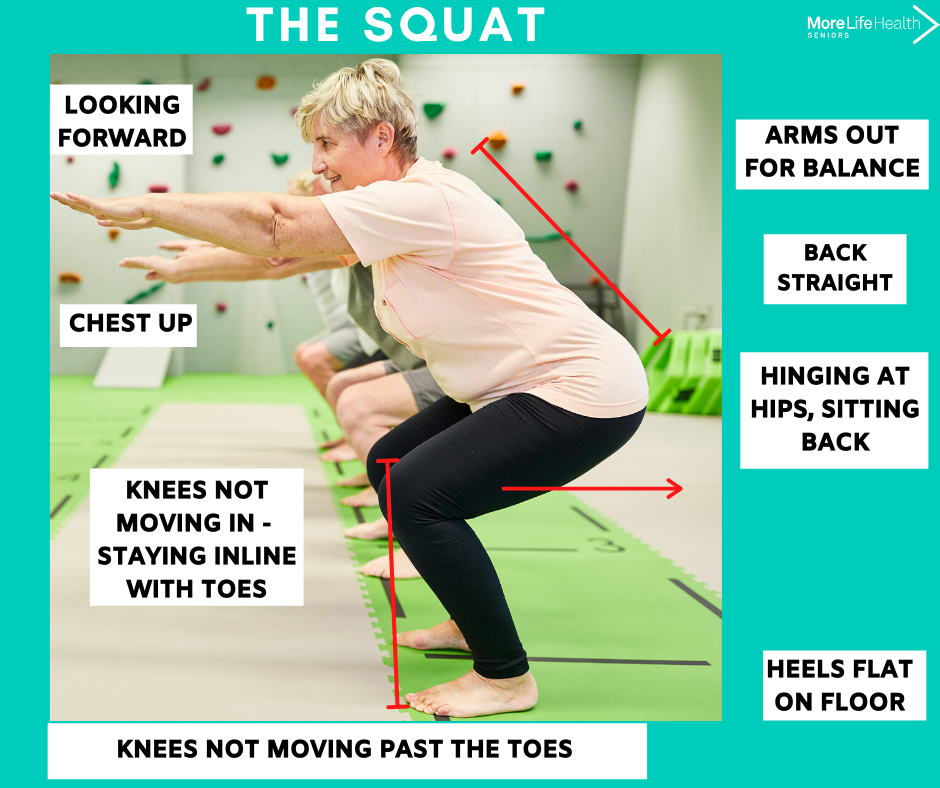
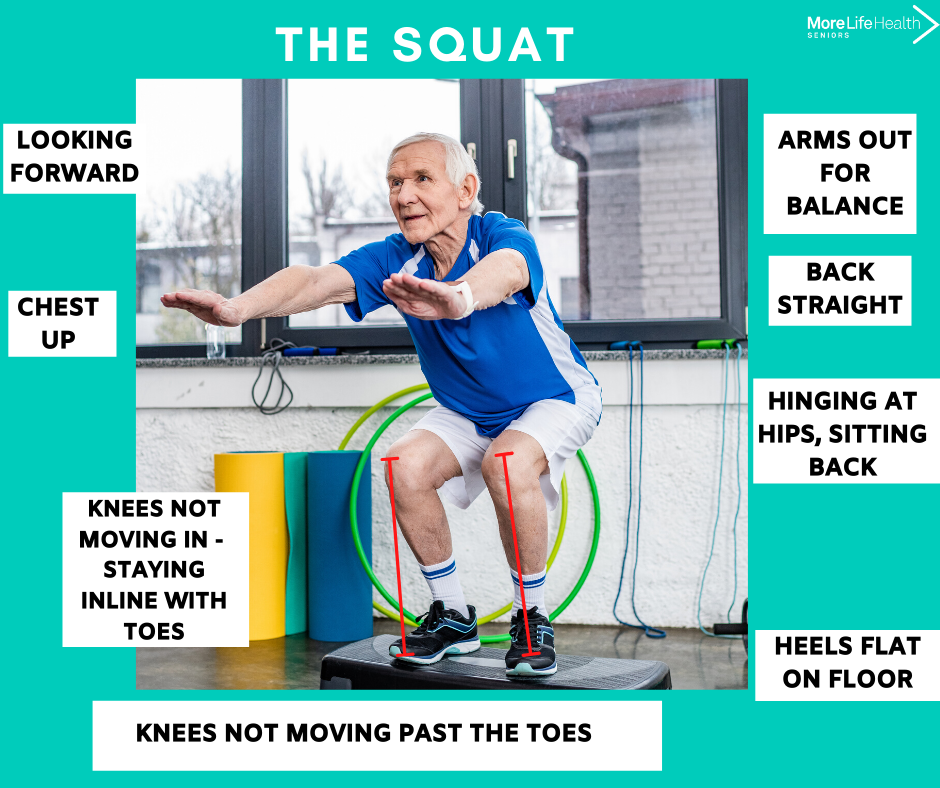
Squat: How to
Standing up tall with your feet shoulder-width apart. Toes can be facing forward, or slightly outwards.
Holding onto your chair with both hands, or keep your arms straight out in front for balance.
Engage your core, hinge (bend) at the hips and sit back as you would if you were to sit on a chair.
As you sit back, keep your chest up and your core tight, and go no lower than 90 degrees.
As you stand back up, put equal weight through both legs, ensuring your heels remain on the floor throughout.
Make sure your knees stay in the line of your toes; they don’t go forward past your toes, and they aren’t moving inward throughout the exercise.
Now, I also want to go through some common mistakes with the squat!
Let's take a look at these two ladies performing a partial squat.
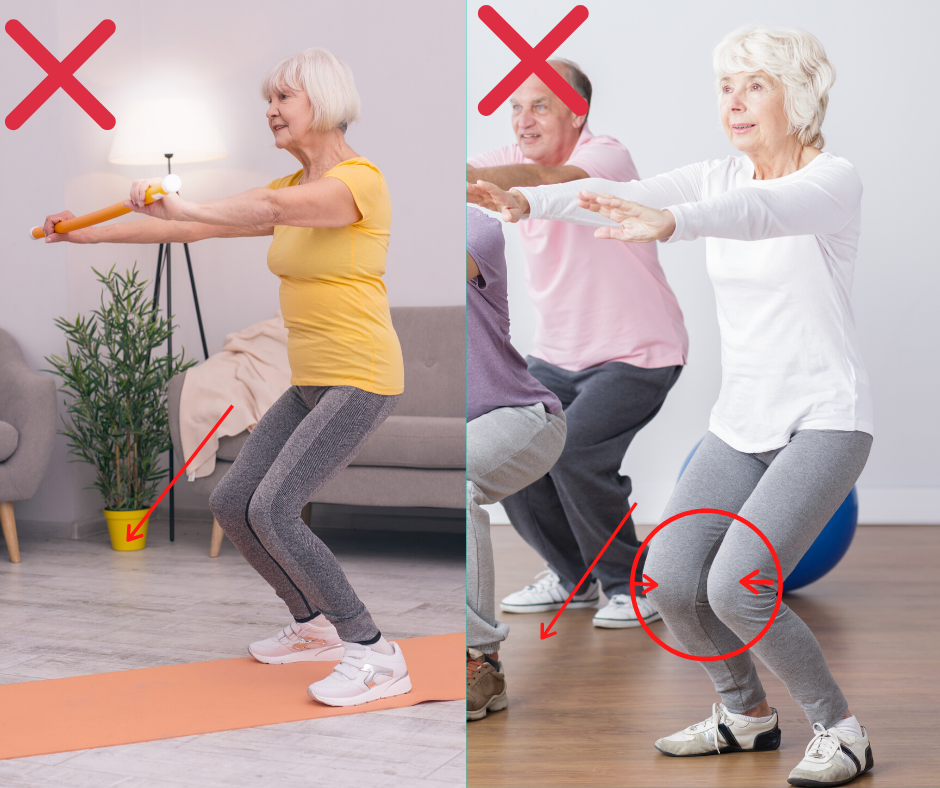
In these photos, it may look at first glance like the squat is being performed correctly, however, both ladies are leading with their knees.
With the lady on the right (white shirt), her knees are also moving inwards as she squats down (they are not in line with her toes).
Performing the squat like this places excess strain on the knees.
Remember to sit back and keep your knees in line with your toes.
Get the exercise technique correct - practice, practice, practice. It's important!
Benefits of Squats for Seniors
Improves Functional Independence: Regular squatting enhances leg strength and balance, crucial for daily activities such as walking, climbing stairs, and getting up from a chair.
Increases Bone Density and Joint Health: Weight-bearing exercises like squats can help maintain or increase bone density, reducing the risk of osteoporosis.
Enhances Overall Fitness: Squats engage multiple muscle groups, improving strength, flexibility, and endurance.
Common Concerns Addressed
Knee Pain and Joint Issues: We discuss modifications to the squat technique to reduce strain on knees and joints.
Balance Difficulties: Tips on maintaining balance during squatting, including using support like a chair or wall.
Fear of Injury: Emphasis on proper form and gradual progression to build confidence and prevent injuries.
Senior-Friendly Squat Techniques
Chair Squats: Using a chair for support, this technique is excellent for beginners or those with balance concerns.
Wall Squats: Leaning against a wall reduces pressure on the knees and helps maintain proper posture.
Partial Squats: Reducing the squat depth can benefit those with severe knee or hip issues.
Adapted Squat Routines
With Resistance Bands: Adding resistance bands can increase strength without heavy weights.
Squat to Overhead Raise: Combining squats with an overhead arm raise to engage the upper body and improve coordination.
Squat Holds: Holding the squat position for a few seconds increases muscle endurance and stability.
Tips for Successful Squatting
Warm-Up Properly: Engage in light cardio or stretching exercises to warm up the muscles before squatting.
Focus on Form, Not Depth: Maintaining correct posture’s more important than squatting deeply.
Listen to Your Body: Pay attention to any discomfort or pain and adjust the exercise accordingly.
Stay Consistent: Regular practice leads to improvement. Aim for a routine that is sustainable and enjoyable.
Consult with Health Professionals: Especially important for seniors with existing health conditions or mobility issues.
For more info on the squat:
That's it from me....
Remember new exercise videos are out regularly on the More Life Health YouTube Channel, so make sure you're subscribed to be the first to know.
Stay moving and stay happy!
- Mike
P.S. Join the Facebook Support Group (if you haven't already).

How to Make Your Favourite Exercise Videos Easy to Access.
Finding it difficult to access your favourite exercise videos, here’s how to create a playlist with your favourite More Life Health exercise videos, to ensure you are exercising each day!
CREATING AN EXERCISE VIDEO PLAYLIST ON YOUTUBE
Sifting through all the More Life Health exercise videos can be a time consuming process, and we want to make it as easy as possible to get moving without wasting any time.
When we can make it as easy as possible, sticking to the exercises becomes much easier to do!
So today, I am going to show you how you can save your favourite exercise videos and organise them effectively on YouTube (by creating a playlist), so when you want to get exercising, you’re all set to go with no time wasted.
Creating a YouTube playlist is simple and involves a fairly straight forward process, here’s how to do it.
Step 1: Sign in to your Google account

To create a YouTube playlist, you must have a YouTube account.
This can be achieved by simply signing in to YouTube with your Google account. If you do not have a Google account, you will need to create one and then sign in to YouTube with that account. To do this, please click here.
Step 2: Locate the video to add to The playlist
In the search bar at the top of the YouTube page, search for the exercise video you wish to add to your playlist or browse the multiple videos by clicking on the More Life Health YouTube Channel page.
You can also find the exercises categorised and updated on the More Life Health Website here.
Once you have located the video, click the video as if you are going to watch it.
Step 3: Select the Save icon BELOW the video

Below the video, select the Save icon on the video. This icon looks like three horizontal lines alongside a plus sign.
Step 4: Select Create new playlist

After selecting the Save icon, a menu should appear (as per the image). Select Create a new playlist.
Step 5: Name your playlist

Once you have selected Create a new playlist, another menu will appear. In the box labelled Name, type in the name of your new playlist.
Step 6: Choose your Privacy level

Within the same menu, you can chose the level of privacy that you want for your playlist. From the drop-down menu labelled Privacy, you can chose to make your playlist either public, unlisted, or private. For more information on these options, please click here.
Step 7: Select Create

Once you have named your new playlist and selected a privacy option for it, select the blue Create button. Once you have done this, your new playlist will have been created and the exercise video that you selected will have been automatically added to it.
To add more exercise videos to your new playlist, simply repeat step 3 and select which playlist you wish to add the exercise videos to.
ACCESSING YOUR new YouTube playlist
Step 1: select the GUIDE menu icon

On the very top left-hand corner of your screen, select the Guide menu icon. This icon looks like three horizontal lines stacked on top of one another.
Step 2: Select your playlist from the side menu

Your new playlist will be listed as an option on the side menu.
By selecting your playlist from the side menu, you will be able to view it and watch the exercise videos that you have saved to it (See image below).

Once you’re done, it’s now time to get exercising!
Remember to also make sure you’re subscribed to the More Life Health YouTube channel and you’ve got notifications turned on.
If you have any questions setting this up, let me know down below!
- Mike

Supporting Your Immune System For Seniors
I’m sure you all have coronavirus on your mind and the uncertainty of it all can be unsettling!
The best thing to do is to remain calm and focus on what can be done to keep in good health and protect from any virus best you can.
I’m not talking about rushing out and stocking up on gloves, hand sanitiser and……. toilet paper!
Let’s keep the focus on keeping your immune system as strong as possible!
HOW TO SUPPORT YOUR IMMUNE SYSTEM
Coronavirus is on all of our minds and the uncertainty of it all can be unsettling!
The best thing to do is to remain calm and focus on what can be done to stay in good health and protect yourself from this virus (or any virus) best you can.
I’m not talking about rushing out and stocking up on gloves, hand sanitiser and……. toilet paper!
Let’s keep the focus on the basics - keeping your immune system as strong as possible!
If you’ve been following my previous articles, you’d see the steps I outline in this article aren’t too different to the ones for good health. Because with good health, comes a stronger immune system.
Here are 5 things you can start doing now, to support your immune system!
# 1. DECREASE STRESS

You most probably know by now that I am big on this one.
I would even put decreasing stress before exercise for keeping healthy.
When you’re feeling good, feeling happy and feeling stress-free, life is easier.
Stress weakens our immune system and greatly decreases our health.
If you’re angry, unhappy, frustrated, or have any other negative feelings flowing through your body - you’re in a poorer state than if you were happy, joyous, and calm.
It’s natural to worry, but do your best to not stay with these feelings and emotions for long.
Listen to music, watch a movie, go for a walk, read a book, get into the garden, have a hot bath, meditate, practice mindfulness, talk to a friend, get into nature.
Do more of whatever it is that you enjoy and makes you feel happy and stress-free.
Also, I strongly suggest limiting what you see and hear in the media as to what’s going on in the world.
Watching and reading too much about what’s going on can leave us in a state of fear, depression and helplessness amongst other negative feelings.
Be informed, but try not to bathe in the doom and gloom.
I recommend reading and watching something more light-hearted which make you feel good instead.
This, in my opinion, is one of the best steps you can take to improve your health.
#2. GET MOVING
Spend less time sitting down and get up and get everything moving!
Do an exercise video. You can choose from many of my exercise videos here.
Go for a walk.
Or, do an activity or other exercise you enjoy!
Movement is medicine. Keep moving, everyday!
# 3. PRIORITISE SLEEP

Sleep is so, so important for good health.
Get good quality and quantity of sleep. Try and aim for 7-9 hours of sleep a night!
I am sure there are some steps you can do right now to improve your sleep.
Have a think about what you can be doing to get a better sleep from tonight?
Cut out screens an hour or two before bed?
Take a hot bath before bed?
New pillows?
New mattress?
Sunlight during the day?
Quieter room?
Better room temperature?
There are many things you can do! Invest in your sleep!
For more on getting a good night’s sleep, click here.
#4. GET SUNLIGHT
Along with getting vitamin D (discussed below), getting out in the sun makes us feel good. Sunlight is good for our health.
Aim for at least 20 minutes daily, gradually building up to this if required and avoid the hottest part of the day. Don’t overdo your time in the sun, however!
#5. CUT OUT THE JUNK. EAT HEALTHY NUTRIENT-DENSE, IMMUNE BOOSTING FOODS.
Limit unhealthy food. (For more on this click here).
Eat more nutrient-dense, healthy food.
Ensure you are getting adequate calories each day.
And, add foods in that support your immune system.
Here are some great immune supporting foods:
IMMUNE SUPPORTING FOODS
* VITAMIN C RICH FOODS

The best way to get adequate vitamin C is by eating a variety of colourful fruit and vegetables throughout your week.
Vitamin C rich foods include: citrus fruits (oranges, lemons and limes), guava and other tropical fruits, kiwi fruit, capsicums, berries, leafy greens.
* VITAMIN A RICH FOODS
Vitamin A is a fat-soluble vitamin that plays an essential role in our immune function.
There are 2 types of vitamin A - preformed vitamin A (retinol) and provitamin A (carotenoids).
Preformed Vitamin A (retinol) is only found in animal sources with the best sources being liver, oily fish, egg yolks, cheese and butter.
Provitamin A (Carotenoids) is found in plant foods as beta-carotene and alpha-carotene.
Best sources of provitamin A (carotenoids) include sweet potato, squash, carrots, kale and other leafy greens. Your body must convert carotenoids into retinol (vitamin A).
Not everyone can convert carotenoids into vitamin A (retinol), a balanced diet including the animal sources above will negate this issue.
* VITAMIN D RICH FOODS (AND SOURCES)

Vitamin D is another fat-soluble vitamin which also plays an essential role in immune function.
The best source of vitamin D is the sun, so try and get some sunlight daily.
Along with the sun, vitamin D is found in certain foods. Food sources of vitamin D include oily fish, egg yolks and mushrooms.
There are also foods fortified with vitamin D (For example - milk, cereal and orange juice), however, I recommend sticking to natural sources of vitamin D.
* BONE BROTH
Eating boney soups or swapping your tea or coffee for a cup of bone broth could do great things in keeping you healthy, and your immune system strong.
Bones are the best food source of collagen and contain many other vitamins and minerals including calcium, B vitamins ,vitamin C, D, K, iron, and magnesium.
For a bone broth recipe and to find out more on the benefits, click here.
* SHELLFISH
There are a large variety of shellfish to choose from including oysters, mussels, scallops, prawns (shrimp), crayfish and crab.
Shellfish are rich in nutrients including omega 3 fatty acids, zinc and vitamin B- 12 - all which support immune function.
Oysters contain more zinc per serving than any other food.
Eating shellfish once a week is adequate to supply your body with the vitamins and minerals for good health and a stronger immune system.
* RAW HONEY

When feeling unwell with a cold or flu there are good reasons why many go to a drink of hot tea or water with honey.
Rather than waiting until you get sick, why not make raw honey your sweetener of choice.
Raw honey is rich in antioxidants, contains many vitamins and minerals and has potent antibiotic activities. [1]
Keep in mind, most honey found on supermarket shelves has gone through a heating process which destroys the nutrients available. Choose the honey labelled “Raw Honey”.
* GARLIC & GINGER
Garlic and ginger are also commonly seen as a remedy in times of sickness. Again for good reason.
Ginger and garlic have antibacterial and antioxidant effects which can help fight off viruses and boost the immune system. [2, 3]
Do your best to include more of these steps above in your life to help support your immune system and help protect yourself from viruses.
Most of all remain calm. You will be ok!
How are you feeling about the COVID virus? Which of the above can you improve to help support your immune system?

Overcoming Pain - Empty Your Cup
To be free of persistent, or CHRONIC PAIN (which is pain lasting longer than 6-12 weeks) start with the understanding that medical imaging (i.e. X-Ray, MRI, or Ultrasound) is not going to diagnose the cause of the pain.
Unlike ACUTE PAIN, where the pain can clearly be identified on a scan (e.g. a broken bone, a ligament tear or a dislocation), for CHRONIC PAIN, a scan can only identify ‘abnormalities’ in the area of the pain.
These ‘abnormalities’ are NOT the cause of persistent pain.
To be free of persistent, or CHRONIC PAIN (which is pain lasting longer than 6-12 weeks) starts with the understanding that medical imaging (i.e. X-Ray, MRI, or Ultrasound) is not going to diagnose the cause of the pain.
Unlike ACUTE PAIN, where the pain can clearly be identified on a scan (e.g. a broken bone, a ligament tear or a dislocation), for CHRONIC PAIN, a scan can only identify ‘abnormalities’ in the area of the pain.
These ‘abnormalities’ are NOT the cause of persistent pain.
For more on this, see my article - The Real Cause of Pain.
By keeping the focus only on what has been identified on medical imaging can make overcoming pain difficult.
This goes for osteoarthritis and the many other chronic painful conditions.
Persistent pain is caused by a multitude of factors.
Which means ‘pain’ should be seen as a diagnosis in itself.
The many factors that cause pain include:
Persistent aggravating factors (think overuse injuries)
Weak or tight muscles
Poor movement
Past emotional traumas (even stemming as far back as childhood)
Current stress or worry
Being overweight/obese
Poor diet
Lack of sleep
Unhealthy habits
When these factors cause a significant amount of stress on the body (which happens more so as one gets older) pain will develop.
To see more on how complex pain can be - make sure you read my article Pain is More Than Meets The Eye.
To start overcoming pain, you need to work on ALL these factors.
To help you understand how to do this better, I’d like you to imagine yourself being a cup.
I know this sounds silly, but we’re going to do it anyway.
When you (now acting as a cup) are filled with many pain-inducing factors………….. Pain will result. (See diagram below).

Cup filled with pain causing factors.
All the factors combined are taking their toll on you. When it gets to the point where the mind and body can’t cope anymore, pain will occur in an area of weakness — your mind and body are telling you that things need to change.
To do that, you need to begin emptying your cup.
So you do!
Little by little, you begin making changes.
You also get professional help if needed and you speak to your doctor about your approach.
You know it’s not going to be an easy, quick or even comfortable road but you also understand that by doing this, not only will your pain ease, but your health will improve too.
You cut out or minimise anything you do consistently that could be aggravating your pain (for example overdoing some activities). By having a break, this will allow any underlying injuries to heal.
You start gradually increasing your exercise, working on strengthening weak areas and loosening areas of tightness. You also work towards getting your body in as good physical condition as possible.
You start eating healthier, cutting out foods that could have an inflammatory effect on your body and add more healthy food into your diet.
You start being much kinder to yourself, you stop worrying about the small things and stop trying to control that which you can’t control.
You start meditating daily or do something else that gives peace of mind (journaling, listening to music or whatever you find works for you) to help relieve stress and worry even more so.
It’s been challenging getting used to these new habits, but you feel your stress levels are decreasing.
You understand you may have some suppressed emotions or past traumas - so you decide to find someone who can help you process these past feelings. (This takes time, and past issues could go as far back as childhood).
You’re now involving yourself in more social events, planning exciting future activities and find yourself much happier.
You’re also spending more time outside, getting sunlight and utilising the restorative effect of sleep and make it a priority.
You feel yourself taking greater control of your life and are also feeling reductions in your pain.
Your cup is emptying!
You continue these techniques and have formed habits that are now part of your daily life.

With this continued approach your pain continues to decrease.
Eventually you have minimal to no pain.

Pain-Free, Happy cup
You’re a happy cup!
The above is a simplified version of what's required to be free of pain.
To find more about these techniques, read my article Overcoming Pain.
This approach takes time. Unfortunately, there are no quick, simple fixes for overcoming persistent pain.
Yes, there are ways to help with the pain for a short period, like pills, massage, injections, heat, ice, and so on. And these techniques do have their place.
But these techniques are not getting to the core (or the cause) of the pain. They are techniques for Managing Pain.
To overcome pain, for good, you must understand there is more to pain than what's seen on scans and adopt this new approach.
It is the way to truly be free of pain.
And the bonus is, it is also the way to a healthier you! :)
Are you dealing with any pain issue? What have you tried for your pain before? What do you think about this new way of thinking about pain?
If you need help with your pain, I have started online consults. If you want to determine what is causing your pain and begin overcoming it. Sign up for a CONSULTATION HERE.
Keys To Leading A Healthy Life
Here are the keys to leading a healthy lifestyle.
How are you going with them in your life?
Improving lifestyle for seniors -how to lead a healthy life
How are you going with these in your life?
Head here for more: https://morelifehealth.com/start-here
Need help with a specific area?:
GET MOVING MORE:
Start Here: https://morelifehealth.com/seniors-exercises
Get Walking: https://morelifehealth.com/articles/walkingforseniors
GET EATING HEALTHY
Start Here: https://morelifehealth.com/nutrition
TIPS FOR BETTER SLEEPS
tart Here: https://morelifehealth.com/articles/sleep-tips
SUNLIGHT & CLEAN AIR
Aim for 20 minutes each day avoiding the hottest part of the day.
Spend more time outside, in nature.
DO MORE OF WHAT MAKES YOU HAPPY
You know what it is that makes you happiest - do more of it
SPEND MORE TIME WITH THOSE YOU LOVE
The people that energise you and make you feel good!
RELAX MORE AND LET GO OF STRESS
Start Here: https://morelifehealth.com/relaxation
Make a conscious effort to do more of these and you'll be doing wonders for your health. 🙂
Change your focus to the things going well in your
- Mike
xo
PS. Can you think of any more steps you have taken which have helped you lead a healthy life?
![Healthy Eating For Seniors: How To Begin Eating Healthy - The First Step [Part 2]](https://images.squarespace-cdn.com/content/v1/5652f717e4b0070eb05c2f63/1652353475905-FQKRKH3T2XNYJJ35H6W1/healthy+food+for+seniors.jpg)
Healthy Eating For Seniors: How To Begin Eating Healthy - The First Step [Part 2]
In the first article (click to see part 1) we covered cutting out refined vegetable oils as the first step to improve your health through healthy eating.
The next food to cut out on your journey to being the healthiest you can be is.... any processed foods!
Now you most probably have heard this message before that processed food is no good for your health. But, you may be a little confused about it all.
So let’s get started clearing up what processed food is, and why you should be cutting it out of your diet.
THE FIRST STEP IN HEALTHY EATING FOR SENIORS (CONTINUED)
In the first part of this healthy eating article (click to see part 1) we covered cutting out refined vegetable oils as the first step to improve your health through healthy eating.
The next food to cut out on your journey to being the healthiest you can be is.... processed foods!
Now you most probably have heard this message before, that processed food is no good for your health. But, you may be a little confused about it all.
So let’s get started clearing up what processed food is, and why you should be cutting it out of your diet.
ABOUT PROCESSED FOODS
Processed foods are any food that has been altered in some way during preparation, and they vary in processing from minimally processed to heavily processed.
The greater the processing, usually the less nutrient-dense (and therefore unhealthy) a food becomes.
Foods that have not been processed include fruit, raw vegetables, raw dairy, raw meat, nuts and seafood. Minimally processed foods include dried food (e.g. dried fruit), pasteurised food (e.g. milk), cooked food, or chilled food.
Our foods can be further processed to moderately processed foods. Some examples of moderately processed foods include preserved vegetables and fruit, cheese, fresh bread and canned fish.
Minimally to moderately processed foods can be healthy if no other nasties are added (we’ll discuss certain nasties in this article).
Heavily processed food (usually referred to as ultra-processed foods) is manufactured using special machinery making them cheaper to produce, extending their shelf life and make them taste, and even look delicious (and fun).


Sounds great thus far, but all of this comes at the expense of our health!
Since heavily processed foods have entered our diet, our health has suffered dramatically. They have been linked to weight gain and obesity and health issues, including cardiovascular disease and diabetes. [1, 2]
These highly processed foods contain little, if any, foods in their natural form and are designed to imitate the qualities of natural foods.
They are usually wrapped in attractive packaging and marketed to get us eating more of them.
Highly processed foods contain little to no nutrients and are usually loaded with many, many unhealthy ingredients. These ingredients include:
REFINED VEGETABLE OILS
As discussed in part 1 of this article.
REFINED FLOUR
Whole grains in their natural form have nutrients our body needs. When grains are refined, these nutrients are depleted. Additionally, harmful additives are usually added, including, benzoyl peroxide (bleach) to give the flour its white colour.

When baking your favourite recipes that use flour, consider these healthier options.
Whole wheat flour — make sure it’s whole wheat flour, not wheat flour.
White whole wheat flour - this flour is made with white wheat berries and is milder tasting than regular whole wheat.
Spelt flour - higher in protein with fewer calories. This flour has different properties to other flours, so will take some getting used to when using in recipes.
REFINED SUGAR AND OTHER SWEETENERS - (Including High Fructose Corn Syrup and Aspartame)
Nowadays, we eat more sugar than we ever have before.

The Australian Bureau of Statistics reports that "Australians consume an average of 105 grams of total sugars per day. Just over half of this is free sugars (60 grams, equivalent to approximately 14 level teaspoons of white sugar), with the balance (45 grams) being the naturally occurring sugars."
This is mostly due to the high presence of refined sugars in a variety of products we eat regularly.
Consuming excessive amounts of refined sugar has been linked to weight gain and obesity, diabetes, heart disease and liver disease. [3]
Some of the foods and beverages that usually contain high doses of refined sugars include:
Breakfast cereal & granola.
Soft drinks (sodas).
Confectionary, biscuits (cookies), pastries, and cakes.
Fruit yoghurt and ice cream.
Syrups and juice concentrates.
Condiments like tomato sauce (ketchup), mustard & BBQ Sauce.
On the other hand, other sweeteners, including artificial sweeteners, are no better, and possibly worse.
Take high-fructose corn syrup. A sweetener that is commonly found in soft drinks and sweetened juices, processed desserts, condiments and salad dressings, prepackaged meals and other everyday indulgences. This sweetener has been linked to obesity, diabetes, metabolic syndrome and heart disease. [4, 5, 6]

Aspartame (marketed as NutraSweet or Equal) is another heavily used sweetener. This artificial sweetener is most commonly found in "diet" or "low sugar" food and drinks. Aspartame has been linked to obesity, metabolic syndrome, diabetes, and has been shown to cause cancer when administered to rats. [7, 8, 9]
ADDITIVES AND PROCESSING AIDS
If you read a food label on packaged foods, aside from the main ingredients, you'll probably find a lot of funny words and numbers you may not understand. These words and numbers are additives and processing aids.
Not all of them have shown to be harmful to our health, but to be safe, I say avoid them, or limit them as best you can!
Common additives include preservatives, artificial colourings, artificial flavourings, flavour enhancers, carbonating, firming, bulking and anti-bulking, de-foaming, anti-caking and glazing agents, emulsifiers, sequestrants and humectants.
OUT WITH THE JUNK FOOD
The simplest way to stop (or limit) these processed foods is by avoiding food that comes in a package. Foods that definitely don't look like they come from nature.
Obviously, some foods that come packaged aren't so bad for us. And some are actually healthy.

Not all packaged food is unhealthy.

Healthy - but plastic waste at it’s worst!
The next time you're cruising between the aisles of your local supermarket, try to steer clear of some of the following foods:

Boxed cereal, energy bars, energy drinks.
Confectionary & chocolates.
Low cost, packaged bread.
Cakes, donuts & biscuits (cookies) and other desserts.
Soft drinks (soda) & juices (Yes, even most fruit juices!).
Instant noodle meals and instant sauces.
Processed meats (deli meats, hot dogs, salami, cheap sausages etc.)
Frozen, deep-fried foods.
Margarine and certain other spreads.
Foods labelled "Health" and "weight loss" products.
Plant-based (fake) meats, cheeses and spreads - Impossible, Beyond meat etc. - these are NOT a healthy alternative to grass-fed meats, and natural cheeses or butter. If you’re vegetarian or vegan, stick to whole foods!
IN WITH THE HEALTH FOOD
If you’re thinking “so what's left for me to eat?”.
There's plenty!! Plenty of REAL whole food. Food that nature provides for us!
Your body needs nutrient-dense foods high in vitamins and minerals to not only sustain bodily processes but to also thrive!
And there are so many delicious natural, nutrient-dense foods out there!
Fruit, vegetables, dairy, meat, seafood, nuts, seeds, legumes, whole grains.

And don't just stick to the typical foods, why not try some nutritious foods you may have never tried before, or haven’t in a while.
Some examples (Which include some of mother nature's most nutrient-dense foods):
Tropical and other fruits (e.g. papaya, mangos, dragon fruits, guava, different berries).
Vegetables (e.g. yams, squash, potatoes, bamboo shoots).
Delicious cheeses (e.g. hard cheeses are less processed and very nutrient-dense) and other dairy (e.g. yoghurt, kefir).
Seafood (e.g. prawns, oysters, fish, crayfish, crab).
Meat (e.g. organ meats, bone broth, different cuts of meat. Organ meats are more nutrient-dense than the muscle meat. More on this at a later date).
Opt for grass-fed and organic meats (or wild meat), fruit or vegetables and local grass-fed dairy over other options when you can.
If you enjoy cooking - try new dishes, experiment with new, healthy recipes with fresh and locally grown produce. And, why not pass on your skills to your children and grandchildren? This will ensure their health flourishes for generations to come!
THE FUTURE NEEDS YOUR WISDOM!
CUTTING BACK ON SUGAR

We all know that most of us are getting too much sugar in our diet, but does this mean that you need to ditch sweet food altogether?
Absolutely not!
There are plenty of sugar alternatives to choose from that'll satisfy your sweet tooth and won't do any damage to your overall health.
Raw honey (not regular, processed honey) is the number #1 sweetener AND a health food.
It contains vitamins and minerals and other elements which offer antibacterial and antioxidant properties. Rather than using sugar in your tea or coffee, why not substitute it for a teaspoon of raw honey? (Remember to make sure it’s specifically labelled “raw” honey).
Other healthier sweeteners include maple syrup, coconut sugar and monk fruit.
When having to choose between "diet" and other drink or food options, unless there's a reason why you have to cut out the sugar, choose plain sugar over any harmful sweetener and minimise the amount you consume.
Also keep in mind, that just because something is going to have less of an effect on your waistline, does NOT mean it is healthy.
SHOPPING FOR HEALTHY ALTERNATIVES (READING FOOD LABELS)
Making your own alternatives to supermarket food is one way to make the foods you love healthier.
However, there are many healthier alternatives in your supermarkets, even for foods like ice cream. When you have an idea of what you’re looking for, you can choose the healthier options.
Here are just two examples of healthier alternatives I found in the supermarket:
HEALTHY SUPERMARKET ALTERNATIVE EXAMPLE # 1:
ICE CREAM
If you’re someone that loves ice cream, or maybe it’s something you like to give to your grandkids, there are healthier alternatives in supermarkets.
(If you’re extra keen, you can buy an ice cream maker and make your own. Plenty of healthy recipes online).
Here are two different supermarket vanilla ice creams.

Vanilla Ice Cream Ingredients: “Water, Sugar Syrup, Cream and/or butter (Milk), Skim Milk Concentrate, Glucose Syrup (from Wheat), Maltodextrin (from Maize), Whey Powder, Emulsifier (471-from Palm, 433), Vegetable Gum (410), Natural Flavour, Natural Colour (Caramelised Sugar, 160a).”

Better Option Vanilla Ice Cream Ingredients: “Fresh cream (39%), condensed skim milk, sugar, egg yolk, vanilla extract.” (5 simple ingredients).
When I am looking at these food ingredients, I am looking for less of the nasty ingredients (discussed above), ingredients closer to their natural form and fewer ingredients in total.
As you can see, one is filled with many unwanted ingredients, the other uses 5 simple ingredients close to natural form.
Nowadays, there are many ice creams marketed as “healthy” alternatives. They may be lower in calories, and sugar and higher in protein, however, most are still filled with unhealthy ingredients, so keep an eye out for this.
HEALTHY SUPERMARKET ALTERNATIVE EXAMPLE # 2:
ORANGE JUICE
Here are two different orange “juices” - one is actually labelled a fruit “drink”, because it isn’t just juice.
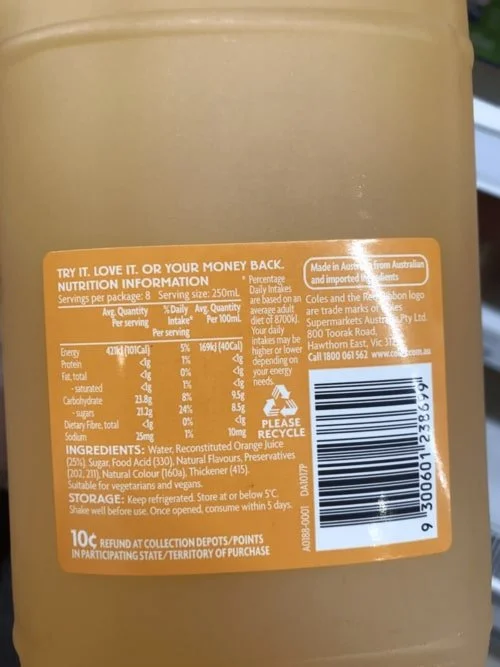
Orange Fruit Drink Ingredients - “Water, Reconstituted Orange Juice (25%), Food Acid (330), Natural Flavours, Preservatives (202, 211), Natural Colour (160a), Thickener (415).”

Better Option Orange Juice Ingredients - “Orange juice (100%)…. and nothing else!”
As you can see again, one is filled with unwanted ingredients, the other is 100% orange juice from local produce.
Choose the healthier options!
Yes, these healthier options might be a little more expensive, but your health is worth it. You are what you eat!
I could do this for many supermarket foods from chocolate, potato chips and even chocolate chip cookies. Although eating a piece of fruit or a plate of vegetables is better than these foods, there are always healthier alternatives.
If you would like to see more examples of healthy alternatives, let me know in the More Life Health Facebook Support Group.
Now you have an idea of what foods you should be cutting out, you can start eliminating them from your pantries and choose healthier alternatives.
Aim to do this gradually over time, little by little.
A significant change in your diet from what you have done for so long can be difficult and overwhelming. There is a lot to learn, and it takes discipline. These unhealthy foods are everywhere!
When you make the change, and you find yourself eating some junk foods again, don't beat yourself up. Don't dwell on it once it's done!
Just get back to eating real, whole foods and try and do this for the majority of the time!
Do your best!
Once you start making a conscious choice to cut out unhealthy foods, and you start getting familiar with food ingredients and reading the food labels, this all becomes much easier.
With these changes, after a while, you'll notice a significant difference in your health - both inside and out.
![Healthy Eating For Seniors: How To Begin Eating Healthy - The First Step [Part 1]](https://images.squarespace-cdn.com/content/v1/5652f717e4b0070eb05c2f63/1652264237787-P7LSF35Q0Y236E19LYWE/healthy+foods+for+seniors.png)
Healthy Eating For Seniors: How To Begin Eating Healthy - The First Step [Part 1]
What goes into our mouth is just as important (and sometimes more important) than the exercise we do for health, and achieving fitness goals.
When eating healthy, often you'll see certain health symptoms decrease and even disappear…..
This, amongst other benefits such as more energy, looking better, feeling better, improved sleep, weight loss, toned muscles, better balance, greater strength.
It is something you want to get right to thrive!
However, nutrition can often be an overlooked area (and not to mention a very confusing area).
THE FIRST STEP IN HEALTHY EATING FOR SENIORS
Often when I get asked a question on how I can improve a particular aspect of health, or even achieve fitness goals, I frequently mention the importance of a good diet or healthy eating.
I know you've heard this before, but I say this because I want to drive home how important what you eat is to your health.
You literally are what you eat!!
What goes into our mouth is just as important (and sometimes more important) than the exercise we do for health, and achieving fitness goals.
When eating healthy, often you'll see certain health symptoms decrease and even disappear…..
This, amongst other benefits such as more energy, looking better, feeling better, improved sleep, weight loss, toned muscles, better balance, greater strength.
It is something you want to get right to thrive!
However, nutrition can often be an overlooked area (and not to mention a very confusing area).
I know when I mention "to eat healthy," questions will arise like…… "Where do I even start with eating healthy?", "What do I do?" and "What do I eat?" to name a few.
And, It IS challenging to know how to start eating well. It really can be confusing, can get overwhelming and be too hard.
There are many new diets, health messages and superfoods that come on the market all the time.
They flood our computer screens, televisions, magazines, newspapers, Facebook feeds, and are all apparently best for us to eat, they'll turn back the clock and do wonders for health.
We are currently seeing the rise of the plant-based diets (where people only eat plant-based foods), and we see reports of great health from this diet. At the same time, we are witnessing the rise of another diet which is not given as much mainstream attention...…. The Carnivore diet, where people only eat animal-based products. These people, too, are reporting great health benefits.
You'll find doctors in favour of plant-based diets and other doctors in favour of carnivore diets.
These are just two of the many diets one can partake in, and already we can see how contradictory nutrition information can be.
Other popular diets include the Mediterranean diet, which was once supposedly the best diet for people to follow. We have the Ketogenic diet, the vegetarian diet, the Atkins diet, the Blood-Type diet, the Primal diet, the Medical Medium diet, intermittent fasting, we hear the heart association recommends this, the cancer council recommends that, to avoid diabetes eat like this…
We also hear many health messages… For example, you may have heard "stop eating eggs for your cholesterol" at a time in your life. Years later, eggs are now called "nature's multivitamin" due to new knowledge on cholesterol.
You may at one time have heard "butter is bad, eat margarine". Now I think it's quite safe to say most of us know that margarine is FAR from healthy.
We also have a large number of so-called superfoods popping up on the market that are meant to be the new best thing for health. (Hot Tip: they never usually are. Here today, gone tomorrow).
It really is very confusing…..
I could go on and on about the different diets, health messages (now and in the past) and all the superfoods out there causing all this confusion…
But, I want to help you end the confusion now!
I want to get you on your way to your healthiest self and to achieving your fitness goals by eating well.
Nutrition is a HUGE topic to cover, however, and I do wish it was just as simple as saying.. "Follow this diet"… Or "Just eat this food, it's super.."
But it's not that simple.
To really convey everything I have learnt from over 15 years of study on nutrition to get seniors eating healthy, I’d have to write a book. There is simply way too much to cover in one post.
But I have to get started somewhere and what these years of nutrition research have shown me is that what works for one person may not work for another. And there is still a whole lot we don't know!
However, all these diets and health messages usually agree on some things, which is EXACTLY the first step where we are going to get started on today for eating your way to better health and fitness.
And that is......
STEP 1: CUT OUT THE JUNK. EAT NATURALLY!
I'm sure it's safe to say that you knew cutting out the junk and eating natural healthy food (vegetables, healthy cuts of meat, fruit, dairy, eggs, nuts and so on), is the first step for everyone to do.
But it gets confusing to know what food is actually junk food and the reason why we cut it out.
So let's take this further now with what food item I recommend people cut out first to begin living a healthy life.
And that would be……… REFINED VEGETABLE (SEED) OILS.
More specifically, these oils:
Sunflower oil
Soybean oil
Safflower oil
Canola oil
Cottonseed oil
Peanut oil
Grapeseed oil
Rice bran oil
Corn oil
Vegetable oil (when you see "vegetable oil" listed as an oil - this refers to a blend of oils that are often based on canola, soybean or sunflower oils)

Now to some of you, this may come as quite a surprise.
Through false and misleading health messages in the past 100 years touting these oils as "healthy", they are now present in many of our foods we buy. They are also still used extensively for cooking in restaurants, despite much research now proving the harmful effects of these oils.
Furthermore, certain health organisations still promote these oils as being healthy.
It's now becoming known that substituting in these vegetable oils (which are predominantly made up of a type of fat known as polyunsaturated fats) for other forms of fat can have a detrimental effect on our health.
WHY ARE REFINED VEGETABLE OILS UNHEALTHY?
Let's take a look at the reasons why you should do your best to cut these oils out of your diet.
HIGH OMEGA-6 TO OMEGA-3 RATIO AND INFLAMMATION (OSTEOARTHRITIS & RHEUMATOID ARTHRITIS)
As touched on above, these oils are predominantly polyunsaturated fats.
Polyunsaturated fats are required in our diet and come in two forms: omega-3 fatty acids and omega-6 fatty acids.
An optimal balance between both omega-3 and omega-6 fatty acids are required for good health.
However, studies show that the modern Western diet contains much more omega-6 fats than the optimal ratio. This optimal ratio of omega-6 to omega-3 fats is 4:1 or less, whereas, in our modern Western diets, the ratio is usually around 16:1 and up.
With the vast use of these high omega-6 vegetable oils, we see this imbalance in the omega-6 to omega-3 fatty acid ratio away from what is optimal.
A high intake of these omega-6 fatty acids, with a low intake of omega-3 fatty acids over the past decade, has coincided with increases in chronic inflammatory diseases such as non-alcoholic fatty liver disease, cardiovascular disease, obesity, inflammatory bowel disease, rheumatoid arthritis, and Alzheimer's disease [1].
Research has looked at the effects of polyunsaturated fats on osteoarthritis. In arthritis, the synovial membrane (the connective tissue that lines the inner surface of joints) is often inflamed, and inflammatory substances (known as cytokines) contribute to cartilage deterioration.
One study on 535 subjects with an average age of 60 showed an increase in omega-6 polyunsaturated fats was associated with inflammation of the synovial membrane.
This study also showed that when omega-3 polyunsaturated fats were increased, leading to a more optimal omega-6 to omega-3 ratio, this was associated with less inflammation of the synovial membrane and cartilage loss.
REFINED VEGETABLE OILS BECOME RANCID EASILY
These polyunsaturated filled oils, when exposed to air, heat and light oxidise and harmful substances are produced - mainly trans fats and aldehydes.
Trans fats can be found in both animal based foods and in vegetable oils. The trans fats in animal based foods are not considered harmful. However, when found in refined vegetable oils, they have been shown to have serious health consequences, including the development of cardiovascular disease and diabetes.
Aldehydes have been linked to illnesses including cancer, heart disease and dementia. The accumulation of these aldehydes in the body promote the development of chronic disease and ageing.
REFINED VEGETABLE OILS CAN CAUSE OTHER HEALTH ISSUES (INCLUDING MENTAL HEALTH & VISION ISSUES) ESPECIALLY WHEN REPEATEDLY REHEATED
Refined vegetable oils have also been linked to decreased mental health (mood disorders, anxiety and depression), cognition and memory issues and dementia [2, 3].
These oils may also contribute to vision loss and have been shown to increase the risk of age-related macular degeneration.
Additionally, when you walk into fish and chip shops or fast food restaurants, you'll see deep fryers like this:

As these oils are frequently reheated (a practice commonly used in restaurants to save on costs and time), they become filled with unhealthy byproducts that are associated with diseases [4, 5].
And finally, these oils are often produced from Genetically Modified (GMO) crops, the full health effects of which are yet to be known.
So now I'm sure you know why I recommend cutting these oils out as the first step to eating for improved health.
Let's now take a look at where these oils are hiding and how you can cut them out of your diet. We'll also look at what oils (fats) you can consume instead that are beneficial to health and can be safely used when cooking.
REFINED VEGETABLE OILS TO CUT OUT
As mentioned above, limit the following oils best you can: canola oil, corn oil, cottonseed oil, grape seed oil, peanut oil, safflower oil, sesame oil, soybean oil, sunflower oil and rice bran oil.
If you have these oils in your pantry - throw them out! There are healthy alternatives which we’ll discuss soon.
Also, look into cutting back on foods that contain plenty of these refined fats as well. Some of the products you should avoid or limit best you can include:
Margarine (use butter), deep-fried foods (chips/fries, nuggets etc.), supermarket freezer/refrigerator foods, pastries, doughnuts and other baked goods (biscuits/cookies and cakes), chocolate, movie/microwave popcorn, mayonnaise, frozen pizzas and pies.

Something else to think about is eating out. Most of us enjoy eating out.. I certainly have places I love going to, and I do enjoy catching up with friends.
There are times when avoiding these oils is very difficult to do. The majority of restaurants, even high-end restaurants, cook their foods in these oils.
I do know people that ask for their foods to be cooked in butter or alternative oils when out. If you want to do this, I say go for it. However, I am not one to do it, and my advice is this.... Try and do the majority of your cooking at home and limit these oils best you can.
Obviously, you still want to enjoy life - so when you do eat out - try to choose healthier options AND just enjoy yourself -- GUILT FREE, WITHOUT WORRY :)
You’re probably thinking at this stage “What the hell am I allowed to eat? These oils seem like they are everywhere”. It does seem like these oils are in everything, and there is truth in that.
However, there are healthy oils/fats that you should opt for instead.
HEALTHY ALTERNATIVES
The right fats are essential for health. Cutting fats out of your diet is unhealthy.
There are plenty of healthy fats that you can consume, and alternatives to vegetable oils that you can use for cooking that are not harmful AND that will also provide you with nutrients your body needs for good health.
Consume these healthy vegetable oil alternatives instead:
Butter
Ghee
Coconut oil
Olive oil
Macadamia oil
Palm oil (sustainable)
Avocado oil

Many people are catching on to the fact that refined vegetable oils are unhealthy, and some food companies realise people are wanting healthy alternatives.
There are also new, smaller companies popping up and providing healthier options. So my advice is to get good at reading food labels.
Reading food labels and knowing the ingredients contained in what you eat can help you determine the difference between good and bad foods with harmful ingredients.
So vegetable oils are the first of the unhealthy foods to cut out of your diet.
For now, take this first step to cut out these harmful vegetable oils best you can and you've taken the first step in improving your health through healthy eating. Won't be long until you're feeling the difference!

How To Walk More - Without Pain And To Avoid Injury!
Whenever I meet a new patient for the first time who looks really healthy, moves well and has a sharp mind and is in their nineties or over a hundred, I always ask..
“What are your secrets to good health
And one of the common answers I get is variations of “I walked a lot”
With walking comes many benefits…
Whenever I have a new patient who is thriving in their nineties (or over a hundred), I always ask: "What is your secret to good health?"
I commonly get variations of: "I walk a lot. Always have!"
I believe walking to be one of the best types of exercise for people, especially seniors, to do to improve health and fitness.
Actually, I could go even further and say it IS the best type of exercise for seniors to improve health and fitness.
Why do I say this?
Because it is a type of exercise that almost everyone can do and comes with many health benefits. Not to mention little-to-no strain on our body!
Whether it's taking a longer walking route to the grocery store, walking (rather than driving) to visit a nearby friend, taking the stairs versus the elevator, or going on regular walks around your town (or in nature).
Whichever way you choose to get more walking into your life, one thing is for sure - more walking will bring many, many health benefits and could be the key to excellent health and fitness later in life.
This somewhat simple and straightforward activity can have a significant impact on your overall health - both physical and mental. I know whenever I am feeling overwhelmed, walking can do wonders for clearing my head and helping me to reset.
In this article, we will cover all you need to be a good walker. We'll cover the benefits of walking, how to make walking easier, how many steps you should be taking each day for good health and fitness (and how to track them). I'll also give a sample program, which if you are new to walking can help you get to 10,000 steps per day, without any hassles.
And, finally, I'll go through tips on how to get more walking into your life if you have knee pain.
Article Contents:
Is Walking Good For Seniors?
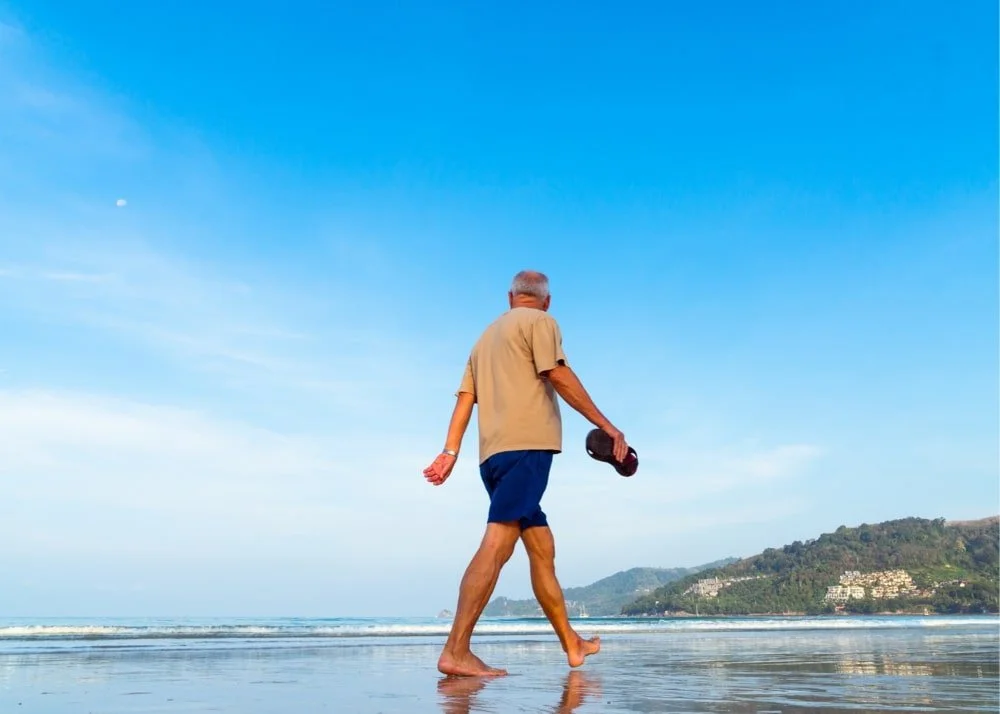
When it comes to exercise, especially when it’s all new, it can be met with some trepidation.
Am I going to be doing my body damage? Will walking wear out my joints? Will it make my arthritis worse? Will it cause me pain? Isn’t it better to rest?
These are some of the common thoughts that may arise for some people when thinking about walking more.
Yes! There are times that walking may aggravate symptoms. For example, knee pain (whether arthritis related or not). Or, weakness in other areas of the body, causing pain.
And there are times when you do need to rest!
However, you are born to move! The more movement you do, the better!
And walking IS GREAT EXERCISE FOR SENIORS!
Not doing exercise in some way is never the answer, even with arthritis.
There are ways to make walking comfortable and to decrease or prevent pain when doing it. At the end of this article, I will cover tips for walking for those who get knee pain.
Top 7 Benefits of Walking For Seniors
Walking is a great way to improve strength, endurance, mobility/flexibility and leads to many other health benefits.
Let’s now look at the benefits of walking:
Helps Build A Stronger, Fitter Body in a Safe Way
Gradually adding more walking into your day and making a conscious effort to spend less time sitting, is an effective way to get exercising more, each day, for the long run.
Although you also want to be doing specific exercises weekly to ensure you cover all components of fitness, walking alone will help you build a body of strong foundations and get you fit.
When you stay consistent, you will get a more conditioned body, able to withstand the stresses of daily life.
Yes, you may not get as fit or as strong in a short amount of time as someone who goes all out in the gym or begins running. But these types of higher-intensity exercises should only be done on a body able to withstand this.
High-intensity exercise on a weak body, not conditioned for this exercise, can lead to many problems. This is how your body can start breaking down, and pain and injuries occur.
Walking is a great way to get you stronger and build health and fitness while causing less harm.
If you do decide to do more strenuous/higher-intensity exercise or activity after some time of walking, you'll be more equipped to deal with it.
Weight Loss/Weight Maintenance
If you’re looking to maintain your weight or perhaps even lose some weight, then why not add daily walks into your schedule.
Contrary to popular belief, walking can be just as effective as running when it comes to burning those calories. Depending on your weight and walking speed, you can easily burn around 100 calories for every kilometre you pass.
Walking is one of the best ways to keep your weight in check, and it’s safer and less stressful on the joints than running and other forms of exercise.
Strengthens Bones, Improves mobility and Decreases pain
Walking for 30 minutes every day can reduce the risk of hip fractures. Studies have shown that regular walking can prevent loss of bone mass and reduce pain, which is important for those suffering from arthritis and osteoporosis.
Walking can also be beneficial for strengthening muscles, increasing mobility in the process and alleviating pain and pressure on the joints.
Walking is also another great way to improve overall flexibility and stability.
Improves Cardiovascular Health and Muscular Endurance
Older adults are at a higher risk of experiencing health issues relating to high blood pressure, high levels of cholesterol and heart disease in general.
Numerous studies have linked walking to improved cardiovascular health.
A 30-minute walk each day can improve circulation and lower blood sugar levels, leading to lower risks of diabetes, strokes and cardiac arrest.
Boosts Immune System
Want to help avoid the sniffles, sore throats and even the flu?
Put on some good shoes and let’s get walking!
Certain studies suggest that low and moderate exercise, including walking, can help fight off the flu, can help fight off infections and boost your immune system. [1, 2]
Promotes Better Mental Health and Cognition
Regular long walks can do wonders for mental wellbeing! They can help relieve symptoms of stress, anxiety and even depression.
Cardiovascular exercises such as walking are known to release endorphins - the feel-good chemicals in your body, helping you to feel good!
Staying active can also improve attention, memory, processing speed and cognitive function and can also reduce the risk of cognitive decline and dementia.
Another amazing thing about walking is that it works as a group activity as well! This is a great way to socialise, spend time with friends and family or even meet some new people. Why not search for a walking group you can join in your local area!
Improves Quality Of Sleep
If you have insomnia or lack of sleep, in general, you could find that walking more helps you get better quality and quantity of sleep.
Not only will walking exert your strength and tire out your body, but breathing in the fresh air can also help clear your head and put you straight into that sleep mode.
For more sleep tips, click here.
Top 5 Walking Tips For Seniors
Sometimes just putting your shoes on and taking off on a walk isn’t the best strategy when you decide to get walking more. Especially when it’s something you haven’t done in a long time.
Follow these tips below to help prevent any pain or injuries, to get the most out of your walking and help you keep it up for life!
EASE INTO IT
Although walking is considered low-impact exercise, I don’t recommend you just dive straight into it and go for gold.
If it has been a while since you’ve gone for a walk, don’t do too much too soon, and don’t do what you used to do.
It doesn’t matter if an activity is high or low in intensity, what matters is to ease your way into it.
If it has been some time since you’ve last walked, do half the distance you used to do and gradually build back to where you once were.
Give your body adequate rest, build up the distance and intensity (plus the number of walks) you do each week, over time.
Another aspect to keep in mind is preparation. The best way to avoid injuries and make the most out of your walking routines is to properly warm-up (click for a warm-up videos). Especially in colder weather and when doing brisk walks.
Yes even with walking, doing a light warm-up is a good idea. This will help loosen up your muscles and joints and get you ready for the exercise.
MAKE IT A GROUP ACTIVITY
Unlike most exercises, walking can be more fun when done with a friend or friends!
If you’re someone who enjoys the company of others or likes to make their workouts more engaging, then it might be a good idea to find a walking partner(s) or even join a walking group in your local area.
EQUIP YOURSELF
One of the best parts about walking is that it’s free of charge! There’s no monthly fees, pricey memberships or expensive gear - it’s just you and the world around you.
Of course, to make this experience safer and more pleasant, you do want to invest in a nice pair of comfortable walking shoes. Walking shoes are designed to offer good support and traction, as well as ultimate comfort for those lengthy strolls.
While it’s always a good idea to wear some breathable, moisture-wicking garments, wear whatever feels most comfortable for you.
Step tracking devices may be something that interests you if you want to get more serious with your walking. I cover step tracking devices below.
And, make sure you always have a bottle of water at your fingertips if going on long walks! Keeping hydrated is essential while staying active, so make sure to have some water handy at all times.
CHOOSE YOUR ENVIRONMENT

Thinking about where you walk (the terrains) can bring many individual benefits, helping you to get the most out of your walking, but it’s a good idea to be wary of the risks each pose.
Harder surfaces like sidewalks and roads can put a heavy strain on your knees and joints, but the even ground poses less of a falls risk.
Earth, beach or grass surfaces are generally softer and more comfortable on the joints than harder surfaces, however, ensure to keep an eye out for holes or any potential trip hazards.
You can also find out whether the city you live in has specialised tracks for walkers and runners. These tracks are made from rubber-like material and are much softer and springier than their concrete counterparts.
Natural walking trails can help improve your stability, strength and balance more than a flat surface due to the different movements required with the changes in terrain. Again, however, these surfaces pose a greater risk of falling than an even, flat surface. So ensure you're alert throughout your walk.
Adding in hills and stairs during your walks can help further increase your strength and fitness.
LISTEN TO YOUR BODY
Finally, listen to what your body is telling you. Your capabilities can change daily.
If your muscles are too sore or you’re feeling off, it may be time to have a rest, rather than push through it.
The best way to exercise safely is to consult with your Doctor or Physiotherapist before venturing into any new activity.
You can always shoot me a message if you have any questions or concerns about your routine! Alternatively, join the Facebook Support Community.
Walking is a great way to improve your health and fitness, and it is something that can be thoroughly enjoyable.
How Many Steps Should Seniors Take Each Day?
So we’ve established walking is good for health, but you’re probably thinking how many steps should you be getting to get in your daily activity requirements to help improve health and fitness.
Public health guidelines recommend 150 minutes of moderate-intensity physical activity each week to improve fitness (both cardiorespiratory and muscular) and for bone health, functional health, mental health and to decrease the risk of certain diseases.
But how many steps does this equate to each day? One study has done the fantastic work of working this all out for us.
This study rightly noted that steps walked must be taken over and above activities of daily living and must be done at least of moderate intensity. (For an easy way to track intensity. An RPE (Rating Of Perceived Exertion) Scale can be used- click to access).
Moderate intensity walking would be 11-14 on the RPE scale, meaning taking the steps at a pace that feels “Light” to “Somewhat Hard”.
Vigorous-intensity walking would be 15 - 16 or “Hard”.
This study concluded that taking 7,000-10,000 steps/day of at least moderate intensity and including activities of daily life, would provide the equivalent exercise to that recommended by the public health guidelines.
Another study concluded that more walking was associated with decreased risk of functional decline over two years in older adults. This study also recommended that greater than 6,000 steps/day gives a basic estimate of the amount of walking required to protect against functional decline in people with, or at risk of, knee osteoarthritis.
Tools To Track Your Walking
Tracking your steps is a great way to keep you motivated, and there are some simple and cost-effective ways you can track your steps taken.
Smartphone Tracking
Almost all of us have smartphones, which have built-in health applications (or that can be downloaded). These apps can track your steps.
Here is how to track your steps using your smartphone.
The Apple iPhone
The Apple iPhone (the most commonly used phone, and the phone I use) has one built-in. Here is how you access it:
1. Turn your phone on and look for an application called “health” - Usually anywhere on the first page.
2. Open the app and click on the date you want.
3. See the steps you’ve completed for that day. (Here you can also see any mindful minutes if you have relaxation apps connected).
Note - Steps taken will start collecting automatically in the background. You do not have to activate anything.

1. Find the “Health” App
2. Click on your date you walked.
3. View your steps taken.
Android Devices
Samsung or other smartphones, using android software, have similar capabilities also.
To track your steps, download “Google Fit” from the Google Play store on your smartphone.
Activity Trackers
Another way to help track your steps are activity trackers (or fitness trackers) that can be worn on your wrist.
Activity trackers can monitor an array of activity measures including walking, swimming or running, sleep and heart rate.

A common type of activity tracker you may have heard of is the “Fitbit”.
If you’re wanting to take your fitness to the next level and are super keen on tracking your activity levels, an activity tracker may be for you!
Activity trackers range in price for very basic models and increase in price depending on brands and features.
A great starting activity tracker is the Fitbit Inspire. This tracker will track your all-day activity, including steps, distance, hourly activity, active minutes, calories burned and your sleep. This model is also affordable and lightweight. Keep in mind these trackers have very small font size, so may be difficult to read.
Pedometers
A pedometer is simple device to help track your steps.

Although some pedometers track calories burned and distance covered; usually they only track steps taken.
If you want to track your steps and you’re not after the bells and whistles of an activity tracker and don't use a smartphone, a pedometer might be a cost-effective solution for you.
Remember, exercise should be fun! Getting moving more is what's most important, and tracking your steps may not be for you! So if you don't want to track your steps, you don't need to track your steps - just get walking, and enjoy it!
Here is a pedometer I recommend (click link) and is one of the most accurate pedometers.
COUCH POTATO TO 10,000 STEPS: A Sample Walking Program For Seniors
I’m sure you may have heard the goal of getting to 10,000 steps a day!
What about you? Would you love to be able to walk 10,000 steps yourself?
Do you think it is out of reach?
Well.... It doesn’t have to be!
Although it is not necessary to be getting in this many steps each day to improve your health and fitness, if this is a goal you would love to achieve, I say go for it!
With the right walking plan, you too can be walking 10,000 steps a day!
And.. I want to help you get there safely!
If you are new to walking or haven’t walked in some time one of the biggest mistakes you can make, and one commonly made, is doing too much too soon.
To achieve a goal like this, the key is to build it up over time.
Build your foundation, allow your body to adapt to the new stresses placed upon it, let your body to get stronger and fitter over time. Don’t do too much, too soon.
Attempting to do too much too soon could lead to pain, injury and frustration. Take your time. Do it properly. Give your body the rest and recovery it needs. There is no rush.
This goes for everyone. Put your ego aside; don’t rush it - build your foundation!
Now, here is a sample walking program:
[Note - I have made this program starting for a person who currently gets minimal amounts of walking in each day (hence the couch part) - If your fitness is beyond this, go straight to the 5,000-10,000 program below]
couch-5,000 Steps Per day
Week 1:
Monday, Wednesday, Friday - Walk 1000 steps on each of these days.
Week 2:
Monday, Wednesday, Friday - Walk 2000 steps on each of these days.
Week 3:
Monday, Wednesday, Friday - Walk 3000 steps on each of these days.
Week 4:
Monday, Wednesday, Friday - Walk 4000 steps on each of these days.
Week 5:
Monday, Wednesday, Friday - Walk 5000 steps on each of these days.
Week 6:
Monday, Wednesday, Friday - Walk 5000 steps on each of these days.
Tuesday, Thursday - Walk 2500 steps on each of these days.
Week 7:
Monday, Tuesday, Wednesday, Thursday, Friday - Walk 5000 steps on each of these days.
Tuesday, Thursday, Saturday - Walk 2500 steps on each of these days.
Week 8:
Monday, Wednesday, Friday - Walk 5000 steps on each of these days.
Tuesday, Thursday, Saturday - Walk 5000 steps on each of these days.
Sunday - Is Fun Day (Rest and forget about getting your steps in).
Do this walking plan as set out. The first couple of weeks may seem too easy, but it gradually gets more challenging, and you will feel it as the weeks progress.
Remember to always listen to your body and never push into pain. If you find the plan above is too challenging and ramping up too fast, do it over three or four months (rather than two).
Breaking up the steps throughout your day (e.g. in 10-minute bouts) will make it all more manageable.
If you are still getting pain with your walking even by following a walking program like the above, it's best to see a Physiotherapist in person to get an individualised program to help work through your pain issues.
Now you've comfortably reached 5,000 steps per day, and only when you can comfortably do 5,000 steps per day, it's time you can set your sights on the 10,000 steps/day goal.
5,000 - 10,000 Steps Per day
Week 1:
Monday, Wednesday, Friday - Walk 5000 steps on each of these days.
Tuesday, Thursday, Saturday- Walk 2500 steps on each of these days.
Sunday - Is still Fun Day (Rest and forget about getting your steps in for the rest of this program)
Week 2:
Monday, Wednesday, Friday - Walk 6000 steps on each of these days.
Tuesday, Thursday, Saturday - Walk 3000 steps on each of these days.
Week 3:
Monday, Wednesday, Friday - Walk 7000 steps on each of these days.
Tuesday, Thursday, Saturday - Walk 3500 steps on each of these days.
Week 4:
Monday, Wednesday, Friday - Walk 8000 steps on each of these days.
Tuesday, Thursday, Saturday - Walk 4000 steps on each of these days.
Week 5:
Monday, Wednesday, Friday - Walk 9000 steps on each of these days.
Tuesday, Thursday, Saturday - Walk 4500 steps on each of these days.
Week 6:
Monday, Wednesday, Friday - Walk 10000 steps on each of these days.
Tuesday, Thursday, Saturday - Walk 5000 steps on each of these days.
Week 7:
Monday, Wednesday, Friday - Walk 10000 steps on each of these days.
Tuesday, Thursday, Saturday - Walk 7500 steps on each of these days.
Week 8:
Monday, Wednesday, Friday - Walk 10000 steps on each of these days.
Tuesday, Thursday, Saturday - Walk 10000 steps on each of these days.
There are many ways to build up your walking volume to 10,000 steps over time, ensuring you allow your body to adapt to the activity. This sample program is just one of many ways you can do this.
As mentioned above, keep listening to your body and never push into pain. If you find the plan above is too challenging and ramping up too fast, take your time and do it over twelve or sixteen weeks rather than eight weeks.
Keep it up, stay consistent, and before you know it, you'll have hit your 10,000 steps goal!
10 TIPS FOR WALKING WITH ARTHRITIC/PAINFUL KNEES
For some of you, knee pain can make it challenging to get in your walking; and avoiding walking or exercise (in chronic pain conditions), is not the answer! It's about finding what works for you, to help keep you mobile and those legs strong.
Here are ten tips that can help ease the pain and allow more walking.
1. Wear The Right Footwear: Avoid toes with pointed ends, high heels, heavy shoes, or shoes with worn soles. Get a comfortable pair of walking shoes with good shock absorption to help decrease impact and pain through your knees.
2. Warm-Up: Start at a slow pace to allow your muscles to wake up and to help lubricate your joints prior to the walking and build into a faster pace. Also completing one of the warm-up videos will help get you ready for movement.
3. Build Up Your Walking Over Time: As with any exercise, if you are new to walking, or it has been some time since you have started walking, always, I'll repeat.... ALWAYS, ease your way into it. Start with less duration (or distance) at lower speed (e.g. ten minute blocks) and work your way up to longer duration and faster speeds. If you find yourself sore after a walk, a rest day in between may be required. Start small, and gradually progress, even if it seems too small. You want to be avoiding pain. Do not work into pain.
Choose the softer surface.
4. Choose Softer Surfaces: When walking on concrete surfaces, more shock goes through the knees. Jogging and running on concrete surfaces increases these impact forces.
Walking on softer surfaces such as sand, grass and dirt place less strain on your joints. Softer athletic tracks even more so.
5. Start By Walking In a Pool: If you find you have pain walking on the ground, a simple way to build your muscle strength while taking the pain out of walking by reducing weight is to start walking in water.
The deeper the water (while still able to stand) the less strain on the knees (and other joints).
Once you have spent some weeks walking in a pool, your legs will be better suited to handle land-based walking.
6. Walk When Your Pain is Lowest: If you get pain in the morning, or at night, for example, avoid these times and walk during the times of day where your pain levels are decreased.
7. Lose Excess Weight: Carrying extra weight puts extra stress and strain on your knees. Even just losing a few kilos, if overweight, can help reduce pain symptoms. Remember, 90% of weight loss is diet, so to lose weight faster, make sure you’re eating the right amount and types of food.
8. Build Your Leg Strength - Performing knee strengthening exercises to help strengthen your knees or adding in cycling or stationary bike work can help improve leg strength. When the muscles surrounding your knee joints are strong, the strain on your joints will be reduced.

9. Walking Aid/Poles May Help: Depending on your condition, a walking stick, or a wheeled walking aid may help reduce the strain on your knees. These devices will help decrease fatigue and also help with stability. Trekking poles may also help when going on longer walks.
10. Movement is Medicine: Get stronger, get more flexible, build your fitness. Stop sitting so much. Aim to get more movement and exercises in your life each day.
Walking is a great way to improve your health and fitness and something that can be thoroughly enjoyable.
Get more walking in your life and start improving your health today!

A VERY QUICK INTRODUCTION TO NUTRITION FOR SENIORS: LEARNING THE BASICS
Healthy eating keeps our muscles strong and our minds alert and gives our bones the nutrients they need to stay strong.
When we increase our physical activity and exercise, our metabolic demands increase. What this means is we should ensure we are getting adequate nutrition.
We want the nutrients required to keep us healthy and the energy to fuel our body, to not only undertake the activity but to assist in the recovery process to make us stronger and healthier versions of ourselves.
To understand how to do this, a short nutrition lesson is required. Nutrition is a big topic, so I’m going to break it down in a simple way to understand and give some guidelines to help you keep healthy.
FIRST PUBLISHED: 11/11/2019. LAST UPDATED: 11/7/2022
GETTING STARTED EATING HEALTHY
Healthy eating keeps our muscles strong and our minds alert and gives our bones the nutrients they need to stay strong.
When we increase our physical activity and exercise, our metabolic demands increase. What this means is we should ensure we are getting adequate nutrition.
We want the nutrients required to keep us healthy and the energy to fuel our body, to not only undertake the activity but to assist in the recovery process to make us stronger and healthier versions of ourselves.
To understand how to do this, a short nutrition lesson is required. Nutrition is a big and complex topic, so I’m going to break it down in a simple way to understand and give some guidelines to help you keep healthy.
NUTRITION BASICS
All the food we eat is made up of both macronutrients and micronutrients.
Macronutrients are the nutrients that supply us with energy. There are three macronutrients: Protein, carbohydrates and fats. Macronutrients make up most of the food, whatever it is (hence macro).
The micronutrients, on the other hand, are the nutrients only needed in small amounts yet are vital for the proper functioning of our body to maintain health. (These are the vitamins and minerals.)
To maintain good health, we must ensure adequate energy from protein, carbohydrates, and fats daily from healthy foods.
These foods should also contain plenty of micronutrients to ensure our body is functioning optimally and is in good health. Some foods are more nutrient-dense than others.
We also want to stay properly hydrated. Our body is 70% water, after all.
THE MACRONUTRIENTS
So now, let’s dive into the macronutrients that make up most of our food.
Starting with the one I feel older adults do not get enough of:
PROTEIN
When thinking of protein, think of meats, fish, cheese, eggs, milk, beans, nuts and seeds.

Protein is vital for every cell in our body. Its main job is to build and repair tissues.
It’s the building block for muscles, cartilage, skin, bones and blood. It is used to make enzymes, hormones and other body chemicals.
Protein will increase our metabolism. Make us feel fuller after eating. It will help us lose weight, build muscle and give us a fitter/more toned appearance (by helping us lose weight and build muscle).
Protein is an essential nutrient, and we must ensure we get adequate amounts daily.
HOW MUCH PROTEIN SHOULD SENIORS EAT?
The Australian Dietary Guidelines recommends that 15-25% of our total energy intake should come from protein, with a daily intake of the following:
The RDI of protein for women aged 19–70 is 46 grams daily.
The RDI of protein for men aged 19-70 is 64 grams daily.
Women over 70 should have at least 57g per day.
Men over 70 should have over 81g per day.
Do you feel you are getting enough?
To learn more about protein and get tips to get more protein daily, click here to learn more.
The next macro nutrient is our fats.
FATS
Healthy fats are our oils, cheeses, butter, nuts, avocados and oily fish.

Fats are vital nutrients that supply us with energy and allow the other nutrients to do their jobs. Fats are essential for healthy body function; without them, we can't live.
Although there may have been a time when you heard that fats are the enemy of health and our waistline, this is not true. Don't cut out fats.
But be mindful of the TYPE of fats you put into your body.
There are four types of dietary fats:
Saturated fats - beef, lamb, pork, whole milk, cream, butter, cheese.
Monounsaturated fats - olive oil, nuts (almonds, cashews, pecans etc.), avocados, nut butter, olives.
Polyunsaturated fats - walnuts, fish (salmon, mackerel, herring, trout), seeds
Trans fats - cakes, cookies, crackers, icings, margarine, and microwave popcorn. The bad fats.
The healthier fats are the top three fats. Trans fats are the fats we want to avoid!
Saturated fats get a bad rap also, but they are not to be feared.
Eat the natural sources of fats and stay away from anything that is processed!
CARBOHYDRATES
The next and final macronutrient of the food we eat is carbohydrates.
Carbohydrates are your starches (your bread, pasta, rice, potatoes, breakfast cereals etc.), sugars and fibres found in grains, vegetables, fruits and dairy products (which contain fats and protein).

Carbohydrates are our fruits and other sugars, our vegetables (our starches and fibre), and our dairy products.
Like fats have in the past (and still do among some people today), carbohydrates now get a bad rap for our health and waistline.
This is where everything gets very confusing. If fats are bad, carbohydrates are bad, red meats are bad, dairy is bad, ….. (I could go on with what is supposedly bad). What are we meant to eat?
In short, my answer is... There will always be nutrient-dense healthy sources and highly processed, unhealthy sources with fats, carbohydrates and even proteins.
The best way to get adequate amounts of the above macronutrients (protein, carbohydrates and fats) and micronutrients (vitamins and minerals) is to choose natural food sources over packaged and processed food and eat a diet filled with fruit and vegetables, grains, quality meat sources and dairy.
Carbohydrates are one of the primary food groups and are essential to living a healthy life.
The majority of your calories should come from carbohydrates. This includes healthy grains, dairy products, fruit and vegetables.
The Australian Dietary Guidelines recommends 5-6 serves of vegetables a day for people 65+ and 2 serves of fruit. Where it can get confusing is how much a serve is. See the diagram below to see what a serving of fruit and vegetables looks like.

The equivalent of a serving of fruit and vegetables.
Aim to get three healthy meals daily filled with adequate protein, healthy fats and carbohydrates.
When eating healthy, these natural food sources take care of our macronutrient needs and are filled with our micronutrients (the vitamins and minerals) needed to maintain optimal bodily function.
So now you have a basic understanding of nutrition, to continue on your journey of healthy eating:

HOW TO MAKE EGGSHELL CALCIUM: A SIMPLE, NATURAL, EFFECTIVE CALCIUM SUPPLEMENT FOR STRONGER BONES
Eggshells are comprised of calcium carbonate, which is the most common type of calcium found in nature.
The abundance of calcium makes eggshells an excellent, although fairly under-appreciated, source of this essential mineral.
Calcium plays a significant role in preventing conditions commonly seen in older adults, particularly osteoporosis and osteopenia.
What is Eggshell Calcium Powder?
Ever wondered what to do with those leftover eggshells from your brekkie? Well, here's a bit of a surprise – those eggshells can be turned into something quite beneficial. Say hello to eggshell calcium powder, a nifty way to up your calcium intake naturally.
So, what's in this powder? It's mostly made up of calcium carbonate, the same stuff you find in limestone and chalk. Here's the interesting bit: to make this powder, eggshells are first boiled to get rid of any nasties, then baked to dry out, and finally ground into a fine powder. Simple, yet brilliant!
Now, let's have a chinwag about how it stacks up against other calcium sources. Compared to over-the-counter supplements, eggshell calcium is more natural and just as effective. Plus, it's a win for the environment, turning waste into something wonderful!
HOW TO MAKE EGGSHELL CALCIUM POWDER
You may remember a time when eggs were deemed unhealthy due to their cholesterol content.
Nowadays, and many years of research later, this criticism has now been proven wrong! Eggs have since been shown to have almost NO effect on blood cholesterol levels.
The Heart Foundation agrees that eggs are healthy and DO NOT increase the risk of heart disease.
In fact, eggs are known now as nature’s multivitamin and for good reason.
Eggs are abundant in vitamins, minerals and other healthy nutrients. Including, quality protein, omega-3 fatty acids, vitamins A, D, E and B12, antioxidants and choline. All essential for health.
But the health benefits of eggs don’t stop with the whites and yolks. You’d be surprised to learn how nutritious and beneficial the shell can be.
Now, the thought of consuming eggshells probably doesn’t appeal to you. However, they are an effective (and inexpensive) source of calcium to make your bones stronger and further improve health. And, when made into a powder, it is very easy to consume, and flavourless!
In this article, I’ll explain how consuming eggshell powder can benefit you and show how you can make eggshell calcium powder in a few simple steps.
So the next time you decide to crack a few eggs to make a delicious omelette or bake a cake, make sure you don’t scrap those eggshells! Save them for later use!
The Benefits Of Consuming Eggshells!
Eggshells are comprised of calcium carbonate, which is the most common type of calcium found in nature.
The abundance of calcium makes eggshells an excellent, although fairly under-appreciated, source of this essential mineral.
Calcium plays a significant role in preventing conditions commonly seen in older adults, particularly osteoporosis and osteopenia.
A study conducted at The National Institute of Rheumatic Diseases shows the benefits of eggshells on improving bone metabolism. The research suggests that eggshell powder, being rich in calcium and other organic compounds such as strontium and fluorine, can have a positive effect on improving bone density.
This study further notes that eggshell powder can stimulate cartilage growth and in postmenopausal women and women with senile osteoporosis, eggshell powder increases bone density and mobility and reduces pain and bone resorption.
This study concluded that eggshell powder is suitable in preventing and treating osteoporosis.
Another study notes that eggshell powder is a great source of bioavailable calcium, increases bone mineral density and can delay bone demineralisation when consumed regularly. The participants in the study also reported experiencing less pain when consuming eggshell powder for longer periods.
Moreover, eggshell membrane, the substance found between the eggshells and egg whites, is mostly comprised of collagen, which is known to promote joint health among other benefits (to find out more about the benefits of collagen - click here).
Eggshell membrane supplements are used to treat pain and discomfort in joints, something that often affects older adults.
How Much Calcium Do I Need
According to Osteoporosis Australia, the recommended daily intake of calcium, through diet, should be around 1,300 mg per day. (To find out more about calcium click here).
However, plenty of people, especially seniors suffering from calcium deficiency, resort to calcium supplements enriched with vitamin D3. Vitamin D is often used alongside calcium supplements, as it helps the body absorb the mineral.
Research suggests a daily supplement dose of 1,000 mg of calcium and 600 mg of vitamin D can counteract the effects of osteoporosis. However, it is said that older adults might benefit from a slightly higher dose to reduce the risks of fractures and falls.
Of course, supplements are only advised to those who aren’t able to get sufficient amounts of calcium and vitamins from natural food sources.
Before resorting to supplementation of any kind, try to bump up your calcium intake by consuming calcium-rich foods such as dairy and eggs (or try this bone broth recipe).
A single teaspoon of the eggshell calcium powder contains roughly 800 - 1,000 mg of calcium. It’s best to divide this dose up into smaller doses throughout the day
There are many ways to consume the eggshell powder. You can mix it up with a small amount of water, or juice. Sprinkle it on your cereal on in spaghetti bolognese. Whatever works best for you
The process of making your calcium powder is pretty straightforward and simple; let's begin.
Different Uses of Eggshell Calcium Powder
This little gem has a few tricks up its sleeve. As a dietary supplement, it's a cracker. Just a pinch of this powder in your smoothie or sprinkled over your morning cereal, and you're sorted for your daily calcium needs.
But wait, there's more! Eggshell calcium isn't just for people; your plants love it too. Sprinkle it in your garden, and watch your greens grow with gusto. It's a top-notch natural fertiliser.
Precautions and Side Effects
Now, it's not all beer and Skittles. There are a few things to keep in mind. Firstly, moderation is key. Too much of this, and you might end up with more calcium than you bargained for. Also, if you're already on calcium supplements or other medications, have a yarn with your doctor first. It's essential to make sure everything works together harmoniously.
So, there you have it – eggshell calcium powder in a nutshell. Whether it's in your breakfast bowl or helping your petunias perk up, it's a versatile little number. Just remember, like with anything, to use it wisely.
HOW TO MAKE EGGSHELL CALCIUM
INGREDIENTS AND EQUIPMENT
To make your powder you will need a few easy to source things that you probably already have lying around the house.
You will need:
A carton of eggs (stick to organic, pasture raised eggs if you can)
A medium to large sized pot
An electric coffee grinder - One can be purchased for $20-30 online. (I bought mine from K-Mart for $30 AUD).
A fine strainer
An airtight container to store your eggshell powder
DIRECTIONS
The entire procedure of making eggshell powder is relatively quick and painless, so it shouldn’t take much of your time.
The best part is that once you’re done, you can easily store the powder for future use and you now have an inexpensive, effective source of calcium to help get your daily calcium requirements and keep your bones strong.
Step 1

Next time you are eating your eggs, preparing a meal or baking a cake, rinse your eggs in water to remove any excess and save your eggshells. I kept mine in the carton. Make sure not to dispose of the egg membranes as they are also healthy.
Step 2
Repeat step 1 until you have a carton full of eggshells!
Step 3
Fill a pot with water, bring to the boil and carefully place the eggshells inside.
Step 4
Boil the eggshells for about 5-10 minutes to help kill off any nasties.
Step 5
Drain the eggshells and place them on a baking tray and allow to dry all day or overnight.
Step 6
Preheat an oven to 90 degrees Celcius (195 Fahrenheit) and place the eggshells in the oven for 12 minutes to allow them to dry out entirely
Step 7
Remove the tray from the oven and place the shells in your coffee grinder. Grind until the eggshells become a finely ground powder. Continue until you’ve used up all the eggshells.
Step 8
Sift the powder through a strainer to ensure any larger shells are removed.


Step 9
Pour the eggshell powder into an airtight container and seal tightly. Store the jar in a cold and dry place for up to 2 months.
Step 10
Enjoy your homemade eggshell calcium powder!
And that’s all it takes to get an effective, inexpensive calcium supplement which will help you get stronger bones!
Enjoy! and Keep Moving
Mike
Do you need more calcium in your diet? Are you currently supplementing? How do you get more calcium?