Gentle Hand & Finger Arthritis Exercises for Seniors
Dealing with hand arthritis, stiff fingers, or sore hands? In this gentle follow-along routine, I'll guide you through simple exercises designed to improve hand and finger mobility, gently build strength, and help keep your hands moving well for everyday activities.
A Full Routine for Hand Mobility, Strength and Everyday Movement
If you have arthritis in your hands, or your fingers have been feeling stiff or sore, you’ll often notice it during the little things you do every day.
Opening a jar, turning a tap, doing up buttons, picking things up or gripping and holding objects can all become more difficult when your hands aren’t moving as comfortably as they used to.
In this full follow-along routine, I’ll take you through a range of gentle exercises for the hands, fingers, thumbs and wrists.
We’ll work on mobility and strength, as well as some of the movements your hands need for everyday tasks such as gripping, pinching and picking things up.
What We’ll Work On
Throughout the routine, we’ll cover:
Hand and finger mobility
Thumb movement and strength
Wrist mobility
Gentle grip strength
Finger and thumb pinch strength
Practical movements such as gripping, pinching and picking up objects
You don’t need any special exercise equipment. Just grab a small towel, a soft sponge or squeeze ball and something light to pick up, such as a mug, remote control or glasses case.
Why Keep Your Hands Moving?
We use our hands all day without really thinking about it.
And just like the rest of the body, regular, comfortable movement can help maintain mobility and strength and keep your hands working well for the things you do every day.
If your hands have been still for a while, even a few gentle movements such as opening and closing your fingers or moving your wrists can be a nice way to get them moving again.
Exercising With Hand Arthritis
If you have arthritis, your hands may feel different from one day to the next. Some days they might move quite freely, while on other days they may feel stiffer or more sensitive.
There’s no need to force the movements or squeeze as hard as you can. Work within a comfortable range and adjust the exercises to how your hands are feeling on the day.
If your hands are particularly stiff, you may also find that warming them with warm water or a heat pack for a few minutes before exercising feels comfortable.
Before You Get Started
Take a moment before the routine to notice how your hands and fingers are feeling.
Then, once you’ve finished, check in with them again. Notice whether they feel any different and whether your fingers, thumbs and wrists are moving a little more comfortably.
These exercises are designed to be gentle and should feel comfortable. If an exercise causes pain, make the movement smaller or leave that exercise out.
If you have significant hand pain or swelling, a recent injury or surgery, or you’re unsure whether these exercises are suitable for you, speak with your doctor or physiotherapist before starting.
Our hands play such an important role in keeping us active and independent, so don’t forget to give them a little attention too.
Stay Moving, Stay Happy, and Enjoy Each Day!
Mike

Hand Exercises With Therapy Balls For Older Adults: Improving Strength and Dexterity
As we age, our hands can become weaker and less dexterous (less able to perform precise and coordinated movements) due to natural muscle loss and decreased activity levels affecting our ability to perform everyday tasks.
Arthritis can have a profound impact on hand function, making everyday tasks difficult and painful.
Fortunately, regular hand strengthening exercises can help improve grip strength, dexterity, and overall hand function, making it easier to perform daily activities and maintain independence.
Today we are going to be covering some exercises for the hands using therapy balls to help provide resistance and improve hand strength and flexibility.
10 BEST Hand Exercises with STRESS Balls
Our hands are a vital part of our daily lives, enabling us to perform everyday tasks, communicate, and interact with the world around us.
They play a critical role in fine motor tasks which are activities that require precise and coordinated movements of the small muscles in the hands, fingers, and wrists, allowing us to write, type, button up a shirt, open a jar or participate in hobbies like drawing, playing an instrument, sewing and knitting.
And gross motor tasks which are activities that involve larger muscle groups of the hand. Which could be carrying an object, opening or closing a door, using a broom to sweep the yard, or throwing a ball!
Strong and healthy hands can improve our quality of life and reduce the risk of injuries conditions like arthritis and carpal tunnel syndrome, and allow us to do the things we love.

As we age, our hands can become weaker and less dexterous (less able to perform precise and coordinated movements) due to natural muscle loss and decreased activity levels affecting our ability to perform everyday tasks.
Arthritis can have a profound impact on hand function also, making everyday tasks difficult and painful. Osteoarthritis, which is caused by wear and tear on the joints over time, can lead to joint pain, stiffness, and reduced mobility in the hands, affecting motor skills.
Rheumatoid arthritis, an autoimmune disorder that causes joint inflammation, can lead to joint deformities of the hand, limiting mobility and dexterity.
Fortunately, regular hand strengthening exercises can help improve grip strength, dexterity, and overall hand function, making it easier to perform daily activities and maintain independence.
Today we are going to be covering some exercises for the hands using therapy balls to help provide resistance and improve hand strength and flexibility.
In the future I will also be covering hand exercises using no equipment.
BENEFITS OF USING THERAPY BALLS FOR HAND STRENGTHENING EXERCISES
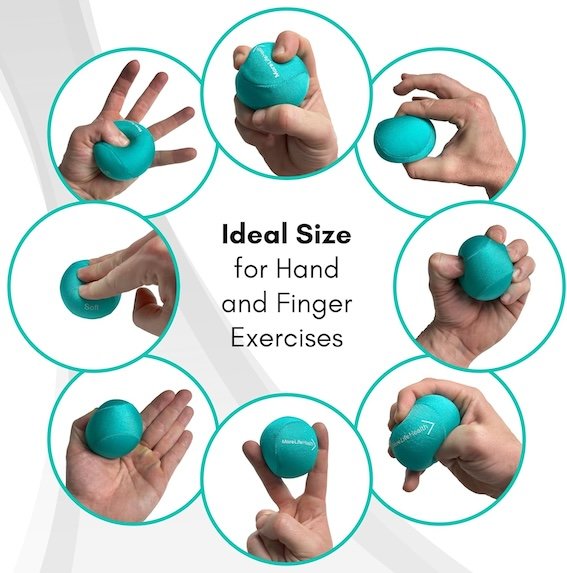
Therapy balls, also known as stress balls or exercise balls, provide resistance that helps strengthen the muscles in the hands and fingers.
They come in various sizes, shapes, and resistances, allowing for customisation to individual needs and abilities. Incorporating therapy balls into hand strengthening exercises can provide additional benefits, including improved grip strength, increased range of motion, and enhanced coordination.
TO PURCHASE THE MORE LIFE HEALTH THERAPY BALLS, CLICK HERE.
Additionally, for individuals with arthritis, using therapy balls can provide a low-impact form of resistance that is gentle on the joints while still providing strength-building benefits.
HAND AND FINGER EXERCISES WITH THERAPY BALLS
These exercises are designed to help improve the strength and dexterity of your hands, forearms and fingers.
Remember to perform the exercises slowly and deliberately, focusing on squeezing with as much strength as you can without causing pain or discomfort.
Choose a resistance (light, moderate or heavy) for the level you are at, and progress the exercises as you get stronger.
Make sure to do the exercises on BOTH hands.
EXERCISE 1: BALL GRIP SQUEEZES (WRIST UP)
This exercise works the muscles of the fingers, hand and forearms helping to improve grip strength.
Hold your therapy ball in your hand with your wrist facing up. Squeeze the ball as tightly as you can, for 5 seconds then release.
Repeat 5 times.

EXERCISE 2: BALL GRIP SQUEEZES (WRIST DOWN)
This exercise works the muscles of the fingers, hand and forearms helping to improve grip strength.
Hold your therapy ball in your hand with your wrist facing down.
Squeeze the ball as tightly as you can for 5 seconds then release.
Repeat 5 times.

EXERCISE 3: TWO FINGER BALL SQUEEZE
This squeeze in particular is good to help strength the grip for tasks such as turning on or off a tap, or using a can opener.
Hold a therapy ball in one hand, with your palm facing up and your fingers slightly bent.
Position your index and middle fingers on one side of the ball and your thumb on the underneath the ball as per the picture below
Squeeze the ball between your two fingers and thumb as tightly as you can, hold for 5 seconds, then release.
Repeat 5 times.

EXERCISE 4: BALL PINCHES - ALL FINGERS
Hold your therapy ball between your thumb and first finger.
Pinch the ball as tightly as you can, hold for 5 seconds, then release.
Do the same for each finger.
Repeat 5 times.

EXERCISE 5: FINGER SIDE SQUEEZES - ALL FINGERS
Hold your therapy ball between the side of your index finger and your thumb.
Squeeze the ball as tightly as you can, hold for 5 seconds then release.
Do the same between your index finger and middle finger.
Repeat 5 times.

EXERCISE 6: THUMB FLEXION SQUEEZE
Hold your therapy ball between your thumb and your fingers.
Squeeze your thumb into the ball as tightly as you can, hold for 5 seconds, then release.
Repeat 5 times.

EXERCISE 7: FINGER BALL ROLL OUTS:
Place your fingers on top of your therapy ball, with the therapy ball on a table.
Roll your fingers over the top of the ball and back.
Repeat 5 times.

EXERCISE 8: BALL ROTATIONS (PALM/BALL UP)
Start by holding a therapy ball in your palm, with your fingers wrapped around it with your palm/ball facing up
Use your thumb and fingers to gently rotate the ball in a circular motion, as if you're trying to "roll" it around your palm.
Continue rotating the ball for several seconds, then switch directions and rotate it in the opposite direction.
Repeat the exercise for about 30 seconds to a minute, or for as long as you can comfortably maintain good form.

EXERCISE 9: BALL ROTATIONS (PALM/BALL DOWN)
Start by holding your therapy ball in your palm, with your fingers wrapped around it with your palm/ball facing down - this is more difficult as you have to hold the ball in place to not allow it to drop.
Use your thumb and fingers to rotate the ball in a circular motion, as if you're trying to "roll" it around your palm. - go at a speed you can manage.
Continue rotating the ball for several seconds, then switch directions and rotate it in the opposite direction.
Repeat the exercise for about 30 seconds to a minute, or for as long as you can comfortably maintain good form.

EXERCISE 10: BALL TOSSES
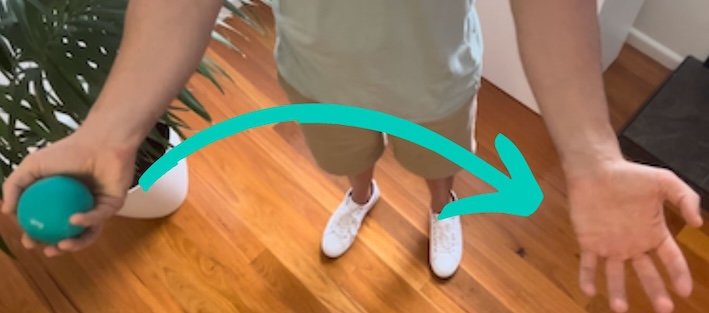
Start by holding ytour therapy ball in one hand, with your fingers wrapped around it.
Gently toss the ball to your other hand, catching it with your fingers and palm.
Immediately toss the ball back to the first hand, again catching it with your fingers and palm.
Repeat this gentle back-and-forth tossing motion for 30 seconds to a minute, or for as long as you can maintain good form.
BONUSE EXERCISE: ROLLING BALL MASSAGES
Place a therapy ball on a table and roll your hand over it, applying pressure to the palm and fingers as you go.
Continue for several minutes, focusing on any areas of tension or discomfort.

TIPS FOR INCORPORATING HAND EXERCISES INTO YOUR ROUTINE
Start slowly and gradually increase the number of exercises and repetitions or resistance as your strength improves. Also hold the exercises for longer time.
Start with 5 repetitions work your way up to 10-15.
Start with 5 second holds and work up to 10 - 15 seconds
Perform these hand strengthening exercises 2-3 times per week, allowing for rest days in between.
Use proper form and avoid straining your hands or fingers to prevent injury.
If you are using your hands a lot, maybe you are in a job that required heavy use of your hands, or you are doing a hobby that requires the same, rest off your hands until they feel better, and gradually incorporate these exercises into your life, and balance them with the task you are doing.
Listen to your body and stop if you experience pain or discomfort.
WHAT THERAPY BALLS TO USE - THERAPY BALLS I RECOMMEND
To purchase some high quality therapy balls, with different strengths, designed and tested by me, to improve your hand strength and dexterity (and can also be used as stress balls), click below.